

Energy drink (Mountain Dew AMP)
Common food

Photo: Wikipedia
Mountain Dew AMP is a citrus-flavored energy drink with a bold, sweet, and slightly tangy taste, designed for a quick, fizzy pick-me-up. Its nutrition profile is dominated by simple sugars, providing a rapid but short-lived energy boost with virtually no protein, fat, or fiber.
Calorie split: 2% protein · 97% carbs · 1% fat
↓ Full nutrition💚 Why it's loved
People love it for its intense, sugary citrus burst that delivers a fast energy lift, making it a popular choice for gaming sessions, late-night drives, or a quick afternoon slump.
⚠️ Watch-outs & how to enjoy it better
The high sugar content can lead to a rapid blood-sugar spike and subsequent crash, and the caffeine may cause jitters or disrupt sleep. To counteract, consume only a small portion, pair it with a protein-rich snack like nuts or cheese to slow sugar absorption, and avoid it late in the day.
Key benefits
- Provides a quick source of carbohydrates for immediate energy
- Contains caffeine for alertness and focus
- Convenient, portable, and widely available
- Offers a familiar, sweet citrus flavor profile
🍽️ Popular dishes
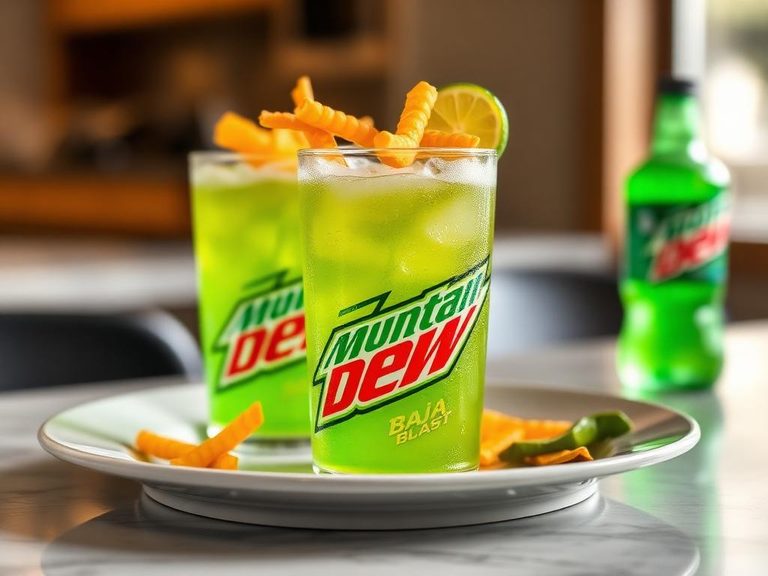
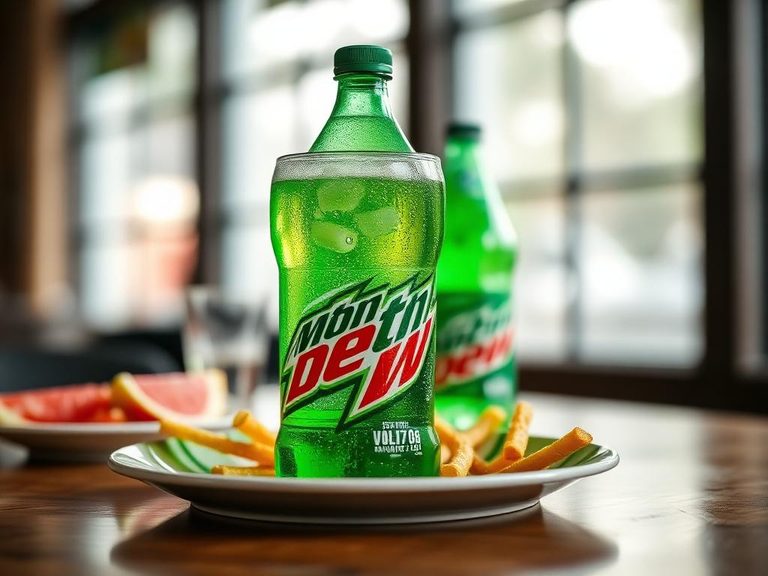
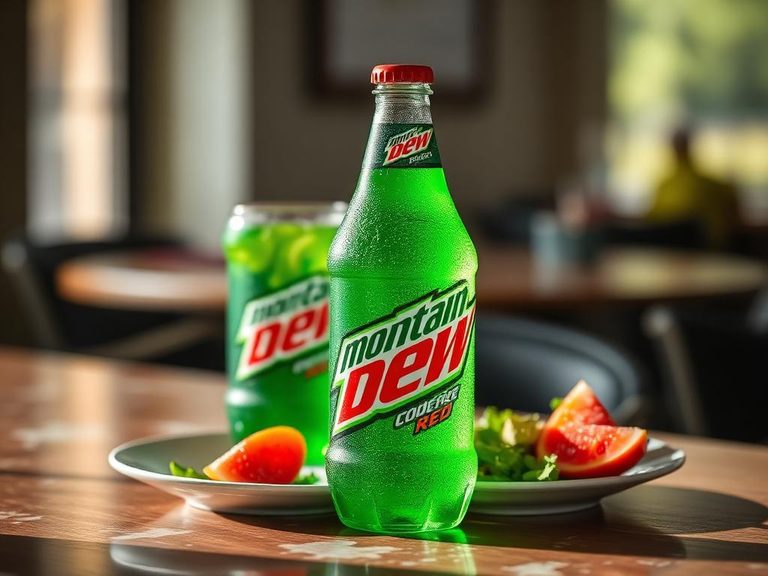
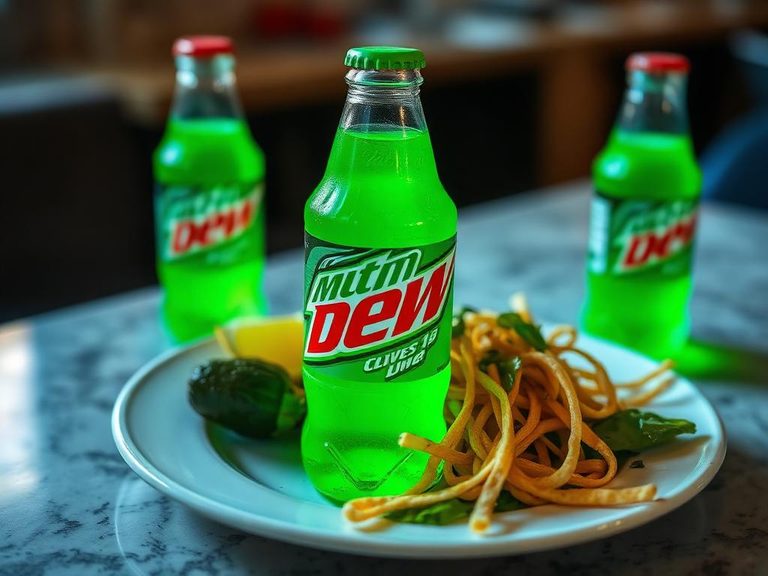
🌍 Where it's eaten
💡 Did you know?
The original Mountain Dew was created in Tennessee as a mixer for whiskey, and the name 'Mountain Dew' was slang for moonshine.
Full nutrition (USDA data · scales with serving)
| Water | 87.3 g |
| Energy | 46.0 kcal |
| Protein | 0.25 g |
| Total lipid (fat) | 0.08 g |
| Carbohydrate, by difference | 12.1 g |
| Fiber, total dietary | 0.00 g |
| Total Sugars | 12.1 g |
| Calcium, Ca | 13.0 mg |
| Iron, Fe | 0.02 mg |
| Magnesium, Mg | 3.0 mg |
| Phosphorus, P | 17.0 mg |
| Potassium, K | 3.0 mg |
| Sodium, Na | 27.0 mg |
| Zinc, Zn | 0.00 mg |
| Copper, Cu | 0.01 mg |
| Selenium, Se | 0.20 ug |
| Vitamin C, total ascorbic acid | 0.00 mg |
| Thiamin | 0.03 mg |
| Riboflavin | 0.34 mg |
| Niacin | 2.0 mg |
| Vitamin B-6 | 0.20 mg |
| Folate, total | 0.00 ug |
| Folic acid | 0.00 ug |
| Folate, food | 0.00 ug |
| Folate, DFE | 0.00 ug |
| Choline, total | 0.30 mg |
| Vitamin B-12 | 0.60 ug |
| Vitamin B-12, added | 0.43 ug |
| Vitamin A, RAE | 0.00 ug |
| Retinol | 0.00 ug |
| Carotene, beta | 0.00 ug |
| Carotene, alpha | 0.00 ug |
| Cryptoxanthin, beta | 0.00 ug |
| Lycopene | 0.00 ug |
| Lutein + zeaxanthin | 0.00 ug |
| Vitamin E (alpha-tocopherol) | 0.00 mg |
| Vitamin E, added | 0.00 mg |
| Vitamin D (D2 + D3) | 0.00 ug |
| Vitamin K (phylloquinone) | 0.00 ug |
| Alcohol, ethyl | 0.00 g |
| Caffeine | 31.0 mg |
| Theobromine | 0.00 mg |
Fat & fatty acid profile (per 100g)
| Fatty acids, total saturated | 0.00 g |
| SFA 4:0 | 0.00 g |
| SFA 6:0 | 0.00 g |
| SFA 8:0 | 0.00 g |
| SFA 10:0 | 0.00 g |
| SFA 12:0 | 0.00 g |
| SFA 14:0 | 0.00 g |
| SFA 16:0 | 0.00 g |
| SFA 18:0 | 0.00 g |
| Fatty acids, total monounsaturated | 0.00 g |
| MUFA 16:1 | 0.00 g |
| MUFA 18:1 | 0.00 g |
| MUFA 20:1 | 0.00 g |
| MUFA 22:1 | 0.00 g |
| Fatty acids, total polyunsaturated | 0.00 g |
| PUFA 18:2 | 0.00 g |
| PUFA 18:3 | 0.00 g |
| PUFA 18:4 | 0.00 g |
| PUFA 20:4 | 0.00 g |
| PUFA 20:5 n-3 (EPA) | 0.00 g |
| PUFA 22:5 n-3 (DPA) | 0.00 g |
| PUFA 22:6 n-3 (DHA) | 0.00 g |
| Cholesterol | 0.00 mg |
FAQ
Is Mountain Dew AMP a healthy drink?
No, it is not considered a healthy drink. It is high in added sugar (over 12g per 100g) and provides empty calories with no significant vitamins, minerals, or beneficial nutrients.
How much caffeine is in Mountain Dew AMP?
A standard 16 oz (473g) bottle contains approximately 142mg of caffeine, which is comparable to many other energy drinks and significantly more than a typical cup of coffee.
Can I use Mountain Dew AMP in cooking or baking?
While not traditional, it can be used in recipes like glazes for meats (e.g., ham or chicken) or in some cake batters to add a citrusy, sugary flavor, though this is not a common culinary practice.
Nutrient density (calculated · NRF9.3)
Nutrient Rich Foods index: beneficial nutrients (protein, fiber, vitamins, minerals) minus saturated fat, added sugar & sodium, per 100 kcal.
NRF9.3 index — Fulgoni, Keast & Drewnowski, 2009. Computed from USDA nutrients.
Weight-loss friendliness (composite index)
Energy density 0.46 kcal/g · 2% calories from protein · 0.0 g fiber · 12.1 g sugar per 100 g.
Composite of energy density (Rolls et al., 1999), protein & fiber satiety, minus sugar. A calculated heuristic — ranks satiety-per-calorie, not a clinical measure.
Dietary load (calculated from USDA values)
Potential renal acid load. Positive = acid-forming, negative = alkaline-forming.
Sodium-to-potassium ratio: 9.00 (lower is better — aim for ≤ 1)
Sodium:potassium per WHO potassium guidance. Computed from USDA nutrients.