

Dessert dip
Common food
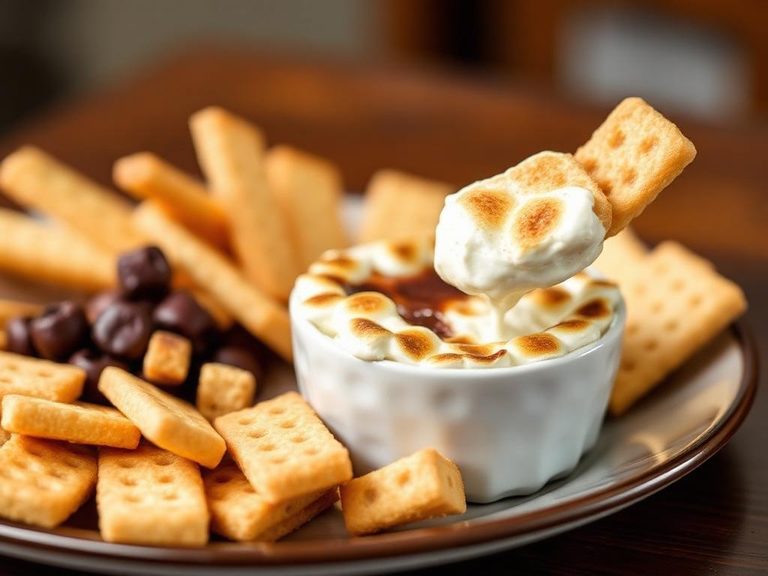
Dessert dip is a rich, sweet, and creamy concoction designed for scooping with fruits, cookies, or pastries. Its texture is typically smooth and velvety, ranging from a thick, frosting-like consistency to a lighter, mousse-like fluff. Nutritionally, it is a calorie-dense treat, primarily composed of sugars and fats, offering a quick energy boost but little in the way of fiber or protein.
Calorie split: 10% protein · 36% carbs · 54% fat
↓ Full nutrition💚 Why it's loved
People love dessert dip for its indulgent, spoonable nature and the sheer variety of flavors it can take—from chocolate and caramel to fruit-based creams. It transforms simple dippers like apple slices or pretzels into a decadent experience, making it a staple at social gatherings and a nostalgic comfort food.
⚠️ Watch-outs & how to enjoy it better
The primary downside is its high sugar and fat content, which can lead to blood sugar spikes and is not ideal for those monitoring caloric intake or managing diabetes. To counteract this, practice strict portion control and pair it with high-fiber dippers like whole apple slices or high-protein options like a handful of nuts to slow sugar absorption.
Key benefits
- Provides a quick source of energy from carbohydrates and fats.
- Can be a fun, interactive way to encourage fruit consumption.
- Offers a concentrated flavor experience for portion-controlled indulgence.
- Highly customizable to various dietary preferences (e.g., vegan, gluten-free).
- Serves as a versatile component in dessert platters and party spreads.
🍽️ Popular dishes





🌍 Where it's eaten
💡 Did you know?
The concept of a sweet, communal dip is ancient; medieval European 'subtleties' often included sweet sauces for fruits and wafers, serving as both dessert and edible entertainment.
Full nutrition (USDA data · scales with serving)
| Water | 55.6 g |
| Energy | 249 kcal |
| Protein | 6.0 g |
| Total lipid (fat) | 15.1 g |
| Carbohydrate, by difference | 22.5 g |
| Fiber, total dietary | 0.00 g |
| Total Sugars | 22.2 g |
| Calcium, Ca | 82.0 mg |
| Iron, Fe | 0.02 mg |
| Magnesium, Mg | 8.0 mg |
| Phosphorus, P | 95.0 mg |
| Potassium, K | 104 mg |
| Sodium, Na | 170 mg |
| Zinc, Zn | 0.44 mg |
| Copper, Cu | 0.01 mg |
| Selenium, Se | 7.7 ug |
| Vitamin C, total ascorbic acid | 0.00 mg |
| Thiamin | 0.03 mg |
| Riboflavin | 0.20 mg |
| Niacin | 0.12 mg |
| Vitamin B-6 | 0.04 mg |
| Folate, total | 8.0 ug |
| Folic acid | 0.00 ug |
| Folate, food | 8.0 ug |
| Folate, DFE | 8.0 ug |
| Choline, total | 25.1 mg |
| Vitamin B-12 | 0.27 ug |
| Vitamin B-12, added | 0.00 ug |
| Vitamin A, RAE | 160 ug |
| Retinol | 160 ug |
| Carotene, beta | 1.0 ug |
| Carotene, alpha | 0.00 ug |
| Cryptoxanthin, beta | 0.00 ug |
| Lycopene | 0.00 ug |
| Lutein + zeaxanthin | 3.0 ug |
| Vitamin E (alpha-tocopherol) | 0.37 mg |
| Vitamin E, added | 0.00 mg |
| Vitamin D (D2 + D3) | 0.40 ug |
| Vitamin K (phylloquinone) | 1.0 ug |
| Alcohol, ethyl | 0.00 g |
| Caffeine | 0.00 mg |
| Theobromine | 0.00 mg |
Fat & fatty acid profile (per 100g)
| Fatty acids, total saturated | 8.8 g |
| SFA 4:0 | 0.33 g |
| SFA 6:0 | 0.26 g |
| SFA 8:0 | 0.17 g |
| SFA 10:0 | 0.45 g |
| SFA 12:0 | 0.47 g |
| SFA 14:0 | 1.4 g |
| SFA 16:0 | 4.1 g |
| SFA 18:0 | 1.3 g |
| Fatty acids, total monounsaturated | 3.2 g |
| MUFA 16:1 | 0.28 g |
| MUFA 18:1 | 3.4 g |
| MUFA 20:1 | 0.03 g |
| MUFA 22:1 | 0.00 g |
| Fatty acids, total polyunsaturated | 0.70 g |
| PUFA 18:2 | 0.33 g |
| PUFA 18:3 | 0.06 g |
| PUFA 18:4 | 0.00 g |
| PUFA 20:4 | 0.02 g |
| PUFA 20:5 n-3 (EPA) | 0.00 g |
| PUFA 22:5 n-3 (DPA) | 0.01 g |
| PUFA 22:6 n-3 (DHA) | 0.00 g |
| Cholesterol | 44.0 mg |
FAQ
Is dessert dip the same as frosting or icing?
Not exactly. While they share similar ingredients, dessert dip is typically thinner, more dippable, and often served at room temperature or slightly chilled with dippers, whereas frosting is thicker and designed to spread on baked goods.
Can I make a healthier version of dessert dip?
Yes. You can use Greek yogurt or blended silken tofu as a base, sweeten with mashed fruit or a small amount of maple syrup, and add flavor with extracts or spices to significantly reduce sugar and fat while adding protein.
What are the best dippers for dessert dip?
The best dippers balance the dip's sweetness and texture. Think fresh fruit (apple wedges, strawberries, pineapple), salty pretzels, graham crackers, vanilla wafers, or even vegetable sticks like celery for a surprising crunch.
Nutrient density (calculated · NRF9.3)
Nutrient Rich Foods index: beneficial nutrients (protein, fiber, vitamins, minerals) minus saturated fat, added sugar & sodium, per 100 kcal.
NRF9.3 index — Fulgoni, Keast & Drewnowski, 2009. Computed from USDA nutrients.
Weight-loss friendliness (composite index)
Energy density 2.49 kcal/g · 10% calories from protein · 0.0 g fiber · 22.2 g sugar per 100 g.
Composite of energy density (Rolls et al., 1999), protein & fiber satiety, minus sugar. A calculated heuristic — ranks satiety-per-calorie, not a clinical measure.
Dietary load (calculated from USDA values)
Potential renal acid load. Positive = acid-forming, negative = alkaline-forming.
Sodium-to-potassium ratio: 1.63 (lower is better — aim for ≤ 1)
Sodium:potassium per WHO potassium guidance. Computed from USDA nutrients.