

Cracker chips
Common food
Cracker chips are a crispy, savory snack that bridges the gap between a classic cracker and a potato chip, offering a satisfying crunch with a light, airy texture. They are typically made from wheat flour, corn, or other grains, baked or fried to a golden crisp. Nutritionally, they provide a quick energy boost from carbohydrates, with a moderate amount of fat and a surprising touch of fiber.
Calorie split: 6% protein · 55% carbs · 39% fat
↓ Full nutrition💚 Why it's loved
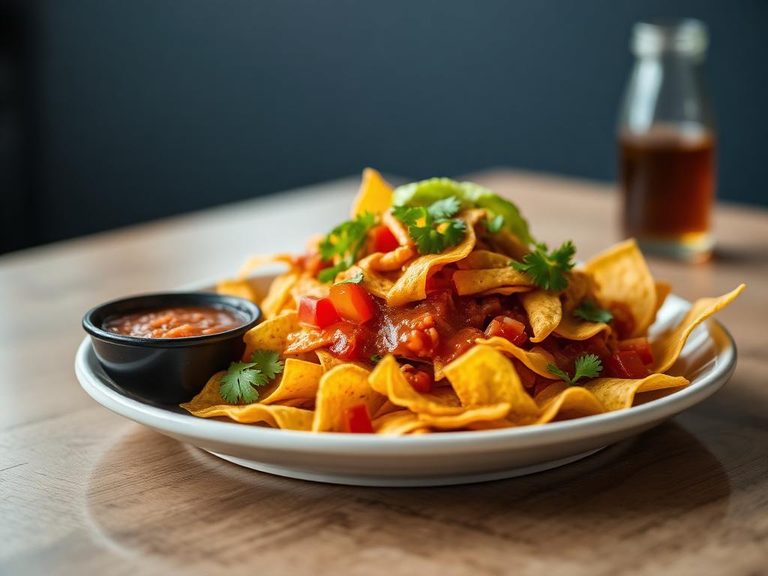
People love cracker chips for their addictive, salty crunch and versatility—they're the perfect canvas for dips like hummus or salsa, or simply enjoyed on their own. Their light, crispy texture makes them a go-to for snacking, parties, and casual gatherings.
⚠️ Watch-outs & how to enjoy it better
The high carbohydrate content can lead to blood sugar spikes, especially for those managing diabetes or insulin resistance. To counteract this, pair them with protein-rich dips like Greek yogurt or cheese, or fiber-rich options like guacamole to slow digestion. Also, watch portion sizes, as it's easy to overeat these crunchy snacks.
Key benefits
- Quick source of energy from carbohydrates
- Provides dietary fiber for digestive health
- Convenient and portable snack option
- Offers a satisfying crunch without the heaviness of dense chips
- Can be a base for various toppings and dips
🍽️ Popular dishes


🌍 Where it's eaten
💡 Did you know?
Cracker chips were popularized in the 1990s as a 'healthier' alternative to traditional potato chips, often marketed for being baked rather than fried.
Full nutrition (USDA data · scales with serving)
| Water | 2.0 g |
| Energy | 491 kcal |
| Protein | 8.0 g |
| Total lipid (fat) | 21.1 g |
| Carbohydrate, by difference | 67.3 g |
| Fiber, total dietary | 8.8 g |
| Total Sugars | 7.2 g |
| Calcium, Ca | 20.0 mg |
| Iron, Fe | 1.7 mg |
| Magnesium, Mg | 76.0 mg |
| Phosphorus, P | 222 mg |
| Potassium, K | 232 mg |
| Sodium, Na | 423 mg |
| Zinc, Zn | 1.6 mg |
| Copper, Cu | 0.23 mg |
| Selenium, Se | 12.2 ug |
| Vitamin C, total ascorbic acid | 0.00 mg |
| Thiamin | 0.14 mg |
| Riboflavin | 0.02 mg |
| Niacin | 2.1 mg |
| Vitamin B-6 | 0.20 mg |
| Folate, total | 25.0 ug |
| Folic acid | 8.0 ug |
| Folate, food | 17.0 ug |
| Folate, DFE | 31.0 ug |
| Choline, total | 14.8 mg |
| Vitamin B-12 | 0.00 ug |
| Vitamin B-12, added | 0.00 ug |
| Vitamin A, RAE | 3.0 ug |
| Retinol | 0.00 ug |
| Carotene, beta | 29.0 ug |
| Carotene, alpha | 19.0 ug |
| Cryptoxanthin, beta | 0.00 ug |
| Lycopene | 0.00 ug |
| Lutein + zeaxanthin | 441 ug |
| Vitamin E (alpha-tocopherol) | 7.0 mg |
| Vitamin E, added | 0.00 mg |
| Vitamin D (D2 + D3) | 0.00 ug |
| Vitamin K (phylloquinone) | 2.4 ug |
| Alcohol, ethyl | 0.00 g |
| Caffeine | 0.00 mg |
| Theobromine | 0.00 mg |
Fat & fatty acid profile (per 100g)
| Fatty acids, total saturated | 2.2 g |
| SFA 4:0 | 0.00 g |
| SFA 6:0 | 0.00 g |
| SFA 8:0 | 0.00 g |
| SFA 10:0 | 0.00 g |
| SFA 12:0 | 0.00 g |
| SFA 14:0 | 0.00 g |
| SFA 16:0 | 1.3 g |
| SFA 18:0 | 0.69 g |
| Fatty acids, total monounsaturated | 11.5 g |
| MUFA 16:1 | 0.00 g |
| MUFA 18:1 | 11.4 g |
| MUFA 20:1 | 0.05 g |
| MUFA 22:1 | 0.00 g |
| Fatty acids, total polyunsaturated | 6.5 g |
| PUFA 18:2 | 6.4 g |
| PUFA 18:3 | 0.09 g |
| PUFA 18:4 | 0.00 g |
| PUFA 20:4 | 0.00 g |
| PUFA 20:5 n-3 (EPA) | 0.00 g |
| PUFA 22:5 n-3 (DPA) | 0.00 g |
| PUFA 22:6 n-3 (DHA) | 0.00 g |
| Cholesterol | 0.00 mg |
FAQ
Are cracker chips gluten-free?
Most traditional cracker chips are made from wheat flour and contain gluten. However, gluten-free versions made from rice, corn, or other grains are increasingly available.
Can I eat cracker chips on a diet?
Yes, but in moderation. Their high carbohydrate and fat content means calories add up quickly. Stick to a single serving (about 50g) and pair with protein or vegetables to stay full longer.
What's the difference between cracker chips and regular chips?
Cracker chips are typically lighter, airier, and often baked, giving them a crispier texture than denser, fried potato chips. They also tend to have a more uniform shape.
Nutrient density (calculated · NRF9.3)
Nutrient Rich Foods index: beneficial nutrients (protein, fiber, vitamins, minerals) minus saturated fat, added sugar & sodium, per 100 kcal.
NRF9.3 index — Fulgoni, Keast & Drewnowski, 2009. Computed from USDA nutrients.
Weight-loss friendliness (composite index)
Energy density 4.91 kcal/g · 6% calories from protein · 8.8 g fiber · 7.2 g sugar per 100 g.
Composite of energy density (Rolls et al., 1999), protein & fiber satiety, minus sugar. A calculated heuristic — ranks satiety-per-calorie, not a clinical measure.
Dietary load (calculated from USDA values)
Potential renal acid load. Positive = acid-forming, negative = alkaline-forming.
Sodium-to-potassium ratio: 1.82 (lower is better — aim for ≤ 1)
Sodium:potassium per WHO potassium guidance. Computed from USDA nutrients.