

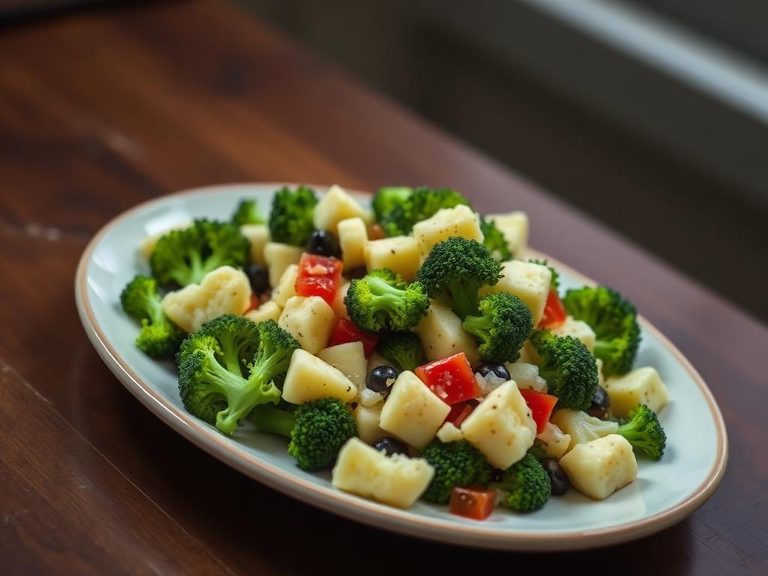
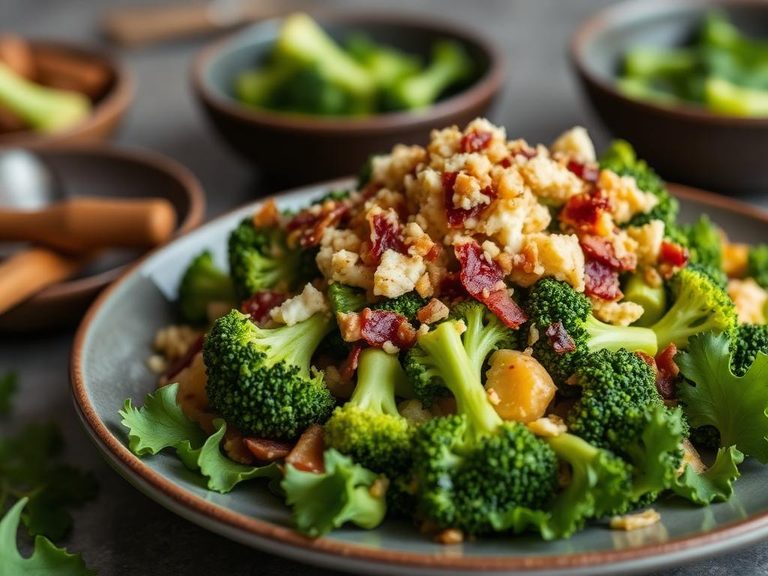
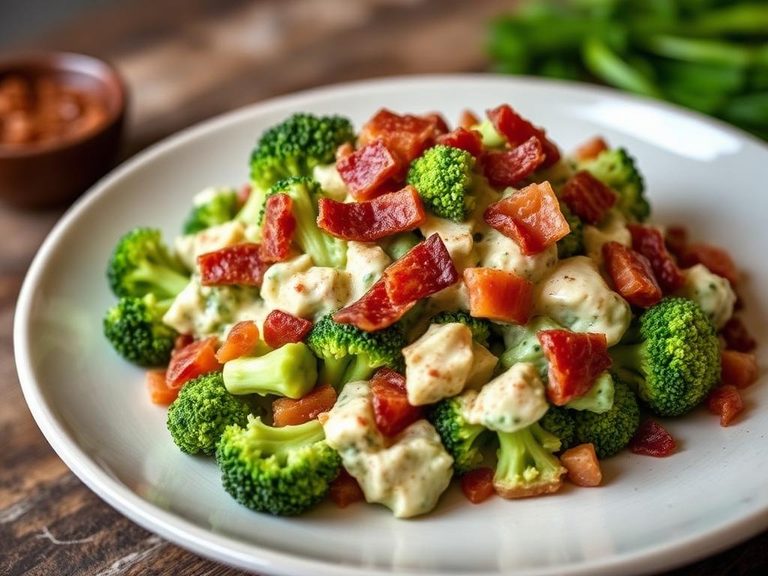
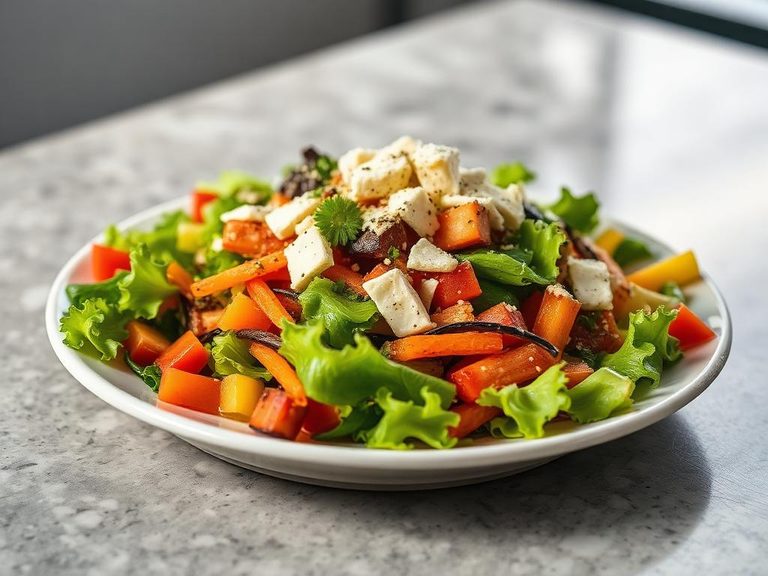
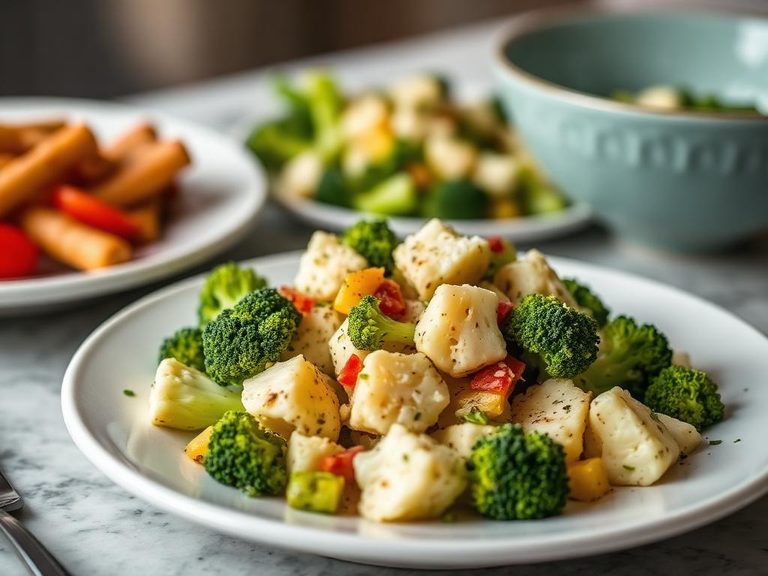
Broccoli salad with cauliflower, cheese, bacon bits, and dressing
Common food
A crunchy, creamy, and savory salad combining the earthy bite of broccoli and cauliflower florets with salty bacon bits and sharp cheese, all bound by a rich, tangy dressing. It offers a satisfying contrast of textures—crisp vegetables, chewy bacon, and smooth cheese—while delivering a notable fat content for satiety. Each 100g serving provides a balanced mix of protein and healthy fats, making it a flavorful side that feels indulgent yet substantial.
Calorie split: 9% protein · 15% carbs · 76% fat
↓ Full nutrition💚 Why it's loved
People adore this salad for its bold, savory flavor profile and satisfying crunch, which makes it a crowd-pleaser at potlucks and barbecues. Its versatility allows it to be served as a side dish, a light main, or even a topping for sandwiches, blending comfort food appeal with a fresh, vegetable-forward twist.
⚠️ Watch-outs & how to enjoy it better
The high fat and sodium content from bacon and cheese may be a concern for those monitoring cholesterol or blood pressure, and the dressing can add hidden sugars. To counteract, opt for low-sodium bacon, use a lighter dressing like a vinaigrette, and pair the salad with lean protein like grilled chicken to balance the meal. For those sensitive to oxalates in broccoli, lightly steaming the vegetables can reduce oxalate levels while preserving nutrients.
Key benefits
- High in healthy fats for sustained energy and satiety
- Provides a good source of protein from cheese and bacon
- Contains fiber from cruciferous vegetables for digestive health
- Rich in vitamins C and K from broccoli and cauliflower
- Low in sugar, making it suitable for low-carb diets
🍽️ Popular dishes
🌍 Where it's eaten
💡 Did you know?
Broccoli and cauliflower are both members of the same species, Brassica oleracea, but were selectively bred for different edible parts—broccoli for its flower heads and cauliflower for its compact curd.
Full nutrition (USDA data · scales with serving)
| Water | 59.2 g |
| Energy | 270 kcal |
| Protein | 5.8 g |
| Total lipid (fat) | 22.8 g |
| Carbohydrate, by difference | 10.4 g |
| Fiber, total dietary | 1.6 g |
| Total Sugars | 6.4 g |
| Calcium, Ca | 107 mg |
| Iron, Fe | 0.36 mg |
| Magnesium, Mg | 17.0 mg |
| Phosphorus, P | 97.0 mg |
| Potassium, K | 162 mg |
| Sodium, Na | 340 mg |
| Zinc, Zn | 0.73 mg |
| Copper, Cu | 0.06 mg |
| Selenium, Se | 4.8 ug |
| Vitamin C, total ascorbic acid | 28.5 mg |
| Thiamin | 0.07 mg |
| Riboflavin | 0.10 mg |
| Niacin | 0.34 mg |
| Vitamin B-6 | 0.10 mg |
| Folate, total | 38.0 ug |
| Folic acid | 0.00 ug |
| Folate, food | 38.0 ug |
| Folate, DFE | 38.0 ug |
| Choline, total | 31.7 mg |
| Vitamin B-12 | 0.22 ug |
| Vitamin B-12, added | 0.07 ug |
| Vitamin A, RAE | 42.0 ug |
| Retinol | 41.0 ug |
| Carotene, beta | 19.0 ug |
| Carotene, alpha | 0.00 ug |
| Cryptoxanthin, beta | 1.0 ug |
| Lycopene | 0.00 ug |
| Lutein + zeaxanthin | 140 ug |
| Vitamin E (alpha-tocopherol) | 1.3 mg |
| Vitamin E, added | 0.00 mg |
| Vitamin D (D2 + D3) | 0.10 ug |
| Vitamin K (phylloquinone) | 59.9 ug |
| Alcohol, ethyl | 0.00 g |
| Caffeine | 0.00 mg |
| Theobromine | 0.00 mg |
Fat & fatty acid profile (per 100g)
| Fatty acids, total saturated | 5.2 g |
| SFA 4:0 | 0.08 g |
| SFA 6:0 | 0.06 g |
| SFA 8:0 | 0.04 g |
| SFA 10:0 | 0.10 g |
| SFA 12:0 | 0.13 g |
| SFA 14:0 | 0.39 g |
| SFA 16:0 | 3.0 g |
| SFA 18:0 | 1.2 g |
| Fatty acids, total monounsaturated | 5.1 g |
| MUFA 16:1 | 0.08 g |
| MUFA 18:1 | 5.0 g |
| MUFA 20:1 | 0.06 g |
| MUFA 22:1 | 0.01 g |
| Fatty acids, total polyunsaturated | 11.2 g |
| PUFA 18:2 | 9.8 g |
| PUFA 18:3 | 1.4 g |
| PUFA 18:4 | 0.00 g |
| PUFA 20:4 | 0.02 g |
| PUFA 20:5 n-3 (EPA) | 0.00 g |
| PUFA 22:5 n-3 (DPA) | 0.00 g |
| PUFA 22:6 n-3 (DHA) | 0.00 g |
| Cholesterol | 21.0 mg |
FAQ
Is this salad suitable for a low-carb diet?
Yes, with only about 10.38g of carbs per 100g, it fits well into low-carb meal plans, especially when paired with protein-rich foods.
Can I make this salad healthier?
Absolutely—use Greek yogurt instead of mayo in the dressing, swap bacon for turkey bacon, and add more vegetables like bell peppers to boost fiber and vitamins.
How long does this salad last in the fridge?
It typically stays fresh for 3-4 days when stored in an airtight container, though the vegetables may soften slightly over time.
Nutrient density (calculated · NRF9.3)
Nutrient Rich Foods index: beneficial nutrients (protein, fiber, vitamins, minerals) minus saturated fat, added sugar & sodium, per 100 kcal.
NRF9.3 index — Fulgoni, Keast & Drewnowski, 2009. Computed from USDA nutrients.
Weight-loss friendliness (composite index)
Energy density 2.70 kcal/g · 9% calories from protein · 1.6 g fiber · 6.4 g sugar per 100 g.
Composite of energy density (Rolls et al., 1999), protein & fiber satiety, minus sugar. A calculated heuristic — ranks satiety-per-calorie, not a clinical measure.
Dietary load (calculated from USDA values)
Potential renal acid load. Positive = acid-forming, negative = alkaline-forming.
Sodium-to-potassium ratio: 2.10 (lower is better — aim for ≤ 1)
Sodium:potassium per WHO potassium guidance. Computed from USDA nutrients.