

Broccoli casserole with noodles
Common food
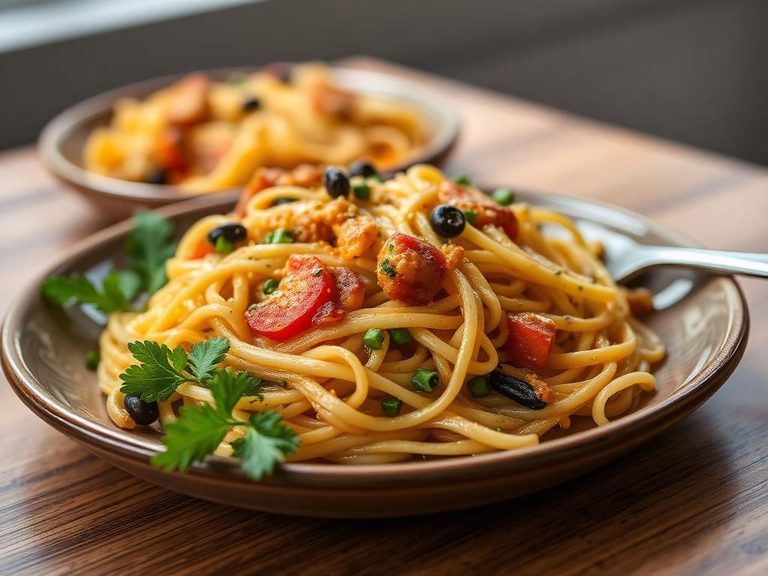
Broccoli casserole with noodles is a comforting, creamy bake where tender broccoli florets and soft egg noodles are bound in a savory sauce, often with cheese or a creamy base. The texture is a delightful contrast of soft noodles and slightly crisp-tender broccoli, all enveloped in a rich, cohesive sauce. Nutritionally, it offers a balanced profile with a good mix of complex carbs from the noodles and fiber and vitamins from the broccoli.
Calorie split: 13% protein · 57% carbs · 30% fat
↓ Full nutrition💚 Why it's loved
People love it for its comforting, homestyle appeal and the way the creamy sauce melds the earthy broccoli and mild noodles into a satisfying, cohesive dish. It's a versatile crowd-pleaser, often appearing at family gatherings and potlucks as a reliable, nostalgic side or main.
⚠️ Watch-outs & how to enjoy it better
The creamy sauce can be high in saturated fat and sodium, and the refined noodles may cause blood-sugar spikes for some. To counteract, use whole-wheat noodles, reduce added salt by seasoning with herbs and garlic, and pair a portion with a lean protein like grilled chicken or a side salad to slow carb absorption.
Key benefits
- Good source of dietary fiber from broccoli and noodles
- Provides plant-based protein from broccoli and egg noodles
- Contains vitamins C and K from broccoli
- Offers a balanced mix of macronutrients for sustained energy
- Can be a vehicle for adding other vegetables or lean proteins
🍽️ Popular dishes
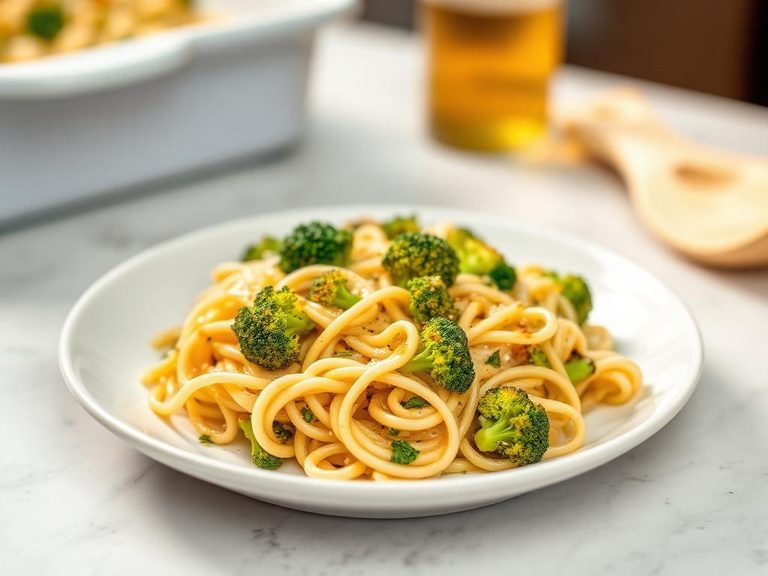
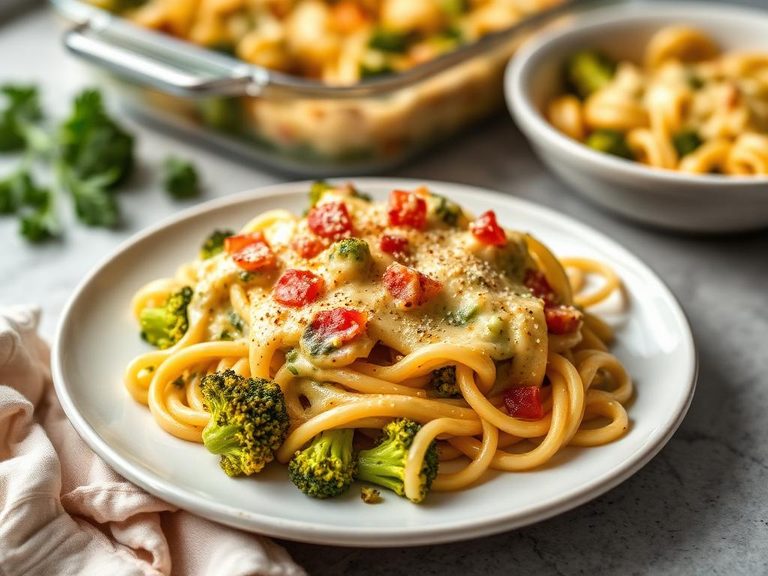
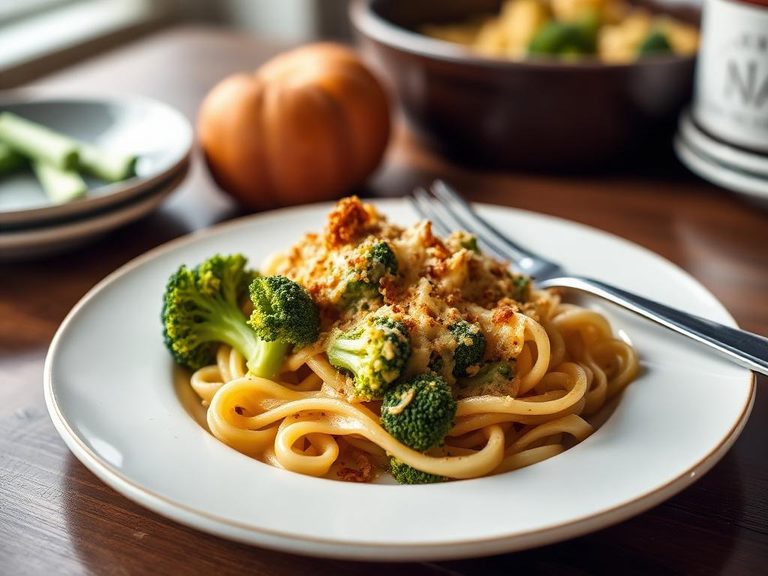
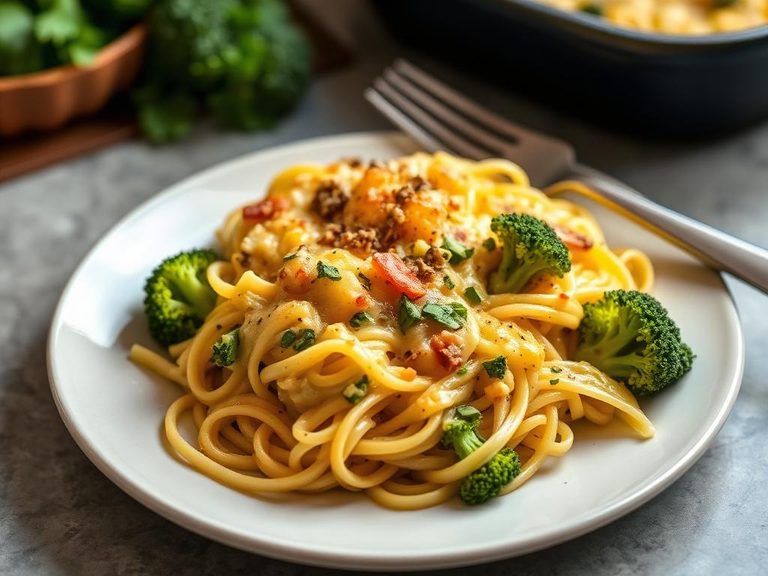
🌍 Where it's eaten
💡 Did you know?
The classic 'green bean casserole' template, invented by a Campbell's Soup employee in 1955, heavily influenced the modern broccoli noodle casserole, leading to its frequent use of condensed cream of mushroom soup as a base.
Full nutrition (USDA data · scales with serving)
| Water | 75.7 g |
| Energy | 112 kcal |
| Protein | 3.5 g |
| Total lipid (fat) | 3.8 g |
| Carbohydrate, by difference | 15.9 g |
| Fiber, total dietary | 1.9 g |
| Total Sugars | 1.3 g |
| Calcium, Ca | 41.0 mg |
| Iron, Fe | 1.1 mg |
| Magnesium, Mg | 20.0 mg |
| Phosphorus, P | 71.0 mg |
| Potassium, K | 191 mg |
| Sodium, Na | 186 mg |
| Zinc, Zn | 0.51 mg |
| Copper, Cu | 0.07 mg |
| Selenium, Se | 9.5 ug |
| Vitamin C, total ascorbic acid | 42.1 mg |
| Thiamin | 0.16 mg |
| Riboflavin | 0.13 mg |
| Niacin | 1.2 mg |
| Vitamin B-6 | 0.11 mg |
| Folate, total | 53.0 ug |
| Folic acid | 20.0 ug |
| Folate, food | 33.0 ug |
| Folate, DFE | 68.0 ug |
| Choline, total | 19.2 mg |
| Vitamin B-12 | 0.04 ug |
| Vitamin B-12, added | 0.00 ug |
| Vitamin A, RAE | 31.0 ug |
| Retinol | 26.0 ug |
| Carotene, beta | 50.0 ug |
| Carotene, alpha | 0.00 ug |
| Cryptoxanthin, beta | 0.00 ug |
| Lycopene | 0.00 ug |
| Lutein + zeaxanthin | 395 ug |
| Vitamin E (alpha-tocopherol) | 0.18 mg |
| Vitamin E, added | 0.00 mg |
| Vitamin D (D2 + D3) | 0.10 ug |
| Vitamin K (phylloquinone) | 55.9 ug |
| Alcohol, ethyl | 0.00 g |
| Caffeine | 0.00 mg |
| Theobromine | 0.00 mg |
Fat & fatty acid profile (per 100g)
| Fatty acids, total saturated | 1.7 g |
| SFA 4:0 | 0.06 g |
| SFA 6:0 | 0.05 g |
| SFA 8:0 | 0.03 g |
| SFA 10:0 | 0.07 g |
| SFA 12:0 | 0.08 g |
| SFA 14:0 | 0.25 g |
| SFA 16:0 | 0.85 g |
| SFA 18:0 | 0.29 g |
| Fatty acids, total monounsaturated | 0.79 g |
| MUFA 16:1 | 0.06 g |
| MUFA 18:1 | 0.78 g |
| MUFA 20:1 | 0.00 g |
| MUFA 22:1 | 0.00 g |
| Fatty acids, total polyunsaturated | 0.39 g |
| PUFA 18:2 | 0.33 g |
| PUFA 18:3 | 0.04 g |
| PUFA 18:4 | 0.00 g |
| PUFA 20:4 | 0.00 g |
| PUFA 20:5 n-3 (EPA) | 0.00 g |
| PUFA 22:5 n-3 (DPA) | 0.00 g |
| PUFA 22:6 n-3 (DHA) | 0.00 g |
| Cholesterol | 16.0 mg |
FAQ
Can I make broccoli casserole with noodles healthier?
Yes, use whole-wheat or legume-based noodles, swap the cream sauce for a lighter version using Greek yogurt or blended cashews, and boost nutrition by adding diced carrots, bell peppers, or lean ground turkey.
Is this dish gluten-free?
Not traditionally, as it contains wheat noodles and often a flour-thickened sauce. To make it gluten-free, use certified gluten-free noodles and thicken the sauce with cornstarch or arrowroot.
How do I prevent the noodles from getting mushy?
Cook the noodles to just al dente before mixing, as they will continue to soften in the oven. Also, ensure the casserole isn't overly saucy before baking.
Nutrient density (calculated · NRF9.3)
Nutrient Rich Foods index: beneficial nutrients (protein, fiber, vitamins, minerals) minus saturated fat, added sugar & sodium, per 100 kcal.
NRF9.3 index — Fulgoni, Keast & Drewnowski, 2009. Computed from USDA nutrients.
Weight-loss friendliness (composite index)
Energy density 1.12 kcal/g · 13% calories from protein · 1.9 g fiber · 1.3 g sugar per 100 g.
Composite of energy density (Rolls et al., 1999), protein & fiber satiety, minus sugar. A calculated heuristic — ranks satiety-per-calorie, not a clinical measure.
Dietary load (calculated from USDA values)
Potential renal acid load. Positive = acid-forming, negative = alkaline-forming.
Sodium-to-potassium ratio: 0.97 (lower is better — aim for ≤ 1)
Sodium:potassium per WHO potassium guidance. Computed from USDA nutrients.