

Beans, adzuki, mature seeds, canned, sweetened
Whole food · Legumes and Legume Products

Photo: Wikipedia
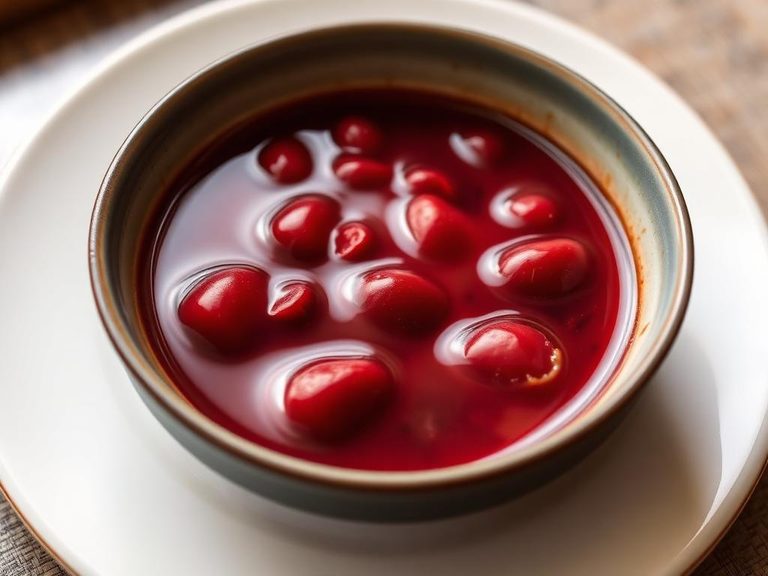
These are mature adzuki beans, pressure-cooked until tender and then simmered in a sweet syrup, resulting in a soft, yielding texture with a distinct, earthy-sweet flavor. Nutritionally, they are a dense source of energy, primarily from complex carbohydrates, with a modest amount of plant-based protein. Their signature ruby-red color often signals their traditional use in sweet, celebratory dishes.
Calorie split: 6% protein · 93% carbs · 0% fat
↓ Full nutrition💚 Why it's loved
People love them for their unique, pleasantly sweet and earthy flavor that forms the heart of beloved desserts across East Asia. Their soft, creamy texture makes them incredibly versatile, easily transforming from a humble bean into a luxurious filling, paste, or soup.
⚠️ Watch-outs & how to enjoy it better
The sweetened, canned variety is very high in carbohydrates and added sugars, which can cause rapid blood-sugar spikes. To counteract this, practice strict portion control and pair a small serving with a source of protein (like nuts or yogurt) or healthy fat to slow sugar absorption. Always check labels for added sodium, which is common in canned legumes.
Key benefits
- Provides quick, sustained energy from complex carbs
- Source of plant-based protein
- Naturally low in fat
- Contains essential minerals like potassium and magnesium
- Traditional ingredient in festive and ceremonial foods
🍽️ Popular dishes

🌍 Where it's eaten
💡 Did you know?
The name 'adzuki' is thought to derive from the Japanese word 'azuki,' which may have originally meant 'small bean' or been linked to the color red, a hue considered auspicious for warding off evil spirits.
Full nutrition (USDA data · scales with serving)
| Water | 40.6 g |
| Energy | 237 kcal |
| Energy | 992 kj |
| Protein | 3.8 g |
| Total lipid (fat) | 0.03 g |
| Ash | 0.58 g |
| Carbohydrate, by difference | 55.0 g |
| Calcium, Ca | 22.0 mg |
| Iron, Fe | 1.1 mg |
| Magnesium, Mg | 31.0 mg |
| Phosphorus, P | 74.0 mg |
| Potassium, K | 119 mg |
| Sodium, Na | 218 mg |
| Zinc, Zn | 1.6 mg |
| Copper, Cu | 0.27 mg |
| Manganese, Mn | 0.50 mg |
| Selenium, Se | 3.2 ug |
| Vitamin C, total ascorbic acid | 0.00 mg |
| Thiamin | 0.10 mg |
| Riboflavin | 0.06 mg |
| Niacin | 0.63 mg |
| Pantothenic acid | 0.38 mg |
| Vitamin B-6 | 0.08 mg |
| Folate, total | 107 ug |
| Folic acid | 0.00 ug |
| Folate, food | 107 ug |
| Folate, DFE | 107 ug |
| Vitamin B-12 | 0.00 ug |
| Vitamin A, RAE | 0.00 ug |
| Retinol | 0.00 ug |
| Vitamin A, IU | 5.0 iu |
| Vitamin D (D2 + D3), International Units | 0.00 iu |
| Vitamin D (D2 + D3) | 0.00 ug |
Fat & fatty acid profile (per 100g)
| Fatty acids, total saturated | 0.01 g |
| Fatty acids, total monounsaturated | 0.00 g |
| MUFA 18:1 | 0.00 g |
| Fatty acids, total polyunsaturated | 0.01 g |
| PUFA 18:2 | 0.01 g |
| Fatty acids, total trans | 0.00 g |
| Cholesterol | 0.00 mg |
Amino acid profile (per 100g)
| Tryptophan | 0.04 g |
| Threonine | 0.13 g |
| Isoleucine | 0.15 g |
| Leucine | 0.32 g |
| Lysine | 0.29 g |
| Methionine | 0.04 g |
| Cystine | 0.04 g |
| Phenylalanine | 0.20 g |
| Tyrosine | 0.11 g |
| Valine | 0.20 g |
| Arginine | 0.25 g |
| Histidine | 0.10 g |
| Alanine | 0.22 g |
| Aspartic acid | 0.45 g |
| Glutamic acid | 0.59 g |
| Glycine | 0.14 g |
| Proline | 0.17 g |
| Serine | 0.19 g |
FAQ
What is the difference between canned adzuki beans and the dry version?
Dry adzuki beans require soaking and long cooking. Canned beans are pre-cooked and ready to use, but are typically packed in a sweet syrup and may contain added salt, significantly altering their nutritional profile and taste.
Is the liquid in the can (the syrup) edible?
Yes, it's a sugar syrup used for preservation and sweetness. It's often incorporated into recipes for soups or desserts to add flavor and body, but it is very high in sugar.
Can I use these beans in savory dishes?
Traditionally, sweetened canned adzuki are used for desserts. Using them in savory cooking would impart a strong sweetness. For savory dishes, it's better to start with dry or unsalted canned adzuki beans.
Nutrient density (calculated · NRF9.3)
Nutrient Rich Foods index: beneficial nutrients (protein, fiber, vitamins, minerals) minus saturated fat, added sugar & sodium, per 100 kcal.
NRF9.3 index — Fulgoni, Keast & Drewnowski, 2009. Computed from USDA nutrients.
Weight-loss friendliness (composite index)
Energy density 2.37 kcal/g · 6% calories from protein · 0.0 g fiber · 0.0 g sugar per 100 g.
Composite of energy density (Rolls et al., 1999), protein & fiber satiety, minus sugar. A calculated heuristic — ranks satiety-per-calorie, not a clinical measure.
Dietary load (calculated from USDA values)
Potential renal acid load. Positive = acid-forming, negative = alkaline-forming.
Sodium-to-potassium ratio: 1.83 (lower is better — aim for ≤ 1)
Sodium:potassium per WHO potassium guidance. Computed from USDA nutrients.