Spanish rice, from restaurant
Common food
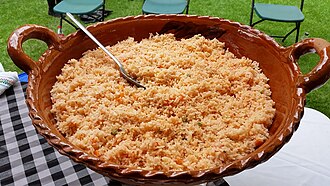
Photo: Wikipedia
Spanish rice, often called Mexican rice, is a savory, tomato-infused side dish where long-grain rice is toasted and simmered with broth, onions, and garlic. It boasts a fluffy, slightly chewy texture with a rich, reddish-orange hue and a deep umami flavor from the tomato base. Nutritionally, it is a carbohydrate-dense staple, providing quick energy with a modest amount of fat and minimal protein per serving.
💚 Why it's loved
People love Spanish rice for its comforting, savory flavor profile and its ability to absorb the tastes of accompanying dishes like beans, stews, and meats. It is a cultural staple that brings a sense of warmth and familiarity to many meals, especially in Mexican and Tex-Mex cuisine.
⚠️ Watch-outs & how to enjoy it better
The dish can be high in sodium and refined carbohydrates, which may cause blood-sugar spikes in some individuals. To mitigate this, pair it with a protein source like grilled chicken or beans and a healthy fat like avocado, and practice portion control by sticking to a single serving.
Key benefits
- Provides quick energy from complex carbohydrates
- Contains lycopene from the tomato base
- Offers a small amount of dietary fiber
- Serves as a versatile, flavorful side dish
- Typically low in sugar
🍽️ Popular dishes
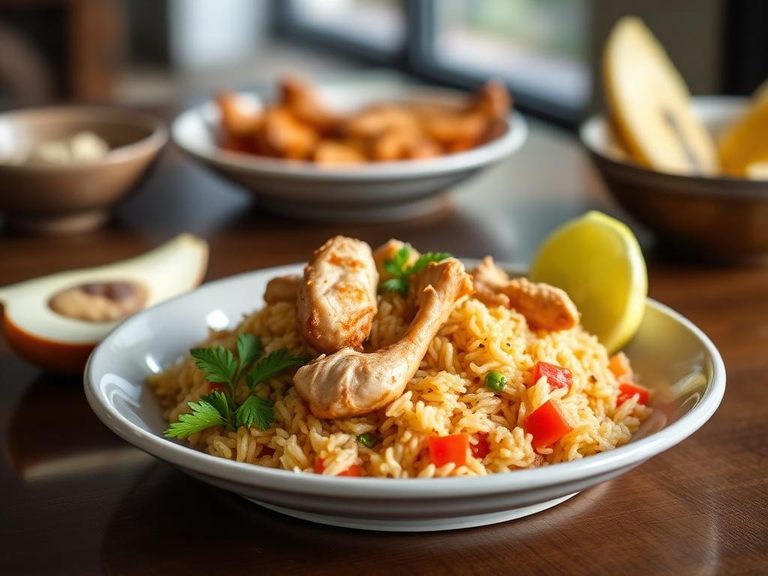
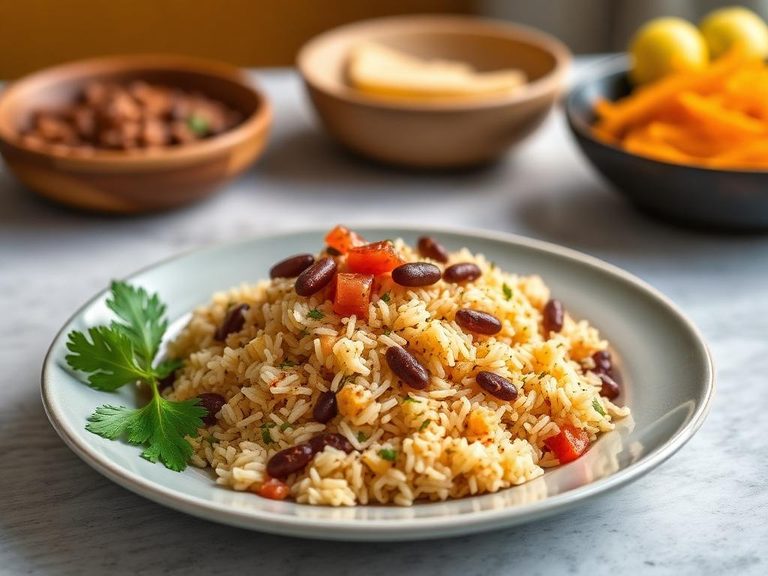
🌍 Where it's eaten
💡 Did you know?
The dish's signature red color comes from tomatoes, but in traditional Spanish recipes, it was sometimes achieved using saffron, which was also used to color paella.
Full nutrition (scales with serving)
| Water | 58.5 g |
| Energy | 185 kcal |
| Protein | 3.3 g |
| Total lipid (fat) | 5.3 g |
| Carbohydrate, by difference | 31.2 g |
| Fiber, total dietary | 1.2 g |
| Total Sugars | 1.3 g |
| Calcium, Ca | 20.0 mg |
| Iron, Fe | 1.1 mg |
| Magnesium, Mg | 13.0 mg |
| Phosphorus, P | 57.0 mg |
| Potassium, K | 116 mg |
| Sodium, Na | 528 mg |
| Zinc, Zn | 0.48 mg |
| Copper, Cu | 0.07 mg |
| Selenium, Se | 7.4 ug |
| Vitamin C, total ascorbic acid | 0.10 mg |
| Thiamin | 0.18 mg |
| Riboflavin | 0.07 mg |
| Niacin | 2.4 mg |
| Vitamin B-6 | 0.08 mg |
| Folate, total | 50.0 ug |
| Folic acid | 46.0 ug |
| Folate, food | 4.0 ug |
| Folate, DFE | 82.0 ug |
| Choline, total | 9.1 mg |
| Vitamin B-12 | 0.08 ug |
| Vitamin B-12, added | 0.00 ug |
| Vitamin A, RAE | 6.0 ug |
| Retinol | 1.0 ug |
| Carotene, beta | 54.0 ug |
| Carotene, alpha | 8.0 ug |
| Cryptoxanthin, beta | 0.00 ug |
| Lycopene | 452 ug |
| Lutein + zeaxanthin | 66.0 ug |
| Vitamin E (alpha-tocopherol) | 0.60 mg |
| Vitamin E, added | 0.00 mg |
| Vitamin D (D2 + D3) | 0.00 ug |
| Vitamin K (phylloquinone) | 13.0 ug |
| Fatty acids, total saturated | 1.0 g |
| SFA 4:0 | 0.00 g |
| SFA 6:0 | 0.00 g |
| SFA 8:0 | 0.00 g |
| SFA 10:0 | 0.01 g |
| SFA 12:0 | 0.00 g |
| SFA 14:0 | 0.02 g |
| SFA 16:0 | 0.66 g |
| SFA 18:0 | 0.28 g |
| Fatty acids, total monounsaturated | 1.5 g |
| MUFA 16:1 | 0.01 g |
| MUFA 18:1 | 1.5 g |
| MUFA 20:1 | 0.02 g |
| MUFA 22:1 | 0.00 g |
| Fatty acids, total polyunsaturated | 2.3 g |
| PUFA 18:2 | 2.1 g |
| PUFA 18:3 | 0.25 g |
| PUFA 18:4 | 0.00 g |
| PUFA 20:4 | 0.00 g |
| PUFA 20:5 n-3 (EPA) | 0.00 g |
| PUFA 22:5 n-3 (DPA) | 0.00 g |
| PUFA 22:6 n-3 (DHA) | 0.00 g |
| Cholesterol | 0.00 mg |
| Alcohol, ethyl | 0.00 g |
| Caffeine | 0.00 mg |
| Theobromine | 0.00 mg |
FAQ
What is the difference between Spanish rice and Mexican rice?
In the U.S., the terms are often used interchangeably, but traditional Spanish rice (arroz rojo) typically uses tomatoes, onions, and garlic, while Mexican rice may include additional spices like cumin and sometimes peas or carrots.
Is Spanish rice gluten-free?
Yes, Spanish rice is naturally gluten-free, but it's important to check for any added seasonings or broth that might contain gluten.
Can I make Spanish rice with brown rice?
Yes, you can substitute brown rice, but it will have a different texture and longer cooking time. The nutritional profile will also change, offering more fiber and nutrients.
How can I reduce the sodium in Spanish rice?
Use low-sodium broth and limit added salt. You can enhance flavor with fresh herbs, garlic, and spices like cumin or paprika instead.