

Scone, with fruit
Common food

Photo: Wikipedia
A scone with fruit is a tender, crumbly quick bread, often studded with currants, raisins, or sultanas, offering a delightful balance of buttery richness and fruity sweetness. Its texture is typically soft and slightly dense inside with a lightly crisp exterior. Nutritionally, it is a calorie-dense treat, primarily providing quick energy from its high carbohydrate content.
Calorie split: 7% protein · 54% carbs · 39% fat
↓ Full nutrition💚 Why it's loved
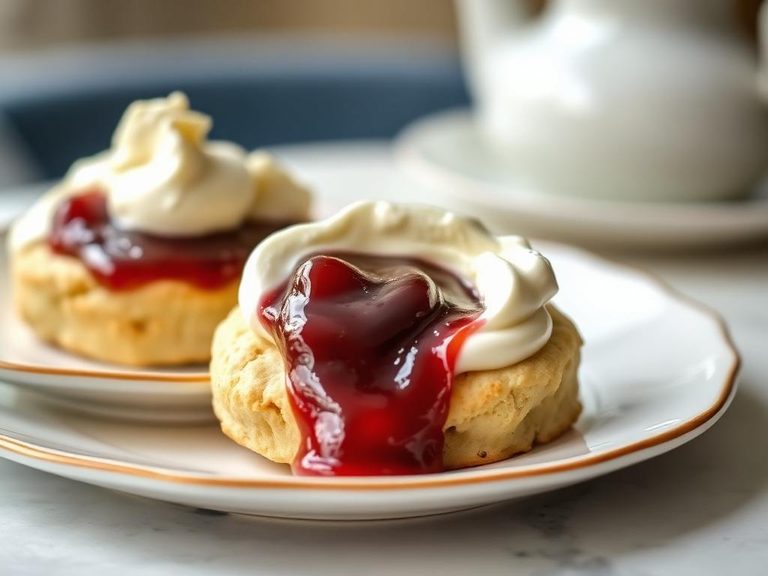
People love it for its comforting, buttery flavor and the pleasant contrast of sweet, chewy fruit against a tender, crumbly base. It's a beloved staple of afternoon tea and a versatile treat that can be enjoyed plain, with jam and cream, or as part of a full breakfast.
⚠️ Watch-outs & how to enjoy it better
The high sugar and refined carbohydrate content can lead to blood-sugar spikes, making it less suitable for those managing diabetes or seeking sustained energy. To counteract this, pair it with a source of protein (like Greek yogurt) or healthy fat (like a handful of nuts) to slow digestion, and practice portion control by enjoying a smaller piece.
Key benefits
- Provides quick energy from carbohydrates
- Contains some protein for satiety
- Offers a convenient, portable snack or breakfast
- Can be a source of iron and other minerals from dried fruit
- Serves as a comforting, traditional baked good
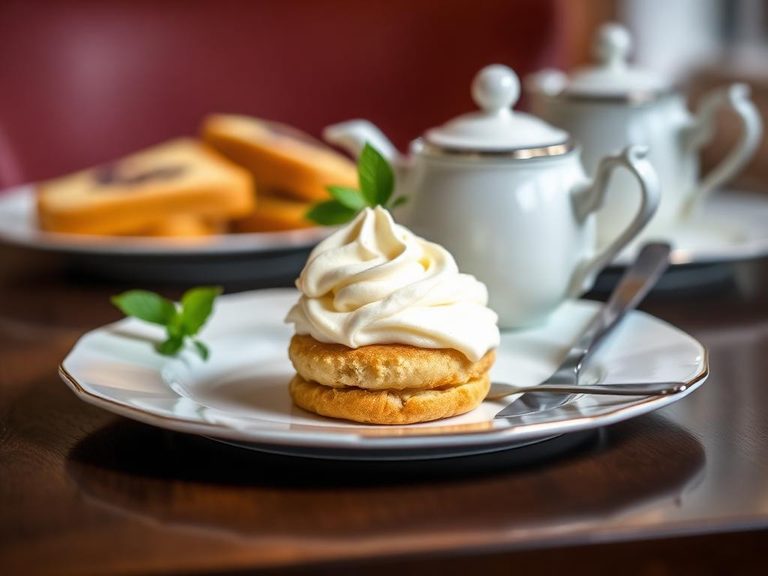
🍽️ Popular dishes


🌍 Where it's eaten
💡 Did you know?
The word 'scone' is believed to derive from the Dutch word 'schoonbrot' (fine bread) or the Gaelic 'sgonn' (a shapeless mass or mouthful).
Full nutrition (USDA data · scales with serving)
| Water | 23.2 g |
| Energy | 374 kcal |
| Protein | 6.3 g |
| Total lipid (fat) | 16.5 g |
| Carbohydrate, by difference | 51.2 g |
| Fiber, total dietary | 1.5 g |
| Total Sugars | 18.6 g |
| Calcium, Ca | 196 mg |
| Iron, Fe | 2.8 mg |
| Magnesium, Mg | 19.0 mg |
| Phosphorus, P | 146 mg |
| Potassium, K | 181 mg |
| Sodium, Na | 404 mg |
| Zinc, Zn | 0.51 mg |
| Copper, Cu | 0.09 mg |
| Selenium, Se | 8.5 ug |
| Vitamin C, total ascorbic acid | 0.20 mg |
| Thiamin | 0.33 mg |
| Riboflavin | 0.23 mg |
| Niacin | 2.5 mg |
| Vitamin B-6 | 0.06 mg |
| Folate, total | 49.0 ug |
| Folic acid | 38.0 ug |
| Folate, food | 11.0 ug |
| Folate, DFE | 76.0 ug |
| Choline, total | 27.0 mg |
| Vitamin B-12 | 0.18 ug |
| Vitamin B-12, added | 0.00 ug |
| Vitamin A, RAE | 161 ug |
| Retinol | 158 ug |
| Carotene, beta | 31.0 ug |
| Carotene, alpha | 0.00 ug |
| Cryptoxanthin, beta | 2.0 ug |
| Lycopene | 0.00 ug |
| Lutein + zeaxanthin | 33.0 ug |
| Vitamin E (alpha-tocopherol) | 0.10 mg |
| Vitamin E, added | 0.00 mg |
| Vitamin D (D2 + D3) | 0.50 ug |
| Vitamin K (phylloquinone) | 1.8 ug |
| Alcohol, ethyl | 0.00 g |
| Caffeine | 0.00 mg |
| Theobromine | 0.00 mg |
Fat & fatty acid profile (per 100g)
| Fatty acids, total saturated | 8.8 g |
| SFA 4:0 | 0.38 g |
| SFA 6:0 | 0.27 g |
| SFA 8:0 | 0.16 g |
| SFA 10:0 | 0.36 g |
| SFA 12:0 | 0.41 g |
| SFA 14:0 | 1.3 g |
| SFA 16:0 | 4.2 g |
| SFA 18:0 | 1.4 g |
| Fatty acids, total monounsaturated | 3.4 g |
| MUFA 16:1 | 0.20 g |
| MUFA 18:1 | 3.0 g |
| MUFA 20:1 | 0.02 g |
| MUFA 22:1 | 0.00 g |
| Fatty acids, total polyunsaturated | 0.74 g |
| PUFA 18:2 | 0.66 g |
| PUFA 18:3 | 0.07 g |
| PUFA 18:4 | 0.00 g |
| PUFA 20:4 | 0.02 g |
| PUFA 20:5 n-3 (EPA) | 0.00 g |
| PUFA 22:5 n-3 (DPA) | 0.01 g |
| PUFA 22:6 n-3 (DHA) | 0.00 g |
| Cholesterol | 66.0 mg |
FAQ
What is the difference between a scone and a biscuit?
In the US, a biscuit is typically savory, flaky, and made with baking powder, while a scone is sweeter, often contains fruit, and has a more cake-like or crumbly texture. In the UK, a 'biscuit' is what Americans call a cookie.
Can I freeze fruit scones?
Yes, fruit scones freeze well. Wrap them tightly in plastic wrap or foil and store in an airtight container or freezer bag for up to 3 months. Thaw at room temperature or warm briefly in the oven.
How do I keep scones from becoming tough?
Avoid overworking the dough; mix just until the ingredients are combined. Use cold butter and handle the dough as little as possible to prevent gluten development, which causes toughness.
Nutrient density (calculated · NRF9.3)
Nutrient Rich Foods index: beneficial nutrients (protein, fiber, vitamins, minerals) minus saturated fat, added sugar & sodium, per 100 kcal.
NRF9.3 index — Fulgoni, Keast & Drewnowski, 2009. Computed from USDA nutrients.
Weight-loss friendliness (composite index)
Energy density 3.74 kcal/g · 7% calories from protein · 1.5 g fiber · 18.6 g sugar per 100 g.
Composite of energy density (Rolls et al., 1999), protein & fiber satiety, minus sugar. A calculated heuristic — ranks satiety-per-calorie, not a clinical measure.
Dietary load (calculated from USDA values)
Potential renal acid load. Positive = acid-forming, negative = alkaline-forming.
Sodium-to-potassium ratio: 2.23 (lower is better — aim for ≤ 1)
Sodium:potassium per WHO potassium guidance. Computed from USDA nutrients.