

Cobb salad, no dressing
Common food

Photo: Wikipedia
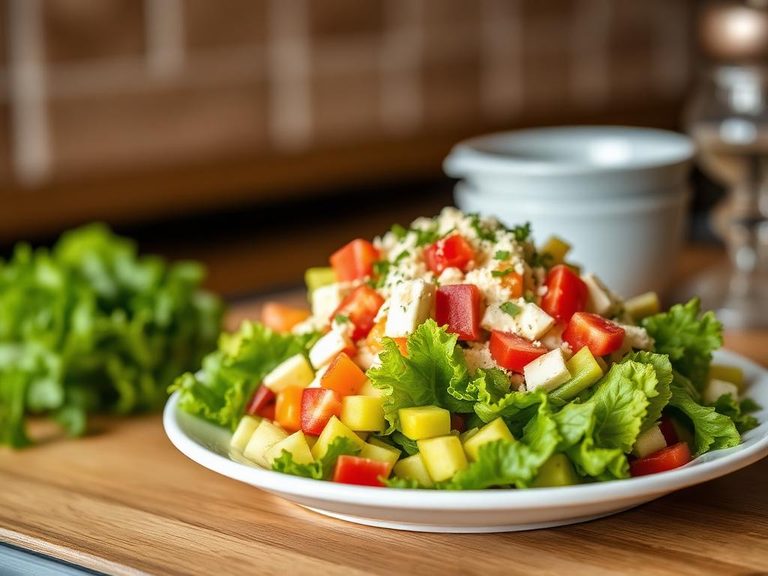
A Cobb salad, served without dressing, is a vibrant, composed salad of chopped ingredients—typically crisp romaine lettuce, hard-boiled egg, grilled chicken, bacon, avocado, tomato, and blue cheese—arranged in neat rows before being tossed. The texture is a delightful mix of crunchy, creamy, and chewy. Nutritionally, it's a protein-packed, low-carb powerhouse, with over 11g of protein and just under 3g of carbs per 100g.
Calorie split: 48% protein · 11% carbs · 41% fat
↓ Full nutrition💚 Why it's loved
People adore the Cobb salad for its satisfying, hearty nature—it feels like a complete, indulgent meal rather than a light salad. Its versatility is a major draw; it's a classic for lunch, a popular dinner option, and a staple of American diner and steakhouse culture.
⚠️ Watch-outs & how to enjoy it better
The primary downside is the high sodium content from cured bacon and blue cheese, which can be a concern for those monitoring blood pressure. The avocado and cheese also make it calorie-dense if portions aren't mindful. To counteract, use a moderate amount of bacon, opt for a lower-sodium cheese like feta, and pair with a vinegar-based dressing to control sodium and fat intake.
Key benefits
- High in satiating protein from chicken, egg, and cheese
- Good source of healthy monounsaturated fats from avocado
- Rich in fiber for digestive health
- Low in carbohydrates and added sugars
- Provides essential vitamins like A, K, and B12
🍽️ Popular dishes
🌍 Where it's eaten
💡 Did you know?
The salad was invented in the 1930s at the Hollywood Brown Derby restaurant, where it was reportedly created as a way to use up leftovers from the kitchen's various stations.
Full nutrition (USDA data · scales with serving)
| Water | 80.8 g |
| Energy | 93.0 kcal |
| Protein | 11.3 g |
| Total lipid (fat) | 4.3 g |
| Carbohydrate, by difference | 2.6 g |
| Fiber, total dietary | 1.2 g |
| Total Sugars | 1.1 g |
| Calcium, Ca | 25.0 mg |
| Iron, Fe | 0.45 mg |
| Magnesium, Mg | 18.0 mg |
| Phosphorus, P | 120 mg |
| Potassium, K | 281 mg |
| Sodium, Na | 159 mg |
| Zinc, Zn | 0.58 mg |
| Copper, Cu | 0.06 mg |
| Selenium, Se | 11.2 ug |
| Vitamin C, total ascorbic acid | 9.0 mg |
| Thiamin | 0.07 mg |
| Riboflavin | 0.13 mg |
| Niacin | 3.6 mg |
| Vitamin B-6 | 0.19 mg |
| Folate, total | 25.0 ug |
| Folic acid | 0.00 ug |
| Folate, food | 24.0 ug |
| Folate, DFE | 24.0 ug |
| Choline, total | 51.1 mg |
| Vitamin B-12 | 0.20 ug |
| Vitamin B-12, added | 0.00 ug |
| Vitamin A, RAE | 82.0 ug |
| Retinol | 15.0 ug |
| Carotene, beta | 787 ug |
| Carotene, alpha | 34.0 ug |
| Cryptoxanthin, beta | 4.0 ug |
| Lycopene | 800 ug |
| Lutein + zeaxanthin | 763 ug |
| Vitamin E (alpha-tocopherol) | 0.66 mg |
| Vitamin E, added | 0.00 mg |
| Vitamin D (D2 + D3) | 0.20 ug |
| Vitamin K (phylloquinone) | 31.9 ug |
| Alcohol, ethyl | 0.00 g |
| Caffeine | 0.00 mg |
| Theobromine | 0.00 mg |
Fat & fatty acid profile (per 100g)
| Fatty acids, total saturated | 1.0 g |
| SFA 4:0 | 0.00 g |
| SFA 6:0 | 0.00 g |
| SFA 8:0 | 0.00 g |
| SFA 10:0 | 0.00 g |
| SFA 12:0 | 0.00 g |
| SFA 14:0 | 0.02 g |
| SFA 16:0 | 0.81 g |
| SFA 18:0 | 0.21 g |
| Fatty acids, total monounsaturated | 2.1 g |
| MUFA 16:1 | 0.19 g |
| MUFA 18:1 | 1.9 g |
| MUFA 20:1 | 0.01 g |
| MUFA 22:1 | 0.00 g |
| Fatty acids, total polyunsaturated | 0.63 g |
| PUFA 18:2 | 0.56 g |
| PUFA 18:3 | 0.04 g |
| PUFA 18:4 | 0.00 g |
| PUFA 20:4 | 0.02 g |
| PUFA 20:5 n-3 (EPA) | 0.00 g |
| PUFA 22:5 n-3 (DPA) | 0.00 g |
| PUFA 22:6 n-3 (DHA) | 0.00 g |
| Cholesterol | 61.0 mg |
FAQ
Is a Cobb salad without dressing still flavorful?
Yes, the combination of salty bacon, tangy blue cheese, rich avocado, and savory chicken provides substantial flavor on its own. The dressing typically adds moisture and a unifying element, but the core ingredients are well-seasoned.
Can I make a Cobb salad vegetarian?
Absolutely. A popular variation replaces the chicken and bacon with grilled halloumi cheese, roasted chickpeas, or smoked tofu for protein, while keeping the egg, avocado, and cheese.
Why is it called a 'composed' salad?
Unlike a tossed salad where ingredients are mixed together, a composed salad features ingredients arranged artfully in rows or sections on the plate. The Cobb salad is a classic example, designed to showcase each component before mixing.
Nutrient density (calculated · NRF9.3)
Nutrient Rich Foods index: beneficial nutrients (protein, fiber, vitamins, minerals) minus saturated fat, added sugar & sodium, per 100 kcal.
NRF9.3 index — Fulgoni, Keast & Drewnowski, 2009. Computed from USDA nutrients.
Weight-loss friendliness (composite index)
Energy density 0.93 kcal/g · 49% calories from protein · 1.2 g fiber · 1.1 g sugar per 100 g.
Composite of energy density (Rolls et al., 1999), protein & fiber satiety, minus sugar. A calculated heuristic — ranks satiety-per-calorie, not a clinical measure.
Dietary load (calculated from USDA values)
Potential renal acid load. Positive = acid-forming, negative = alkaline-forming.
Sodium-to-potassium ratio: 0.57 (lower is better — aim for ≤ 1)
Sodium:potassium per WHO potassium guidance. Computed from USDA nutrients.