Chocolate milk, low fat (1%)
Common food
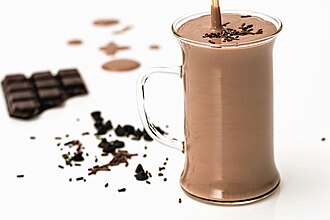
Photo: Wikipedia
Low-fat chocolate milk is a creamy, sweetened dairy beverage made by blending cocoa or chocolate syrup with skim or 1% milk. It offers a rich, chocolatey flavor with a smooth, drinkable texture and provides a notable protein boost alongside its natural sugars. This drink is often used as a post-workout recovery aid due to its balanced carb-to-protein ratio.
💚 Why it's loved
People love its comforting, indulgent taste that feels like a treat but delivers real nutrition. It's a nostalgic favorite for many, often associated with childhood and post-sports recovery.
⚠️ Watch-outs & how to enjoy it better
The added sugar can cause blood-sugar spikes, making it less ideal for those with diabetes or insulin resistance. To counteract this, pair it with a source of protein or healthy fat (like nuts or a hard-boiled egg) to slow sugar absorption, and stick to a 1-cup serving.
Key benefits
- Provides high-quality protein for muscle repair and satiety
- Rich in calcium and vitamin D for bone health
- Contains carbohydrates for quick energy replenishment
- Lower in fat than whole milk while retaining nutritional value
- Convenient and palatable way to increase dairy intake
🍽️ Popular dishes

🌍 Where it's eaten
💡 Did you know?
Chocolate milk was first introduced in the 17th century as a medicinal drink in Europe, often served warm and believed to have healing properties.
Full nutrition (scales with serving)
| Water | 84.5 g |
| Energy | 64.0 kcal |
| Protein | 3.5 g |
| Total lipid (fat) | 1.1 g |
| Carbohydrate, by difference | 10.2 g |
| Fiber, total dietary | 0.10 g |
| Total Sugars | 9.9 g |
| Calcium, Ca | 129 mg |
| Iron, Fe | 0.23 mg |
| Magnesium, Mg | 13.0 mg |
| Phosphorus, P | 96.0 mg |
| Potassium, K | 172 mg |
| Sodium, Na | 65.0 mg |
| Zinc, Zn | 0.43 mg |
| Copper, Cu | 0.03 mg |
| Selenium, Se | 1.9 ug |
| Vitamin C, total ascorbic acid | 0.40 mg |
| Thiamin | 0.03 mg |
| Riboflavin | 0.25 mg |
| Niacin | 0.12 mg |
| Vitamin B-6 | 0.05 mg |
| Folate, total | 3.0 ug |
| Folic acid | 0.00 ug |
| Folate, food | 3.0 ug |
| Folate, DFE | 3.0 ug |
| Choline, total | 17.0 mg |
| Vitamin B-12 | 0.23 ug |
| Vitamin B-12, added | 0.00 ug |
| Vitamin A, RAE | 52.0 ug |
| Retinol | 51.0 ug |
| Carotene, beta | 2.0 ug |
| Carotene, alpha | 0.00 ug |
| Cryptoxanthin, beta | 0.00 ug |
| Lycopene | 0.00 ug |
| Lutein + zeaxanthin | 0.00 ug |
| Vitamin E (alpha-tocopherol) | 0.00 mg |
| Vitamin E, added | 0.00 mg |
| Vitamin D (D2 + D3) | 1.1 ug |
| Vitamin K (phylloquinone) | 0.10 ug |
| Fatty acids, total saturated | 0.62 g |
| SFA 4:0 | 0.02 g |
| SFA 6:0 | 0.01 g |
| SFA 8:0 | 0.01 g |
| SFA 10:0 | 0.02 g |
| SFA 12:0 | 0.03 g |
| SFA 14:0 | 0.09 g |
| SFA 16:0 | 0.27 g |
| SFA 18:0 | 0.12 g |
| Fatty acids, total monounsaturated | 0.30 g |
| MUFA 16:1 | 0.01 g |
| MUFA 18:1 | 0.25 g |
| MUFA 20:1 | 0.00 g |
| MUFA 22:1 | 0.00 g |
| Fatty acids, total polyunsaturated | 0.05 g |
| PUFA 18:2 | 0.04 g |
| PUFA 18:3 | 0.01 g |
| PUFA 18:4 | 0.00 g |
| PUFA 20:4 | 0.00 g |
| PUFA 20:5 n-3 (EPA) | 0.00 g |
| PUFA 22:5 n-3 (DPA) | 0.00 g |
| PUFA 22:6 n-3 (DHA) | 0.00 g |
| Cholesterol | 5.0 mg |
| Alcohol, ethyl | 0.00 g |
| Caffeine | 1.0 mg |
| Theobromine | 12.0 mg |
FAQ
Is low-fat chocolate milk a good post-workout drink?
Yes, its combination of carbohydrates and protein helps replenish glycogen stores and repair muscle tissue effectively.
How does it compare to regular chocolate milk?
Low-fat chocolate milk has less fat but similar sugar and protein content, making it a lighter option with fewer calories.
Can it be used in baking?
Absolutely, it adds moisture and a subtle chocolate flavor to cakes, pancakes, and muffins.