

Antipasto with ham, fish, cheese, vegetables
Common food

Photo: Wikipedia
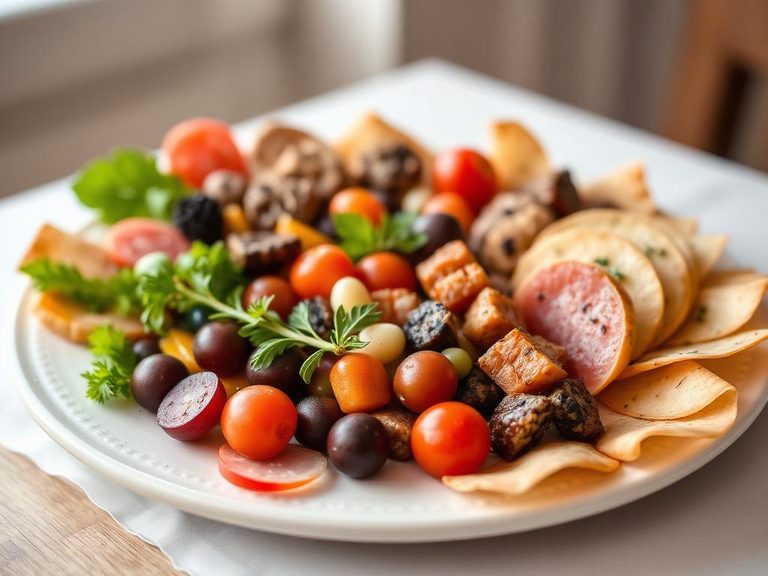
Antipasto is a vibrant, pre-meal platter of cured meats, cheeses, marinated vegetables, and sometimes fish, offering a savory and tangy flavor profile with a variety of textures from creamy to crisp. It's a protein-rich starter, with the ham and cheese providing substantial satiety, while the vegetables add fiber and a refreshing contrast.
Calorie split: 29% protein · 10% carbs · 61% fat
↓ Full nutrition💚 Why it's loved
People adore antipasto for its customizable nature and bold, concentrated flavors—salty, tangy, and umami-rich—that awaken the palate. It's deeply rooted in Italian culture as a symbol of hospitality and abundance, perfect for sharing.
⚠️ Watch-outs & how to enjoy it better
The cured meats and cheeses can be high in sodium and saturated fat, which may concern those monitoring heart health or blood pressure. To mitigate this, balance portions with extra vegetables, opt for low-sodium options, and pair with a fiber-rich side to slow digestion.
Key benefits
- High in protein for muscle maintenance and satiety.
- Provides healthy fats from olive oil and cheeses.
- Contains fiber from vegetables, aiding digestion.
- Offers a wide array of vitamins and minerals from diverse ingredients.
- Encourages mindful, social eating as a shared appetizer.
🍽️ Popular dishes
🌍 Where it's eaten
💡 Did you know?
The word 'antipasto' literally means 'before the meal' in Italian, derived from the Latin 'ante' (before) and 'pascere' (to feed), highlighting its traditional role as a hunger-stimulating opener.
Full nutrition (USDA data · scales with serving)
| Water | 70.7 g |
| Energy | 158 kcal |
| Protein | 11.6 g |
| Total lipid (fat) | 10.7 g |
| Carbohydrate, by difference | 3.8 g |
| Fiber, total dietary | 1.1 g |
| Total Sugars | 1.5 g |
| Calcium, Ca | 178 mg |
| Iron, Fe | 0.80 mg |
| Magnesium, Mg | 21.0 mg |
| Phosphorus, P | 180 mg |
| Potassium, K | 248 mg |
| Sodium, Na | 854 mg |
| Zinc, Zn | 1.5 mg |
| Copper, Cu | 0.08 mg |
| Selenium, Se | 18.9 ug |
| Vitamin C, total ascorbic acid | 1.5 mg |
| Thiamin | 0.11 mg |
| Riboflavin | 0.18 mg |
| Niacin | 3.4 mg |
| Vitamin B-6 | 0.17 mg |
| Folate, total | 11.0 ug |
| Folic acid | 0.00 ug |
| Folate, food | 11.0 ug |
| Folate, DFE | 11.0 ug |
| Choline, total | 28.9 mg |
| Vitamin B-12 | 0.50 ug |
| Vitamin B-12, added | 0.00 ug |
| Vitamin A, RAE | 288 ug |
| Retinol | 54.0 ug |
| Carotene, beta | 2293 ug |
| Carotene, alpha | 1032 ug |
| Cryptoxanthin, beta | 5.0 ug |
| Lycopene | 0.00 ug |
| Lutein + zeaxanthin | 217 ug |
| Vitamin E (alpha-tocopherol) | 1.0 mg |
| Vitamin E, added | 0.00 mg |
| Vitamin D (D2 + D3) | 0.40 ug |
| Vitamin K (phylloquinone) | 9.7 ug |
| Alcohol, ethyl | 0.00 g |
| Caffeine | 0.00 mg |
| Theobromine | 0.00 mg |
Fat & fatty acid profile (per 100g)
| Fatty acids, total saturated | 4.6 g |
| SFA 4:0 | 0.10 g |
| SFA 6:0 | 0.09 g |
| SFA 8:0 | 0.06 g |
| SFA 10:0 | 0.14 g |
| SFA 12:0 | 0.16 g |
| SFA 14:0 | 0.59 g |
| SFA 16:0 | 2.4 g |
| SFA 18:0 | 0.98 g |
| Fatty acids, total monounsaturated | 3.7 g |
| MUFA 16:1 | 0.24 g |
| MUFA 18:1 | 3.5 g |
| MUFA 20:1 | 0.04 g |
| MUFA 22:1 | 0.02 g |
| Fatty acids, total polyunsaturated | 1.1 g |
| PUFA 18:2 | 0.78 g |
| PUFA 18:3 | 0.05 g |
| PUFA 18:4 | 0.01 g |
| PUFA 20:4 | 0.03 g |
| PUFA 20:5 n-3 (EPA) | 0.08 g |
| PUFA 22:5 n-3 (DPA) | 0.01 g |
| PUFA 22:6 n-3 (DHA) | 0.13 g |
| Cholesterol | 39.0 mg |
FAQ
Is antipasto gluten-free?
The core components (meats, cheeses, vegetables) are typically gluten-free, but always check labels for marinades or added ingredients that might contain gluten.
Can I make a healthy version at home?
Absolutely. Use leaner proteins like turkey or chicken, load up on fresh or grilled vegetables, choose low-fat cheeses, and use a light vinaigrette instead of heavy oil.
How long does antipasto last in the fridge?
When stored in an airtight container, most antipasto components will last 3-5 days. Marinated vegetables may last longer, but consume within a week for best quality.
Nutrient density (calculated · NRF9.3)
Nutrient Rich Foods index: beneficial nutrients (protein, fiber, vitamins, minerals) minus saturated fat, added sugar & sodium, per 100 kcal.
NRF9.3 index — Fulgoni, Keast & Drewnowski, 2009. Computed from USDA nutrients.
Weight-loss friendliness (composite index)
Energy density 1.58 kcal/g · 29% calories from protein · 1.1 g fiber · 1.5 g sugar per 100 g.
Composite of energy density (Rolls et al., 1999), protein & fiber satiety, minus sugar. A calculated heuristic — ranks satiety-per-calorie, not a clinical measure.
Dietary load (calculated from USDA values)
Potential renal acid load. Positive = acid-forming, negative = alkaline-forming.
Sodium-to-potassium ratio: 3.44 (lower is better — aim for ≤ 1)
Sodium:potassium per WHO potassium guidance. Computed from USDA nutrients.