

Snacks, potato chips, plain, made with partially hydrogenated soybean oil, salted
Whole food · Snacks
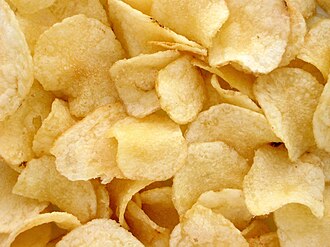
Photo: Wikipedia
These are classic, golden-fried potato slices, their surfaces dusted with fine salt crystals. They deliver a satisfyingly crisp snap followed by a starchy, savory flavor. Nutritionally, they are a dense source of energy, primarily from fats and refined carbohydrates.
Calorie split: 5% protein · 38% carbs · 57% fat
↓ Full nutrition💚 Why it's loved
People adore the addictive combination of salt and fat, which triggers pleasure centers in the brain. Their crunchy texture and savory taste make them a universal, go-to comfort food for casual snacking, parties, and pairing with sandwiches.
⚠️ Watch-outs & how to enjoy it better
The high sodium and fat content can contribute to water retention and excess calorie intake. The refined carbohydrates can cause rapid blood sugar spikes. To counteract this, practice strict portion control (e.g., use a small bowl), pair with a protein like hummus or cheese, and choose lower-sodium varieties when available.
Key benefits
- Provides a quick, concentrated source of energy
- Contains some dietary fiber from the potato
- Offers a small amount of plant-based protein
- A widely available, shelf-stable snack
- Can be a source of potassium from the potato base
🍽️ Popular dishes



🌍 Where it's eaten
💡 Did you know?
The potato chip was invented in 1853 by chef George Crum at Moon's Lake House in Saratoga Springs, New York, reportedly as a spiteful response to a customer who kept complaining his fried potatoes were too thick.
Full nutrition (USDA data · scales with serving)
| Water | 1.9 g |
| Energy | 536 kcal |
| Energy | 2243 kj |
| Protein | 7.0 g |
| Total lipid (fat) | 34.6 g |
| Ash | 3.6 g |
| Carbohydrate, by difference | 52.9 g |
| Fiber, total dietary | 4.8 g |
| Calcium, Ca | 24.0 mg |
| Iron, Fe | 1.6 mg |
| Magnesium, Mg | 67.0 mg |
| Phosphorus, P | 165 mg |
| Potassium, K | 1275 mg |
| Sodium, Na | 594 mg |
| Zinc, Zn | 1.1 mg |
| Copper, Cu | 0.31 mg |
| Manganese, Mn | 0.44 mg |
| Selenium, Se | 8.1 ug |
| Vitamin C, total ascorbic acid | 31.1 mg |
| Thiamin | 0.17 mg |
| Riboflavin | 0.20 mg |
| Niacin | 3.8 mg |
| Pantothenic acid | 0.40 mg |
| Vitamin B-6 | 0.66 mg |
| Folate, total | 45.0 ug |
| Folic acid | 0.00 ug |
| Folate, food | 45.0 ug |
| Folate, DFE | 45.0 ug |
| Vitamin A, RAE | 0.00 ug |
| Retinol | 0.00 ug |
| Vitamin A, IU | 0.00 iu |
Fat & fatty acid profile (per 100g)
| Fatty acids, total saturated | 5.4 g |
| SFA 16:0 | 4.0 g |
| SFA 18:0 | 1.5 g |
| Fatty acids, total monounsaturated | 18.0 g |
| MUFA 18:1 | 17.9 g |
| MUFA 20:1 | 0.07 g |
| Fatty acids, total polyunsaturated | 9.2 g |
| PUFA 18:2 | 8.9 g |
| PUFA 18:3 | 0.26 g |
| Cholesterol | 0.00 mg |
Amino acid profile (per 100g)
| Tryptophan | 0.11 g |
| Threonine | 0.25 g |
| Isoleucine | 0.28 g |
| Leucine | 0.42 g |
| Lysine | 0.42 g |
| Methionine | 0.11 g |
| Cystine | 0.09 g |
| Phenylalanine | 0.31 g |
| Tyrosine | 0.26 g |
| Valine | 0.39 g |
| Arginine | 0.32 g |
| Histidine | 0.15 g |
| Alanine | 0.21 g |
| Aspartic acid | 1.7 g |
| Glutamic acid | 1.2 g |
| Glycine | 0.21 g |
| Proline | 0.25 g |
| Serine | 0.30 g |
FAQ
Why are these chips made with partially hydrogenated oil?
Partially hydrogenated soybean oil was historically used because it is shelf-stable, inexpensive, and gives chips a crisp texture. However, this process creates trans fats, which are linked to heart disease. Many manufacturers have since moved to other oils due to health regulations and consumer demand.
Do potato chips contain sugar?
Plain salted potato chips typically have 0g of added sugar per serving. Any natural sugars come from the potato itself in negligible amounts. However, flavored varieties (like barbecue or sweet onion) often contain added sugars.
How can I enjoy potato chips more healthily?
Choose baked or kettle-cooked varieties (often lower in fat), read labels for sodium content, and always portion them out of the bag into a bowl. Pairing them with a protein-rich food can help slow digestion and increase satiety.
Nutrient density (calculated · NRF9.3)
Nutrient Rich Foods index: beneficial nutrients (protein, fiber, vitamins, minerals) minus saturated fat, added sugar & sodium, per 100 kcal.
NRF9.3 index — Fulgoni, Keast & Drewnowski, 2009. Computed from USDA nutrients.
Weight-loss friendliness (composite index)
Energy density 5.36 kcal/g · 5% calories from protein · 4.8 g fiber · 0.0 g sugar per 100 g.
Composite of energy density (Rolls et al., 1999), protein & fiber satiety, minus sugar. A calculated heuristic — ranks satiety-per-calorie, not a clinical measure.
Dietary load (calculated from USDA values)
Potential renal acid load. Positive = acid-forming, negative = alkaline-forming.
Sodium-to-potassium ratio: 0.47 (lower is better — aim for ≤ 1)
Sodium:potassium per WHO potassium guidance. Computed from USDA nutrients.