

Onion dip, regular
Common food
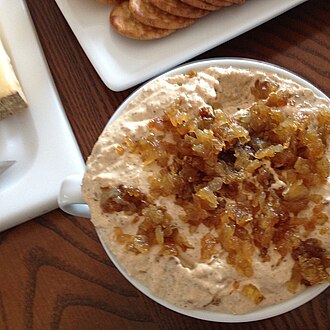
Photo: Wikipedia
A creamy, savory spread with a distinct sweet and tangy onion flavor, typically made from a base of sour cream or mayonnaise and dehydrated onion soup mix. Its texture is smooth and rich, making it a staple for dipping crunchy vegetables or chips. Nutritionally, it is a high-fat, calorie-dense condiment, with over 35 grams of fat per 100 grams, offering minimal protein and fiber.
Calorie split: 2% protein · 5% carbs · 93% fat
↓ Full nutrition💚 Why it's loved
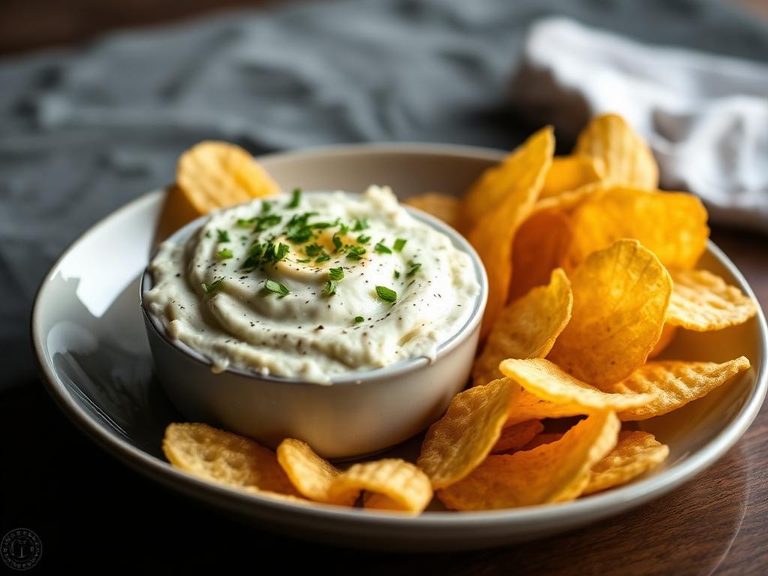
People love it for its addictive, umami-rich flavor that perfectly complements salty, crunchy snacks like potato chips and pretzels. It is a nostalgic party staple in North America, evoking a sense of casual comfort and shared enjoyment.
⚠️ Watch-outs & how to enjoy it better
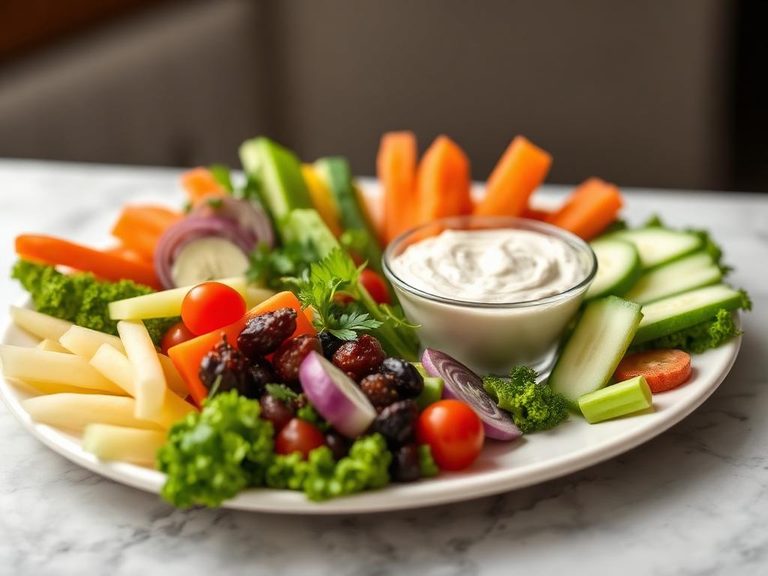
Its high fat and calorie content can be a concern for those monitoring their intake, and it often contains significant sodium. To counteract this, practice strict portion control (e.g., 2 tablespoons per serving) and pair it with a large volume of fiber-rich vegetables like bell peppers or cucumber to increase satiety without excess calories.
Key benefits
- Provides a quick source of energy from its high fat content.
- Contains small amounts of vitamin C and antioxidants from the onion component.
- Serves as a flavorful way to encourage consumption of raw vegetables like carrots or celery.
- Offers a convenient, ready-to-eat option for party snacks and gatherings.
🍽️ Popular dishes


🌍 Where it's eaten
💡 Did you know?
The most popular commercial version, Lipton Onion Soup Mix, was introduced in 1952 and became a cultural phenomenon, with the dip recipe appearing on the back of the box.
Full nutrition (USDA data · scales with serving)
| Water | 56.2 g |
| Energy | 346 kcal |
| Protein | 2.1 g |
| Total lipid (fat) | 35.8 g |
| Carbohydrate, by difference | 3.9 g |
| Fiber, total dietary | 0.20 g |
| Total Sugars | 2.6 g |
| Calcium, Ca | 65.0 mg |
| Iron, Fe | 0.10 mg |
| Magnesium, Mg | 7.0 mg |
| Phosphorus, P | 65.0 mg |
| Potassium, K | 103 mg |
| Sodium, Na | 563 mg |
| Zinc, Zn | 0.29 mg |
| Copper, Cu | 0.01 mg |
| Selenium, Se | 2.6 ug |
| Vitamin C, total ascorbic acid | 0.90 mg |
| Thiamin | 0.03 mg |
| Riboflavin | 0.10 mg |
| Niacin | 0.07 mg |
| Vitamin B-6 | 0.04 mg |
| Folate, total | 6.0 ug |
| Folic acid | 0.00 ug |
| Folate, food | 6.0 ug |
| Folate, DFE | 6.0 ug |
| Choline, total | 23.7 mg |
| Vitamin B-12 | 0.15 ug |
| Vitamin B-12, added | 0.00 ug |
| Vitamin A, RAE | 73.0 ug |
| Retinol | 72.0 ug |
| Carotene, beta | 3.0 ug |
| Carotene, alpha | 0.00 ug |
| Cryptoxanthin, beta | 2.0 ug |
| Lycopene | 0.00 ug |
| Lutein + zeaxanthin | 6.0 ug |
| Vitamin E (alpha-tocopherol) | 1.4 mg |
| Vitamin E, added | 0.00 mg |
| Vitamin D (D2 + D3) | 0.20 ug |
| Vitamin K (phylloquinone) | 62.9 ug |
| Alcohol, ethyl | 0.00 g |
| Caffeine | 0.00 mg |
| Theobromine | 0.00 mg |
Fat & fatty acid profile (per 100g)
| Fatty acids, total saturated | 8.7 g |
| SFA 4:0 | 0.02 g |
| SFA 6:0 | 0.08 g |
| SFA 8:0 | 0.06 g |
| SFA 10:0 | 0.15 g |
| SFA 12:0 | 0.22 g |
| SFA 14:0 | 0.72 g |
| SFA 16:0 | 5.0 g |
| SFA 18:0 | 1.8 g |
| Fatty acids, total monounsaturated | 8.0 g |
| MUFA 16:1 | 0.15 g |
| MUFA 18:1 | 7.9 g |
| MUFA 20:1 | 0.10 g |
| MUFA 22:1 | 0.01 g |
| Fatty acids, total polyunsaturated | 17.4 g |
| PUFA 18:2 | 15.1 g |
| PUFA 18:3 | 2.1 g |
| PUFA 18:4 | 0.00 g |
| PUFA 20:4 | 0.03 g |
| PUFA 20:5 n-3 (EPA) | 0.00 g |
| PUFA 22:5 n-3 (DPA) | 0.00 g |
| PUFA 22:6 n-3 (DHA) | 0.00 g |
| Cholesterol | 38.0 mg |
FAQ
Is onion dip a good source of protein?
No, it is very low in protein, providing only about 2 grams per 100 grams. It is primarily a fat-based condiment.
Can I make a healthier version at home?
Yes, you can use Greek yogurt or a mix of Greek yogurt and light sour cream as the base, and add fresh onions, herbs, and spices to control sodium and fat content.
What is the best way to store leftover onion dip?
Store it in an airtight container in the refrigerator for up to 5 days. The flavor often intensifies as it sits.
Nutrient density (calculated · NRF9.3)
Nutrient Rich Foods index: beneficial nutrients (protein, fiber, vitamins, minerals) minus saturated fat, added sugar & sodium, per 100 kcal.
NRF9.3 index — Fulgoni, Keast & Drewnowski, 2009. Computed from USDA nutrients.
Weight-loss friendliness (composite index)
Energy density 3.46 kcal/g · 2% calories from protein · 0.2 g fiber · 2.6 g sugar per 100 g.
Composite of energy density (Rolls et al., 1999), protein & fiber satiety, minus sugar. A calculated heuristic — ranks satiety-per-calorie, not a clinical measure.
Dietary load (calculated from USDA values)
Potential renal acid load. Positive = acid-forming, negative = alkaline-forming.
Sodium-to-potassium ratio: 5.47 (lower is better — aim for ≤ 1)
Sodium:potassium per WHO potassium guidance. Computed from USDA nutrients.