

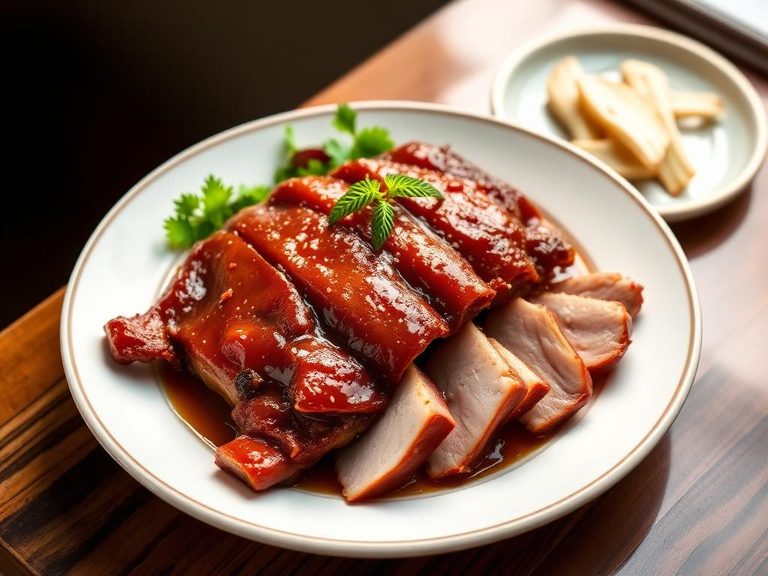
Moo Shu pork, without Chinese pancake
Common food

Photo: Wikipedia
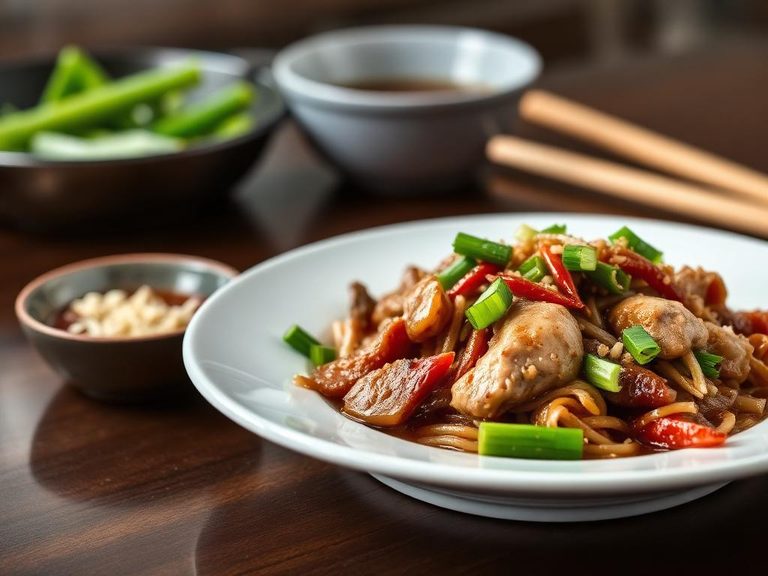
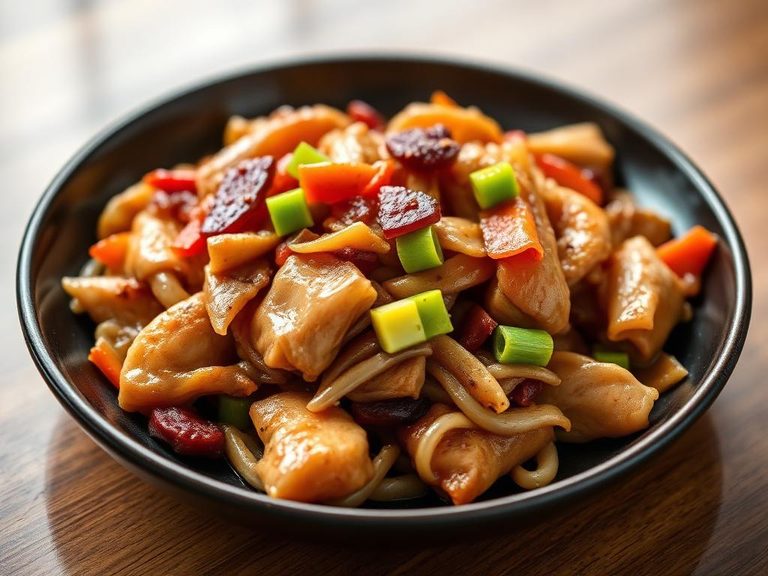
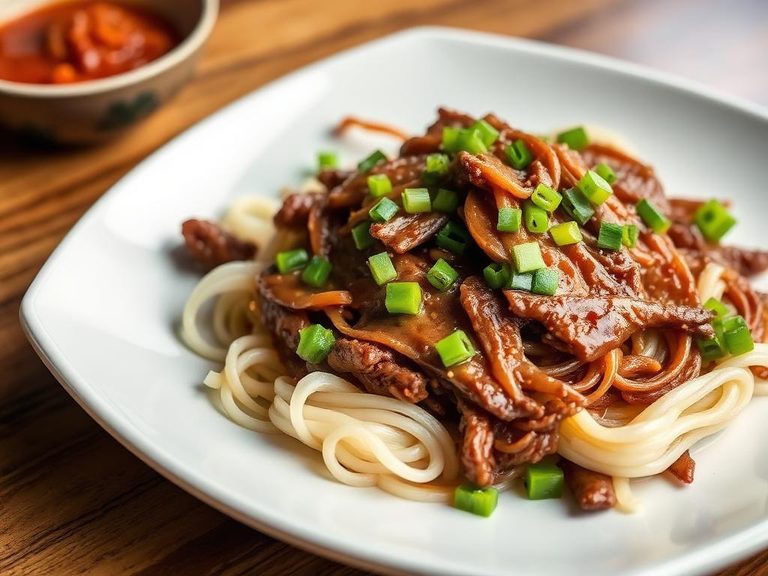
Moo Shu pork is a savory, stir-fried dish of thinly sliced pork, scrambled eggs, and crisp vegetables like cabbage and wood ear mushrooms, all tossed in a rich, savory-sweet sauce. Without the traditional Mandarin pancake, the focus shifts to the tender meat and crunchy vegetables, creating a satisfying mix of textures. Nutritionally, it's a protein-packed dish with a moderate fat content from the cooking oil and pork.
Calorie split: 27% protein · 10% carbs · 63% fat
↓ Full nutrition💚 Why it's loved
People love it for the harmonious blend of savory, sweet, and umami flavors, and the delightful contrast between tender pork, fluffy egg, and crunchy vegetables. It's a beloved staple of Chinese-American cuisine, offering a taste of home-style cooking.
⚠️ Watch-outs & how to enjoy it better
The dish can be high in sodium from the soy-based sauce and may contain added sugar, which could be a concern for those monitoring blood pressure or sugar intake. To counteract this, use low-sodium soy sauce, control the sauce portion, and pair the dish with a side of plain steamed rice or a fresh salad to balance the meal.
Key benefits
- High in protein for muscle maintenance and satiety.
- Contains vegetables like cabbage and wood ear mushrooms for fiber and minerals.
- A balanced, single-pan meal when served without the pancake.
- The wood ear mushrooms are a good source of iron and antioxidants.
🍽️ Popular dishes
🌍 Where it's eaten
💡 Did you know?
The name 'Moo Shu' is an approximation of the Mandarin Chinese term for 'wooden flowers,' which originally referred to the delicate, flower-like shreds of pork used in the dish.
Full nutrition (USDA data · scales with serving)
| Water | 72.1 g |
| Energy | 153 kcal |
| Protein | 10.4 g |
| Total lipid (fat) | 10.7 g |
| Carbohydrate, by difference | 4.0 g |
| Fiber, total dietary | 0.90 g |
| Total Sugars | 1.8 g |
| Calcium, Ca | 43.0 mg |
| Iron, Fe | 1.1 mg |
| Magnesium, Mg | 25.0 mg |
| Phosphorus, P | 137 mg |
| Potassium, K | 264 mg |
| Sodium, Na | 815 mg |
| Zinc, Zn | 1.1 mg |
| Copper, Cu | 0.08 mg |
| Selenium, Se | 15.7 ug |
| Vitamin C, total ascorbic acid | 10.0 mg |
| Thiamin | 0.25 mg |
| Riboflavin | 0.23 mg |
| Niacin | 2.0 mg |
| Vitamin B-6 | 0.25 mg |
| Folate, total | 33.0 ug |
| Folic acid | 0.00 ug |
| Folate, food | 33.0 ug |
| Folate, DFE | 33.0 ug |
| Choline, total | 85.3 mg |
| Vitamin B-12 | 0.31 ug |
| Vitamin B-12, added | 0.00 ug |
| Vitamin A, RAE | 75.0 ug |
| Retinol | 35.0 ug |
| Carotene, beta | 478 ug |
| Carotene, alpha | 1.0 ug |
| Cryptoxanthin, beta | 3.0 ug |
| Lycopene | 0.00 ug |
| Lutein + zeaxanthin | 172 ug |
| Vitamin E (alpha-tocopherol) | 1.8 mg |
| Vitamin E, added | 0.00 mg |
| Vitamin D (D2 + D3) | 0.50 ug |
| Vitamin K (phylloquinone) | 33.9 ug |
| Alcohol, ethyl | 0.00 g |
| Caffeine | 0.00 mg |
| Theobromine | 0.00 mg |
Fat & fatty acid profile (per 100g)
| Fatty acids, total saturated | 1.9 g |
| SFA 4:0 | 0.00 g |
| SFA 6:0 | 0.00 g |
| SFA 8:0 | 0.00 g |
| SFA 10:0 | 0.00 g |
| SFA 12:0 | 0.00 g |
| SFA 14:0 | 0.02 g |
| SFA 16:0 | 1.4 g |
| SFA 18:0 | 0.47 g |
| Fatty acids, total monounsaturated | 4.3 g |
| MUFA 16:1 | 0.09 g |
| MUFA 18:1 | 4.2 g |
| MUFA 20:1 | 0.05 g |
| MUFA 22:1 | 0.00 g |
| Fatty acids, total polyunsaturated | 3.6 g |
| PUFA 18:2 | 3.2 g |
| PUFA 18:3 | 0.34 g |
| PUFA 18:4 | 0.00 g |
| PUFA 20:4 | 0.02 g |
| PUFA 20:5 n-3 (EPA) | 0.00 g |
| PUFA 22:5 n-3 (DPA) | 0.00 g |
| PUFA 22:6 n-3 (DHA) | 0.00 g |
| Cholesterol | 100 mg |
FAQ
Is Moo Shu pork spicy?
Traditionally, it's not spicy. The flavor profile is savory and slightly sweet from hoisin sauce. However, some restaurants or home recipes may add chili for heat.
What are the key vegetables in Moo Shu pork?
The classic vegetables are shredded cabbage (often Napa cabbage), wood ear mushrooms, and sometimes bamboo shoots or carrots for color and crunch.
Can I make Moo Shu pork with other proteins?
Absolutely. Chicken, beef, shrimp, or tofu are common and delicious substitutes, following the same stir-fry method.
Nutrient density (calculated · NRF9.3)
Nutrient Rich Foods index: beneficial nutrients (protein, fiber, vitamins, minerals) minus saturated fat, added sugar & sodium, per 100 kcal.
NRF9.3 index — Fulgoni, Keast & Drewnowski, 2009. Computed from USDA nutrients.
Weight-loss friendliness (composite index)
Energy density 1.53 kcal/g · 27% calories from protein · 0.9 g fiber · 1.8 g sugar per 100 g.
Composite of energy density (Rolls et al., 1999), protein & fiber satiety, minus sugar. A calculated heuristic — ranks satiety-per-calorie, not a clinical measure.
Dietary load (calculated from USDA values)
Potential renal acid load. Positive = acid-forming, negative = alkaline-forming.
Sodium-to-potassium ratio: 3.09 (lower is better — aim for ≤ 1)
Sodium:potassium per WHO potassium guidance. Computed from USDA nutrients.