

McDONALD'S, Hot Caramel Sundae
Whole food · Fast Foods

Photo: Wikipedia
A McDonald's Hot Caramel Sundae is a classic soft-serve vanilla ice cream dessert, swirled into a cup and generously topped with a warm, sweet, and buttery caramel sauce. The experience is a delightful contrast of cold, creamy ice cream and a viscous, sugary topping. Nutritionally, it's a treat high in simple carbohydrates, primarily from sugar, with minimal protein or fat.
Calorie split: 7% protein · 70% carbs · 23% fat
↓ Full nutrition💚 Why it's loved
People love it for the comforting contrast of cold, creamy vanilla soft-serve against the warm, buttery sweetness of the caramel sauce. It's a nostalgic, affordable treat that delivers a reliable hit of sugary satisfaction.
⚠️ Watch-outs & how to enjoy it better
The high sugar content (over 23g per 100g) can lead to a rapid blood-sugar spike and subsequent crash, making it a poor choice for those managing diabetes or seeking sustained energy. To mitigate this, pair it with a source of protein or fiber (like a handful of nuts or a piece of fruit) to slow sugar absorption, and practice strict portion control by sharing it or opting for a smaller size.
Key benefits
- Provides a quick source of energy from carbohydrates
- Offers a moment of comfort and indulgence
- Contains small amounts of calcium from the dairy
- A convenient and widely available dessert option
🍽️ Popular dishes
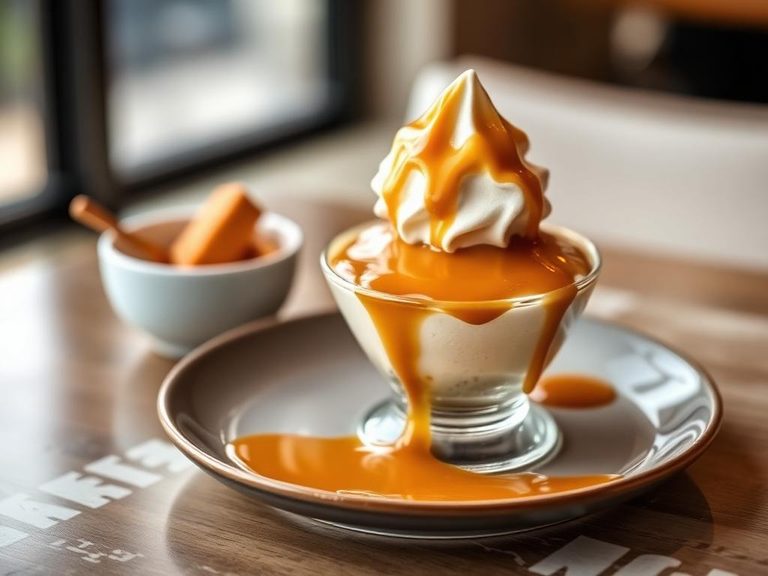


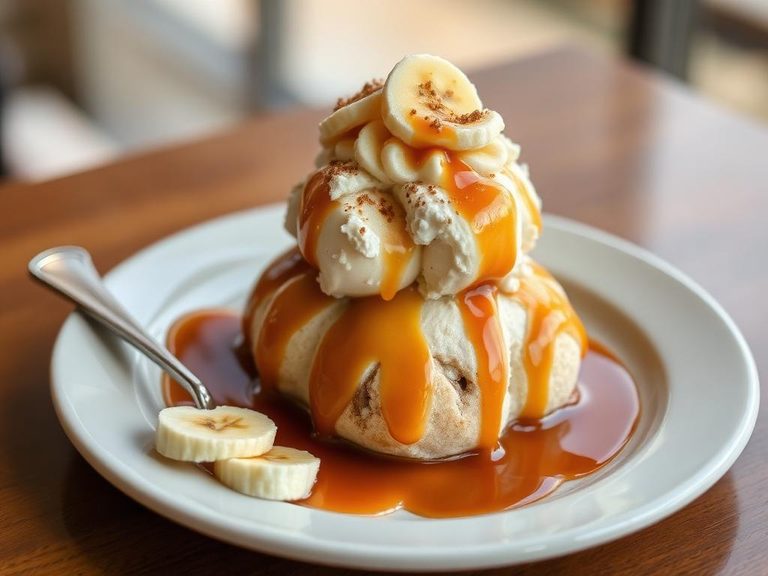

🌍 Where it's eaten
💡 Did you know?
The caramel sauce used in many fast-food sundaes is often a 'butterscotch' style sauce, which gets its flavor primarily from brown sugar and butter rather than the traditional caramelization of white sugar.
Full nutrition (USDA data · scales with serving)
| Water | 57.3 g |
| Energy | 188 kcal |
| Energy | 787 kj |
| Protein | 3.6 g |
| Total lipid (fat) | 4.9 g |
| Ash | 0.90 g |
| Carbohydrate, by difference | 33.4 g |
| Fiber, total dietary | 0.00 g |
| Total Sugars | 23.5 g |
| Sucrose | 12.7 g |
| Glucose | 3.0 g |
| Fructose | 0.78 g |
| Lactose | 5.5 g |
| Maltose | 1.6 g |
| Galactose | 0.00 g |
| Calcium, Ca | 127 mg |
| Iron, Fe | 0.08 mg |
| Magnesium, Mg | 12.0 mg |
| Phosphorus, P | 112 mg |
| Potassium, K | 186 mg |
| Sodium, Na | 80.0 mg |
| Zinc, Zn | 0.45 mg |
| Copper, Cu | 0.01 mg |
| Manganese, Mn | 0.01 mg |
| Thiamin | 0.04 mg |
| Riboflavin | 0.22 mg |
| Niacin | 0.11 mg |
| Pantothenic acid | 0.68 mg |
| Vitamin B-6 | 0.05 mg |
| Folate, total | 2.0 ug |
| Folate, food | 2.0 ug |
| Vitamin B-12 | 0.51 ug |
| Vitamin A, RAE | 92.0 ug |
| Retinol | 92.0 ug |
| Vitamin A, IU | 307 iu |
| Vitamin E (alpha-tocopherol) | 0.01 mg |
Fat & fatty acid profile (per 100g)
| Fatty acids, total saturated | 2.5 g |
| SFA 8:0 | 0.04 g |
| SFA 10:0 | 0.09 g |
| SFA 12:0 | 0.11 g |
| SFA 14:0 | 0.39 g |
| SFA 15:0 | 0.04 g |
| SFA 16:0 | 1.2 g |
| SFA 17:0 | 0.03 g |
| SFA 18:0 | 0.59 g |
| SFA 20:0 | 0.01 g |
| SFA 22:0 | 0.00 g |
| Fatty acids, total monounsaturated | 1.2 g |
| MUFA 14:1 | 0.03 g |
| MUFA 15:1 | 0.00 g |
| MUFA 16:1 | 0.05 g |
| MUFA 17:1 | 0.01 g |
| MUFA 18:1 | 1.1 g |
| MUFA 20:1 | 0.00 g |
| Fatty acids, total polyunsaturated | 0.23 g |
| PUFA 18:2 | 0.21 g |
| PUFA 18:3 | 0.02 g |
| PUFA 20:2 n-6 c,c | 0.00 g |
| PUFA 20:3 | 0.00 g |
| PUFA 20:4 | 0.01 g |
| Fatty acids, total trans | 0.27 g |
| Cholesterol | 16.0 mg |
FAQ
Is the caramel sauce made from real caramelized sugar?
Typically, fast-food caramel sauces are a manufactured product using ingredients like corn syrup, sugar, butter, and cream for consistency and flavor, rather than being made by caramelizing sugar from scratch.
Why does the sauce stay liquid and warm?
The sauce is formulated with stabilizers and thickeners to maintain a pourable, viscous consistency even when heated, preventing it from hardening into a candy shell upon contact with the cold ice cream.
Can I get it without the caramel sauce?
Yes, you can typically order a plain vanilla soft-serve cone or cup, which would have a different nutritional profile with less sugar and fat.
Nutrient density (calculated · NRF9.3)
Nutrient Rich Foods index: beneficial nutrients (protein, fiber, vitamins, minerals) minus saturated fat, added sugar & sodium, per 100 kcal.
NRF9.3 index — Fulgoni, Keast & Drewnowski, 2009. Computed from USDA nutrients.
Weight-loss friendliness (composite index)
Energy density 1.88 kcal/g · 8% calories from protein · 0.0 g fiber · 23.5 g sugar per 100 g.
Composite of energy density (Rolls et al., 1999), protein & fiber satiety, minus sugar. A calculated heuristic — ranks satiety-per-calorie, not a clinical measure.
Dietary load (calculated from USDA values)
Potential renal acid load. Positive = acid-forming, negative = alkaline-forming.
Sodium-to-potassium ratio: 0.43 (lower is better — aim for ≤ 1)
Sodium:potassium per WHO potassium guidance. Computed from USDA nutrients.