

Haupia
Common food

Photo: Wikipedia
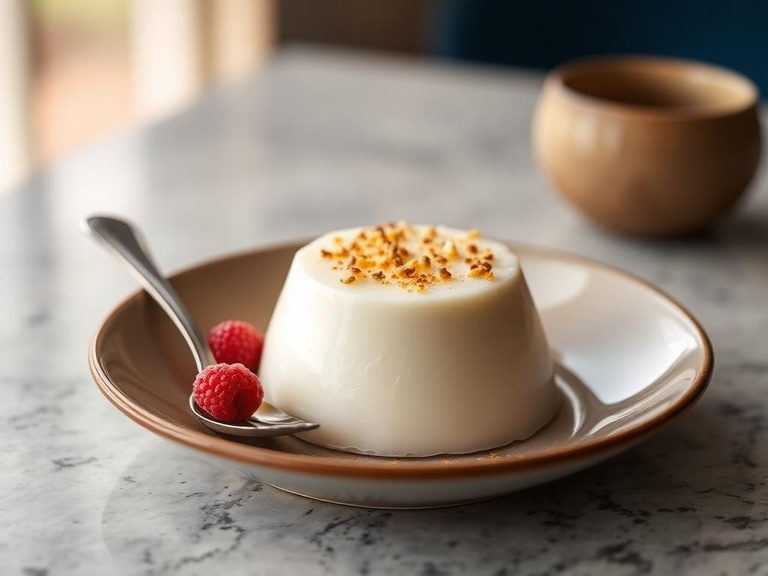
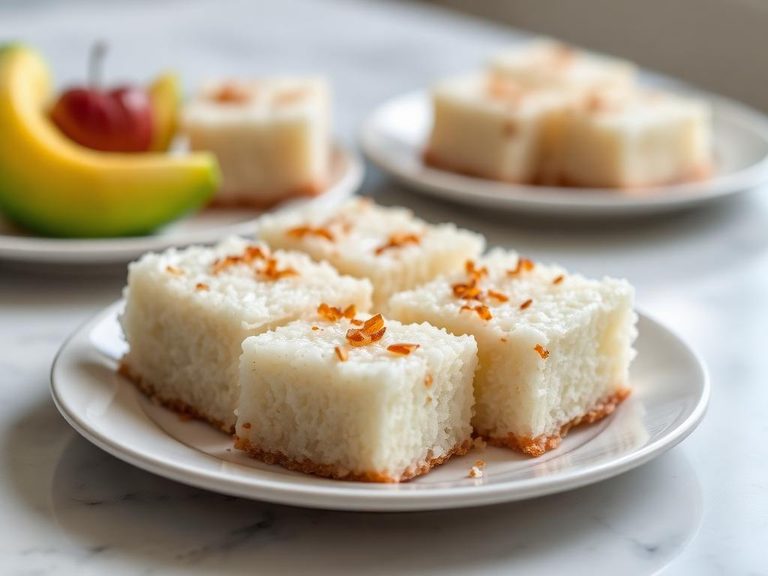
Haupia is a traditional Hawaiian coconut milk pudding, set firm like a delicate panna cotta or gelatin dessert. It has a smooth, creamy, and slightly dense texture with a sweet, pure coconut flavor. Nutritionally, it's a high-fat, moderate-carb treat primarily derived from coconut milk.
Calorie split: 3% protein · 33% carbs · 64% fat
↓ Full nutrition💚 Why it's loved
People love haupia for its simple, comforting coconut flavor and versatile texture—it can be served as a firm sliceable pudding or a softer spoonable dessert. It's deeply tied to Hawaiian culture, often served at lūʻau and celebrations, evoking a sense of tradition and aloha.
⚠️ Watch-outs & how to enjoy it better
Its high saturated fat and sugar content can contribute to blood sugar spikes and may not suit low-fat or low-sugar diets. To enjoy it mindfully, practice portion control and pair it with a protein-rich food like macadamia nuts to help slow sugar absorption.
Key benefits
- Provides quick energy from carbohydrates and fats
- Contains medium-chain triglycerides (MCTs) from coconut
- A good source of dietary fiber
- Offers a satisfying, creamy texture without dairy
🍽️ Popular dishes
🌍 Where it's eaten
💡 Did you know?
The name 'haupia' is Hawaiian, and the dessert's base of coconut milk and arrowroot (or sometimes cornstarch) reflects the traditional use of native 'pia' (arrowroot) as a thickener in ancient Polynesian cooking.
Full nutrition (USDA data · scales with serving)
| Water | 53.3 g |
| Energy | 274 kcal |
| Protein | 2.0 g |
| Total lipid (fat) | 20.4 g |
| Carbohydrate, by difference | 23.5 g |
| Fiber, total dietary | 2.0 g |
| Total Sugars | 14.7 g |
| Calcium, Ca | 14.0 mg |
| Iron, Fe | 1.4 mg |
| Magnesium, Mg | 32.0 mg |
| Phosphorus, P | 87.0 mg |
| Potassium, K | 226 mg |
| Sodium, Na | 83.0 mg |
| Zinc, Zn | 0.58 mg |
| Copper, Cu | 0.23 mg |
| Selenium, Se | 5.6 ug |
| Vitamin C, total ascorbic acid | 2.4 mg |
| Thiamin | 0.02 mg |
| Riboflavin | 0.00 mg |
| Niacin | 0.65 mg |
| Vitamin B-6 | 0.03 mg |
| Folate, total | 14.0 ug |
| Folic acid | 0.00 ug |
| Folate, food | 14.0 ug |
| Folate, DFE | 14.0 ug |
| Choline, total | 7.3 mg |
| Vitamin B-12 | 0.00 ug |
| Vitamin B-12, added | 0.00 ug |
| Vitamin A, RAE | 0.00 ug |
| Retinol | 0.00 ug |
| Carotene, beta | 0.00 ug |
| Carotene, alpha | 0.00 ug |
| Cryptoxanthin, beta | 0.00 ug |
| Lycopene | 0.00 ug |
| Lutein + zeaxanthin | 0.00 ug |
| Vitamin E (alpha-tocopherol) | 0.13 mg |
| Vitamin E, added | 0.00 mg |
| Vitamin D (D2 + D3) | 0.00 ug |
| Vitamin K (phylloquinone) | 0.10 ug |
| Alcohol, ethyl | 0.00 g |
| Caffeine | 0.00 mg |
| Theobromine | 0.00 mg |
Fat & fatty acid profile (per 100g)
| Fatty acids, total saturated | 18.1 g |
| SFA 4:0 | 0.00 g |
| SFA 6:0 | 0.12 g |
| SFA 8:0 | 1.4 g |
| SFA 10:0 | 1.1 g |
| SFA 12:0 | 9.1 g |
| SFA 14:0 | 3.6 g |
| SFA 16:0 | 1.7 g |
| SFA 18:0 | 1.1 g |
| Fatty acids, total monounsaturated | 0.87 g |
| MUFA 16:1 | 0.00 g |
| MUFA 18:1 | 0.87 g |
| MUFA 20:1 | 0.00 g |
| MUFA 22:1 | 0.00 g |
| Fatty acids, total polyunsaturated | 0.23 g |
| PUFA 18:2 | 0.23 g |
| PUFA 18:3 | 0.00 g |
| PUFA 18:4 | 0.00 g |
| PUFA 20:4 | 0.00 g |
| PUFA 20:5 n-3 (EPA) | 0.00 g |
| PUFA 22:5 n-3 (DPA) | 0.00 g |
| PUFA 22:6 n-3 (DHA) | 0.00 g |
| Cholesterol | 0.00 mg |
FAQ
Is haupia the same as coconut jelly?
While similar in concept, haupia is specifically a Hawaiian pudding traditionally thickened with arrowroot or cornstarch, giving it a denser, more opaque texture than the often more gelatinous and translucent coconut jellies found in other Asian cuisines.
Can haupia be made vegan?
Traditional haupia is already vegan, as it's made from coconut milk, sugar, and a starch thickener like cornstarch or arrowroot, with no animal products.
Why does my haupia turn out rubbery?
Overcooking or using too much thickener (cornstarch/arrowroot) can make it rubbery. It's important to cook the mixture only until it thickens and coats the back of a spoon, then let it set undisturbed in the refrigerator.
Nutrient density (calculated · NRF9.3)
Nutrient Rich Foods index: beneficial nutrients (protein, fiber, vitamins, minerals) minus saturated fat, added sugar & sodium, per 100 kcal.
NRF9.3 index — Fulgoni, Keast & Drewnowski, 2009. Computed from USDA nutrients.
Weight-loss friendliness (composite index)
Energy density 2.74 kcal/g · 3% calories from protein · 2.0 g fiber · 14.7 g sugar per 100 g.
Composite of energy density (Rolls et al., 1999), protein & fiber satiety, minus sugar. A calculated heuristic — ranks satiety-per-calorie, not a clinical measure.
Dietary load (calculated from USDA values)
Potential renal acid load. Positive = acid-forming, negative = alkaline-forming.
Sodium-to-potassium ratio: 0.37 (lower is better — aim for ≤ 1)
Sodium:potassium per WHO potassium guidance. Computed from USDA nutrients.