

Fufu
Common food

Photo: Wikipedia
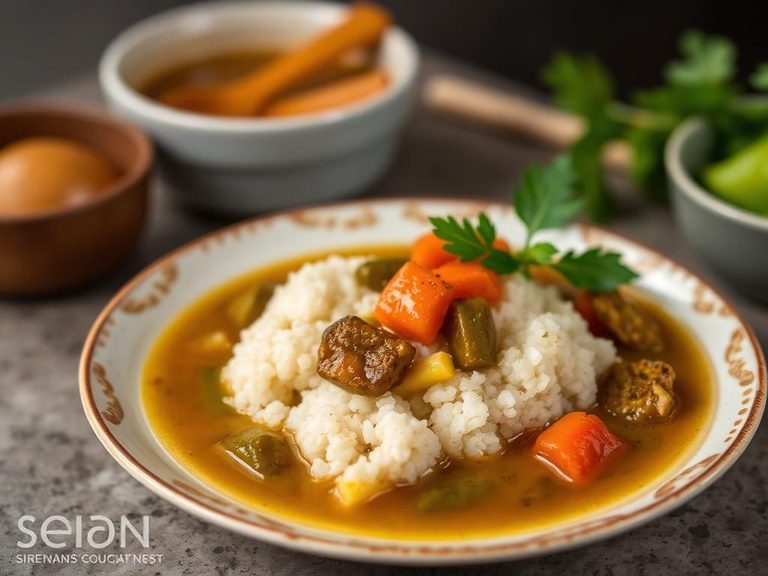
Fufu is a starchy, dough-like staple food made by pounding boiled starchy vegetables like cassava, yams, or plantains until smooth and elastic. It has a neutral, slightly earthy taste with a uniquely stretchy, chewy, and smooth texture that is perfect for scooping up soups and stews. Nutritionally, it is a dense source of energy-providing carbohydrates with very little fat or protein.
Calorie split: 4% protein · 80% carbs · 16% fat
↓ Full nutrition💚 Why it's loved
People love fufu for its satisfying, chewy texture that acts as the perfect edible utensil for savoring flavorful soups. It is deeply cherished as a cultural cornerstone in West and Central African cuisines, representing home, tradition, and communal dining.
⚠️ Watch-outs & how to enjoy it better
Fufu is very high in carbohydrates and low in protein and fat, which can lead to rapid blood sugar spikes if eaten alone. To counteract this, it is traditionally paired with nutrient-dense, protein-rich soups like groundnut soup, palm nut soup, or light soup with fish or meat, which slow down digestion. Those watching their carbohydrate intake should practice portion control.
Key benefits
- Excellent source of quick energy from complex carbohydrates
- Gluten-free staple, suitable for those with celiac disease or gluten sensitivity
- Provides dietary fiber which aids digestion
- Low in fat and sugar, making it a light base for rich stews
- Culturally significant, fostering community through shared meals
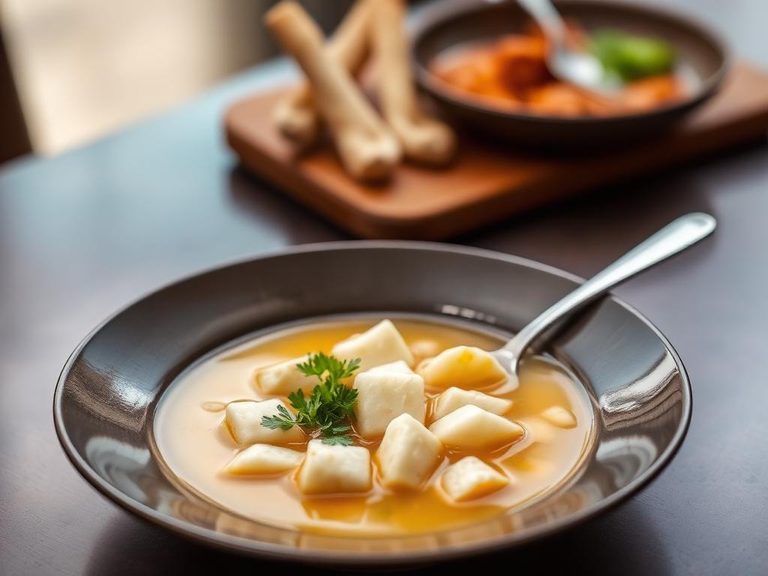
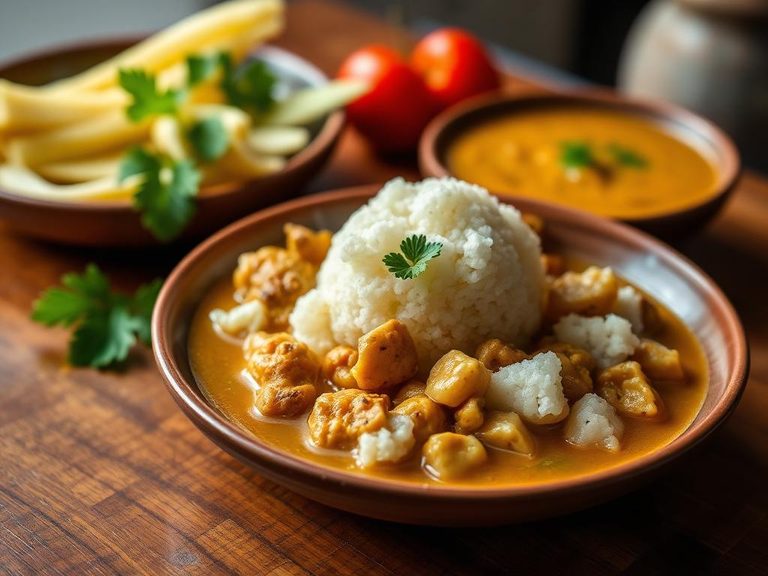
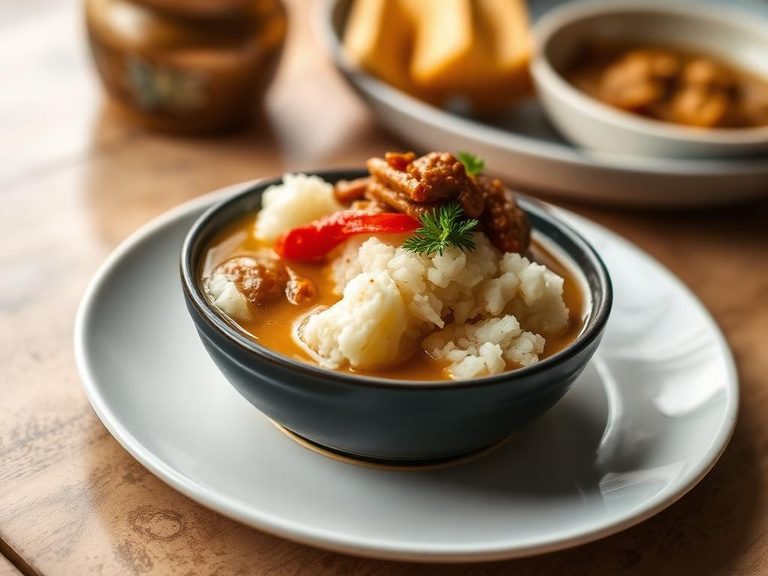
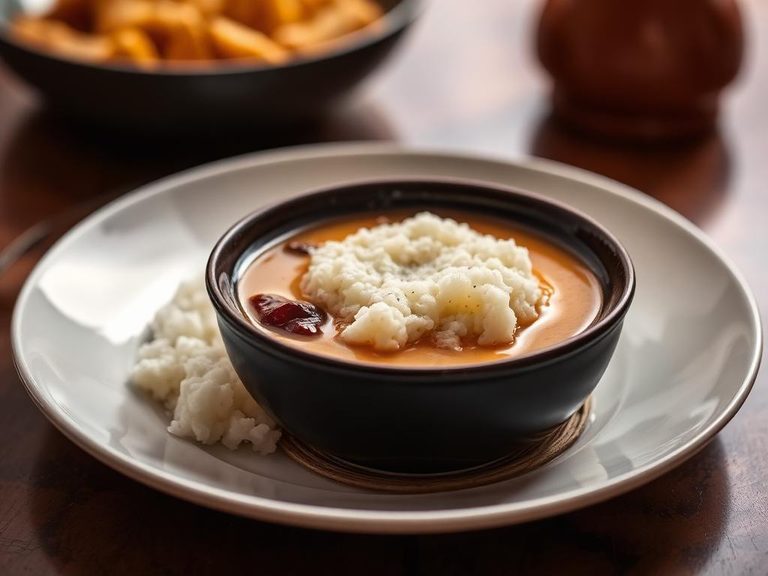
🍽️ Popular dishes
🌍 Where it's eaten
💡 Did you know?
The traditional method of making fufu involves a rhythmic pounding in a large mortar and pestle, often accompanied by a call-and-response song between the pounder and the person adding water.
Full nutrition (USDA data · scales with serving)
| Water | 60.6 g |
| Energy | 166 kcal |
| Protein | 1.5 g |
| Total lipid (fat) | 3.0 g |
| Carbohydrate, by difference | 33.6 g |
| Fiber, total dietary | 3.1 g |
| Total Sugars | 1.1 g |
| Calcium, Ca | 31.0 mg |
| Iron, Fe | 0.43 mg |
| Magnesium, Mg | 28.0 mg |
| Phosphorus, P | 58.0 mg |
| Potassium, K | 449 mg |
| Sodium, Na | 143 mg |
| Zinc, Zn | 0.30 mg |
| Copper, Cu | 0.14 mg |
| Selenium, Se | 0.70 ug |
| Vitamin C, total ascorbic acid | 11.1 mg |
| Thiamin | 0.09 mg |
| Riboflavin | 0.04 mg |
| Niacin | 0.72 mg |
| Vitamin B-6 | 0.19 mg |
| Folate, total | 22.0 ug |
| Folic acid | 0.00 ug |
| Folate, food | 22.0 ug |
| Folate, DFE | 22.0 ug |
| Choline, total | 21.6 mg |
| Vitamin B-12 | 0.00 ug |
| Vitamin B-12, added | 0.00 ug |
| Vitamin A, RAE | 15.0 ug |
| Retinol | 12.0 ug |
| Carotene, beta | 27.0 ug |
| Carotene, alpha | 0.00 ug |
| Cryptoxanthin, beta | 10.0 ug |
| Lycopene | 0.00 ug |
| Lutein + zeaxanthin | 0.00 ug |
| Vitamin E (alpha-tocopherol) | 1.8 mg |
| Vitamin E, added | 0.00 mg |
| Vitamin D (D2 + D3) | 0.00 ug |
| Vitamin K (phylloquinone) | 3.8 ug |
| Alcohol, ethyl | 0.00 g |
| Caffeine | 0.00 mg |
| Theobromine | 0.00 mg |
Fat & fatty acid profile (per 100g)
| Fatty acids, total saturated | 0.78 g |
| SFA 4:0 | 0.02 g |
| SFA 6:0 | 0.01 g |
| SFA 8:0 | 0.01 g |
| SFA 10:0 | 0.02 g |
| SFA 12:0 | 0.02 g |
| SFA 14:0 | 0.07 g |
| SFA 16:0 | 0.45 g |
| SFA 18:0 | 0.15 g |
| Fatty acids, total monounsaturated | 1.0 g |
| MUFA 16:1 | 0.01 g |
| MUFA 18:1 | 0.98 g |
| MUFA 20:1 | 0.01 g |
| MUFA 22:1 | 0.00 g |
| Fatty acids, total polyunsaturated | 0.85 g |
| PUFA 18:2 | 0.74 g |
| PUFA 18:3 | 0.11 g |
| PUFA 18:4 | 0.00 g |
| PUFA 20:4 | 0.00 g |
| PUFA 20:5 n-3 (EPA) | 0.00 g |
| PUFA 22:5 n-3 (DPA) | 0.00 g |
| PUFA 22:6 n-3 (DHA) | 0.00 g |
| Cholesterol | 2.0 mg |
FAQ
What is fufu made from?
Fufu is most traditionally made by pounding boiled cassava (yuca) and green plantains together. Variations can use yams, cocoyams, or even semolina flour.
How do you eat fufu?
You tear off a small piece with your right hand, roll it into a ball, make an indentation with your thumb, and use it to scoop up soup and meat or fish before eating it.
What does fufu taste like?
Fufu itself has a very mild, neutral, and slightly starchy flavor. Its primary appeal is its unique smooth, elastic, and chewy texture, which is designed to complement and carry the bold flavors of the accompanying soup.
Nutrient density (calculated · NRF9.3)
Nutrient Rich Foods index: beneficial nutrients (protein, fiber, vitamins, minerals) minus saturated fat, added sugar & sodium, per 100 kcal.
NRF9.3 index — Fulgoni, Keast & Drewnowski, 2009. Computed from USDA nutrients.
Weight-loss friendliness (composite index)
Energy density 1.66 kcal/g · 4% calories from protein · 3.1 g fiber · 1.1 g sugar per 100 g.
Composite of energy density (Rolls et al., 1999), protein & fiber satiety, minus sugar. A calculated heuristic — ranks satiety-per-calorie, not a clinical measure.
Dietary load (calculated from USDA values)
Potential renal acid load. Positive = acid-forming, negative = alkaline-forming.
Sodium-to-potassium ratio: 0.32 (lower is better — aim for ≤ 1)
Sodium:potassium per WHO potassium guidance. Computed from USDA nutrients.