

Fruit salad, (pineapple and papaya and banana and guava), tropical, canned, heavy syrup, solids and liquids
Whole food · Fruits and Fruit Juices

Photo: Wikipedia
This is a vibrant, ready-to-eat medley of tropical fruits—pineapple, papaya, banana, and guava—preserved in a sweet, heavy syrup. The texture is a delightful mix of soft, yielding papaya and banana with the firmer, fibrous bite of pineapple and guava. Nutritionally, it's a quick source of carbohydrates for energy, though the syrup adds significant calories without much protein or fat.
Calorie split: 2% protein · 97% carbs · 1% fat
↓ Full nutrition💚 Why it's loved
People love it for its instantly accessible, sunny burst of tropical flavors and the nostalgic comfort of a sweet, chilled dessert. It's a versatile staple that can be enjoyed straight from the can, as a topping, or as a base for countless recipes.
⚠️ Watch-outs & how to enjoy it better
The heavy syrup content can lead to rapid blood sugar spikes, making it a poor choice for those monitoring glucose levels. To mitigate this, drain the syrup and rinse the fruit lightly, or pair a small portion with a source of protein or fat like Greek yogurt or nuts to slow sugar absorption.
Key benefits
- Provides quick energy from natural and added sugars.
- Contains dietary fiber from the mixed fruit pieces.
- Offers a convenient way to consume multiple fruit types.
- Low in fat and contains no cholesterol.
- Source of vitamin C from the guava and pineapple.
🍽️ Popular dishes
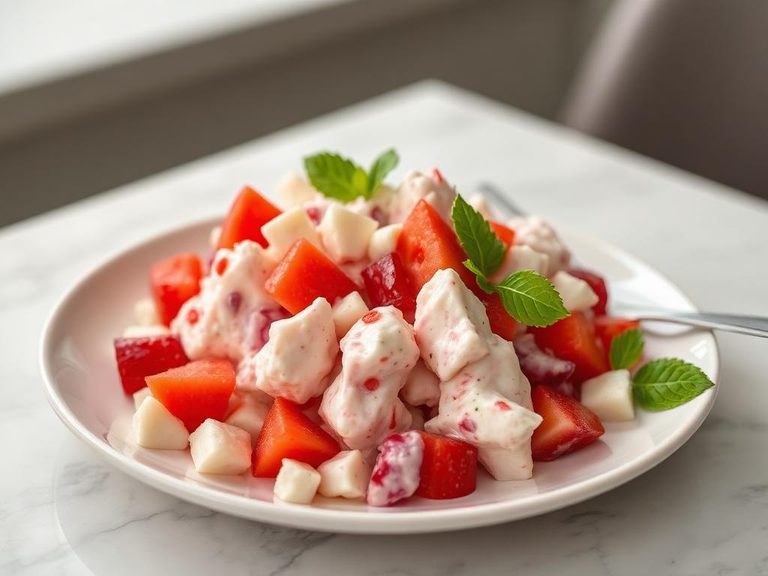
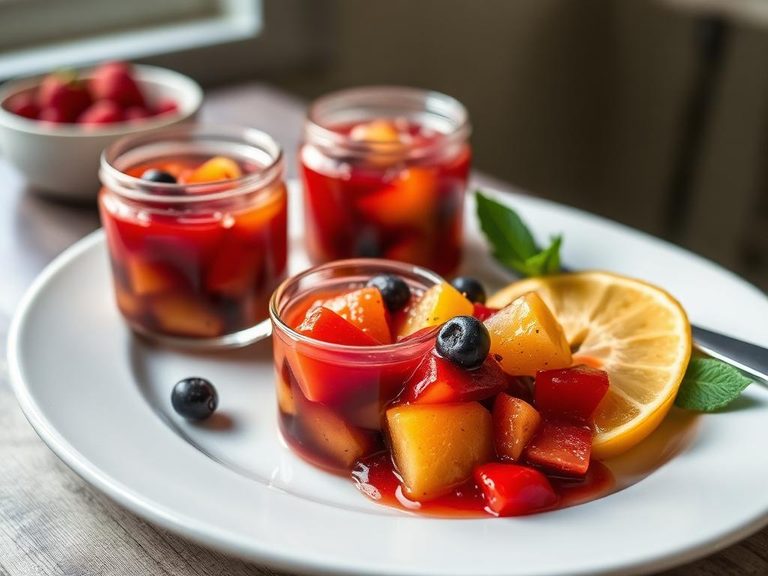
🌍 Where it's eaten
💡 Did you know?
The practice of canning fruit in heavy syrup became a global phenomenon after World War II, as it provided a shelf-stable, sweet treat for soldiers and later, a symbol of modern convenience in home kitchens.
Full nutrition (USDA data · scales with serving)
| Water | 76.8 g |
| Energy | 86.0 kcal |
| Energy | 360 kj |
| Protein | 0.41 g |
| Total lipid (fat) | 0.10 g |
| Ash | 0.35 g |
| Carbohydrate, by difference | 22.4 g |
| Fiber, total dietary | 1.3 g |
| Calcium, Ca | 13.0 mg |
| Iron, Fe | 0.52 mg |
| Magnesium, Mg | 13.0 mg |
| Phosphorus, P | 7.0 mg |
| Potassium, K | 131 mg |
| Sodium, Na | 2.0 mg |
| Zinc, Zn | 0.11 mg |
| Copper, Cu | 0.08 mg |
| Selenium, Se | 0.50 ug |
| Vitamin C, total ascorbic acid | 17.5 mg |
| Thiamin | 0.05 mg |
| Riboflavin | 0.04 mg |
| Niacin | 0.56 mg |
| Vitamin B-6 | 0.12 mg |
| Folate, total | 9.0 ug |
| Folic acid | 0.00 ug |
| Folate, food | 9.0 ug |
| Folate, DFE | 9.0 ug |
| Vitamin B-12 | 0.00 ug |
| Vitamin A, RAE | 6.0 ug |
| Retinol | 0.00 ug |
| Vitamin A, IU | 127 iu |
| Vitamin D (D2 + D3), International Units | 0.00 iu |
| Vitamin D (D2 + D3) | 0.00 ug |
| Alcohol, ethyl | 0.00 g |
Fat & fatty acid profile (per 100g)
| Fatty acids, total saturated | 0.02 g |
| SFA 4:0 | 0.00 g |
| SFA 6:0 | 0.00 g |
| SFA 8:0 | 0.00 g |
| SFA 10:0 | 0.00 g |
| SFA 12:0 | 0.00 g |
| SFA 14:0 | 0.00 g |
| SFA 16:0 | 0.01 g |
| SFA 18:0 | 0.00 g |
| Fatty acids, total monounsaturated | 0.02 g |
| MUFA 16:1 | 0.00 g |
| MUFA 18:1 | 0.01 g |
| MUFA 20:1 | 0.00 g |
| MUFA 22:1 | 0.00 g |
| Fatty acids, total polyunsaturated | 0.03 g |
| PUFA 18:2 | 0.02 g |
| PUFA 18:3 | 0.01 g |
| PUFA 18:4 | 0.00 g |
| PUFA 20:4 | 0.00 g |
| PUFA 20:5 n-3 (EPA) | 0.00 g |
| PUFA 22:5 n-3 (DPA) | 0.00 g |
| PUFA 22:6 n-3 (DHA) | 0.00 g |
| Fatty acids, total trans | 0.00 g |
| Cholesterol | 0.00 mg |
FAQ
Is canned fruit salad as nutritious as fresh?
While it retains some vitamins and fiber, the canning process and heavy syrup add significant sugar and calories compared to fresh fruit. Draining the syrup can reduce the sugar content.
Can I use the syrup for anything?
Yes, the heavy syrup can be reduced on the stove to make a simple fruit-flavored sauce for pancakes, ice cream, or to sweeten beverages. Be mindful of its high sugar content.
How long does an opened can last in the fridge?
Once opened, transfer the fruit and syrup to a sealed container and consume within 3-4 days for best quality and safety.
Nutrient density (calculated · NRF9.3)
Nutrient Rich Foods index: beneficial nutrients (protein, fiber, vitamins, minerals) minus saturated fat, added sugar & sodium, per 100 kcal.
NRF9.3 index — Fulgoni, Keast & Drewnowski, 2009. Computed from USDA nutrients.
Weight-loss friendliness (composite index)
Energy density 0.86 kcal/g · 2% calories from protein · 1.3 g fiber · 0.0 g sugar per 100 g.
Composite of energy density (Rolls et al., 1999), protein & fiber satiety, minus sugar. A calculated heuristic — ranks satiety-per-calorie, not a clinical measure.
Dietary load (calculated from USDA values)
Potential renal acid load. Positive = acid-forming, negative = alkaline-forming.
Sodium-to-potassium ratio: 0.02 (lower is better — aim for ≤ 1)
Sodium:potassium per WHO potassium guidance. Computed from USDA nutrients.