

Baklava
Common food

Photo: Wikipedia
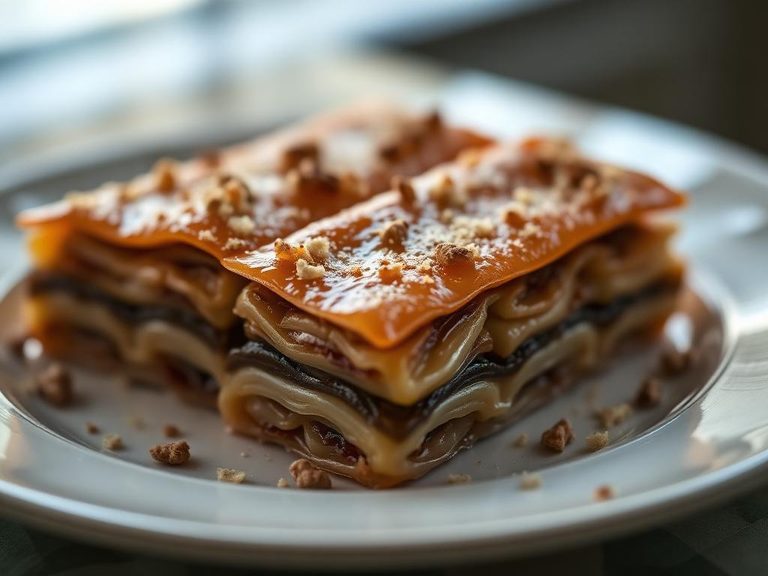
Baklava is a rich, sweet pastry made of layers of thin, crispy phyllo dough, generously filled with chopped nuts, and held together with a sticky honey or sugar syrup. Its texture is a delightful contrast between the shattering, buttery crispness of the pastry and the dense, nutty interior, all soaked in a fragrant, sweet glaze. Nutritionally, it is an energy-dense treat, with a high fat content from nuts and butter, and a significant portion of its carbohydrates coming from added sugars.
Calorie split: 6% protein · 34% carbs · 60% fat
↓ Full nutrition💚 Why it's loved
People love baklava for its intoxicating combination of textures—the flaky, buttery layers giving way to a crunchy, nutty core—and its intense, floral sweetness from honey or syrup. It is a deeply symbolic dessert in many cultures, often associated with hospitality, festivals, and family gatherings, making it a cherished treat for special occasions.
⚠️ Watch-outs & how to enjoy it better
Due to its high sugar and fat content, baklava can cause a rapid spike in blood sugar levels and is very calorie-dense, making it a concern for those managing diabetes or watching their weight. The primary allergens are tree nuts (like pistachios, walnuts, or almonds) and gluten from the wheat-based phyllo dough. To enjoy it more mindfully, practice strict portion control (a small piece is enough), pair it with a source of protein or fat (like Greek yogurt) to slow sugar absorption, and consider homemade versions where you can control the syrup amount and use nuts you tolerate.
Key benefits
- Provides a quick, concentrated source of energy from carbohydrates and fats.
- Nuts in the filling offer plant-based protein, healthy fats, and minerals like magnesium.
- Contains dietary fiber from nuts and whole phyllo layers, aiding in digestion.
- Often includes spices like cinnamon or cloves, which have antioxidant properties.
- A traditional celebratory food that can contribute to cultural and social well-being.
🍽️ Popular dishes
🌍 Where it's eaten
💡 Did you know?
The word 'baklava' is believed to derive from the Mongolian 'baqlava,' meaning 'to pile up' or 'to wrap,' reflecting the pastry's construction of stacked layers.
Full nutrition (USDA data · scales with serving)
| Water | 25.1 g |
| Energy | 440 kcal |
| Protein | 6.6 g |
| Total lipid (fat) | 29.3 g |
| Carbohydrate, by difference | 37.5 g |
| Fiber, total dietary | 2.5 g |
| Total Sugars | 12.8 g |
| Calcium, Ca | 40.0 mg |
| Iron, Fe | 2.0 mg |
| Magnesium, Mg | 38.0 mg |
| Phosphorus, P | 116 mg |
| Potassium, K | 170 mg |
| Sodium, Na | 311 mg |
| Zinc, Zn | 0.70 mg |
| Copper, Cu | 0.25 mg |
| Selenium, Se | 10.9 ug |
| Vitamin C, total ascorbic acid | 1.3 mg |
| Thiamin | 0.24 mg |
| Riboflavin | 0.22 mg |
| Niacin | 1.9 mg |
| Vitamin B-6 | 0.12 mg |
| Folate, total | 36.0 ug |
| Folic acid | 20.0 ug |
| Folate, food | 16.0 ug |
| Folate, DFE | 50.0 ug |
| Choline, total | 16.5 mg |
| Vitamin B-12 | 0.00 ug |
| Vitamin B-12, added | 0.00 ug |
| Vitamin A, RAE | 157 ug |
| Retinol | 153 ug |
| Carotene, beta | 45.0 ug |
| Carotene, alpha | 0.00 ug |
| Cryptoxanthin, beta | 2.0 ug |
| Lycopene | 0.00 ug |
| Lutein + zeaxanthin | 71.0 ug |
| Vitamin E (alpha-tocopherol) | 1.9 mg |
| Vitamin E, added | 0.00 mg |
| Vitamin D (D2 + D3) | 0.10 ug |
| Vitamin K (phylloquinone) | 3.4 ug |
| Alcohol, ethyl | 0.00 g |
| Caffeine | 0.00 mg |
| Theobromine | 0.00 mg |
Fat & fatty acid profile (per 100g)
| Fatty acids, total saturated | 10.9 g |
| SFA 4:0 | 0.42 g |
| SFA 6:0 | 0.30 g |
| SFA 8:0 | 0.17 g |
| SFA 10:0 | 0.40 g |
| SFA 12:0 | 0.45 g |
| SFA 14:0 | 1.5 g |
| SFA 16:0 | 5.4 g |
| SFA 18:0 | 2.0 g |
| Fatty acids, total monounsaturated | 8.8 g |
| MUFA 16:1 | 0.25 g |
| MUFA 18:1 | 8.3 g |
| MUFA 20:1 | 0.04 g |
| MUFA 22:1 | 0.00 g |
| Fatty acids, total polyunsaturated | 5.1 g |
| PUFA 18:2 | 4.5 g |
| PUFA 18:3 | 0.60 g |
| PUFA 18:4 | 0.00 g |
| PUFA 20:4 | 0.02 g |
| PUFA 20:5 n-3 (EPA) | 0.01 g |
| PUFA 22:5 n-3 (DPA) | 0.01 g |
| PUFA 22:6 n-3 (DHA) | 0.00 g |
| Cholesterol | 48.0 mg |
FAQ
What is the difference between Greek and Turkish baklava?
While both are delicious, Greek versions often use honey in the syrup and feature walnuts or almonds, while Turkish baklava frequently uses a sugar-based syrup and is famous for its pistachio-filled Gaziantep style. The phyllo layering technique can also differ slightly.
Why is my homemade baklava soggy instead of crispy?
The key is to pour the cooled syrup over the hot, freshly baked baklava. This allows the pastry to absorb the syrup without becoming waterlogged. Also, ensure your butter is clarified and you're using enough to separate the phyllo layers.
Can baklava be made vegan?
Yes. The butter can be substituted with a high-quality vegan butter or refined coconut oil, and the honey in the syrup can be replaced with a simple sugar syrup flavored with lemon juice, orange blossom water, or rose water.
Nutrient density (calculated · NRF9.3)
Nutrient Rich Foods index: beneficial nutrients (protein, fiber, vitamins, minerals) minus saturated fat, added sugar & sodium, per 100 kcal.
NRF9.3 index — Fulgoni, Keast & Drewnowski, 2009. Computed from USDA nutrients.
Weight-loss friendliness (composite index)
Energy density 4.40 kcal/g · 6% calories from protein · 2.5 g fiber · 12.8 g sugar per 100 g.
Composite of energy density (Rolls et al., 1999), protein & fiber satiety, minus sugar. A calculated heuristic — ranks satiety-per-calorie, not a clinical measure.
Dietary load (calculated from USDA values)
Potential renal acid load. Positive = acid-forming, negative = alkaline-forming.
Sodium-to-potassium ratio: 1.83 (lower is better — aim for ≤ 1)
Sodium:potassium per WHO potassium guidance. Computed from USDA nutrients.