

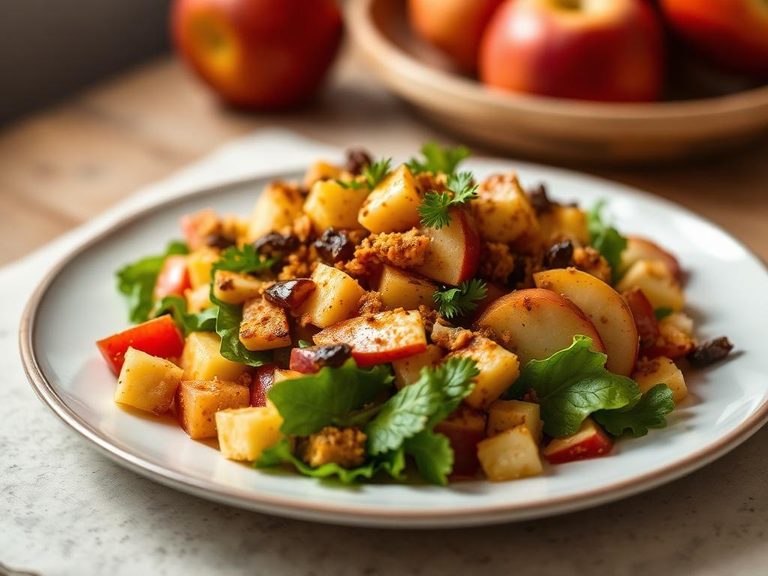
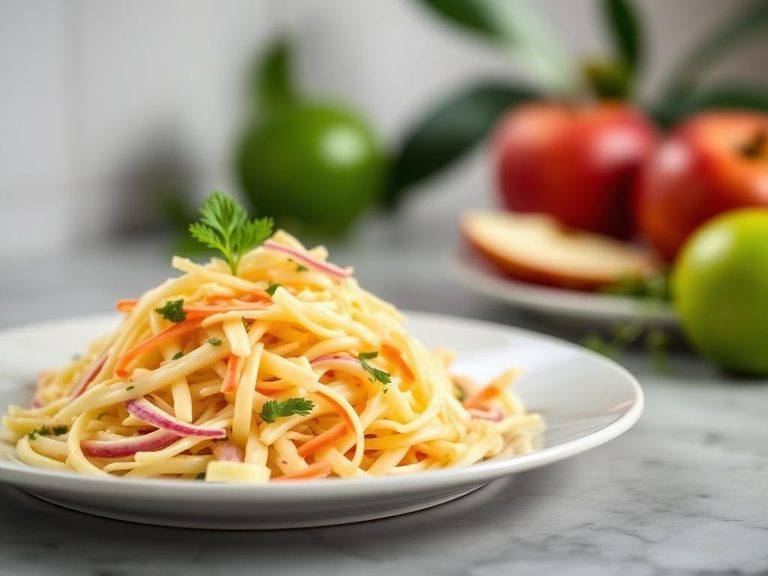
Apple salad with dressing
Common food
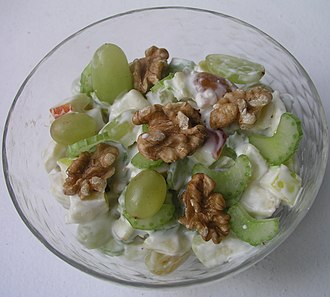
Photo: Wikipedia
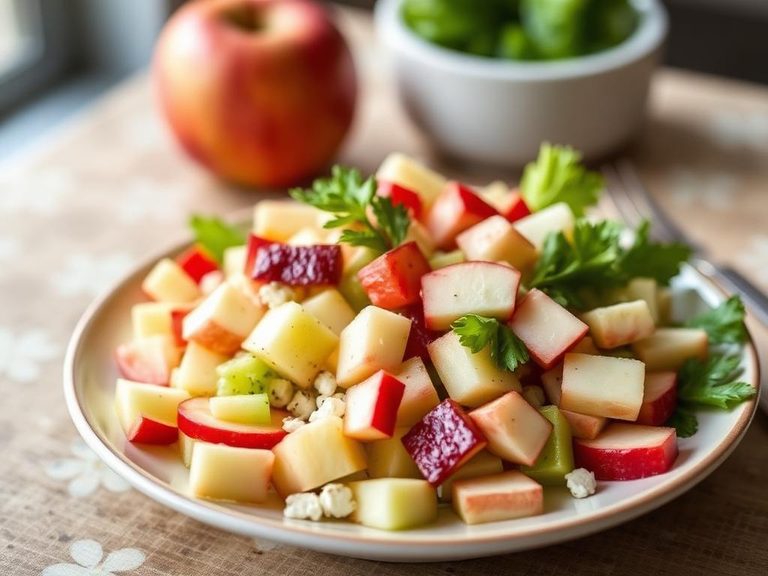
This is a crisp, refreshing salad where tender-crisp apple slices are tossed in a creamy, often tangy dressing. The contrast between the sweet, juicy fruit and the rich, savory coating creates a satisfying bite. While the apples provide fiber and vitamins, the dressing contributes the majority of the calories and fat.
Calorie split: 3% protein · 27% carbs · 70% fat
↓ Full nutrition💚 Why it's loved
People adore the harmonious clash of textures—crunchy fruit against smooth dressing—and the way it bridges the gap between a light snack and a satisfying side dish. Its versatility makes it a staple at potlucks, deli counters, and family dinners, easily customized with nuts, cheese, or different herbs.
⚠️ Watch-outs & how to enjoy it better
The primary concern is the high fat and sugar content from many commercial or creamy dressings, which can turn a healthy fruit into a calorie-dense dish. Those monitoring blood sugar should be mindful of the added sugars in the dressing, and individuals with nut allergies must check for common mix-ins like walnuts. To counteract this, opt for a dressing made with plain Greek yogurt or a vinaigrette, practice portion control, and pair the salad with a protein source like grilled chicken or cheese to slow sugar absorption.
Key benefits
- Provides dietary fiber from apple skin and flesh
- Source of vitamin C and potassium from apples
- Quick source of energy from natural sugars
- Can be a vehicle for healthy fats if using a yogurt or olive oil-based dressing
- Offers a satisfying mix of sweet, savory, and creamy textures
🍽️ Popular dishes
🌍 Where it's eaten
💡 Did you know?
The iconic Waldorf Salad, a famous apple salad, was first created in 1893 at the Waldorf-Astoria Hotel in New York City and originally contained only apples, celery, and mayonnaise—nuts and grapes were added later.
Full nutrition (USDA data · scales with serving)
| Water | 71.5 g |
| Energy | 180 kcal |
| Protein | 1.4 g |
| Total lipid (fat) | 14.2 g |
| Carbohydrate, by difference | 12.2 g |
| Fiber, total dietary | 2.0 g |
| Total Sugars | 9.1 g |
| Calcium, Ca | 15.0 mg |
| Iron, Fe | 0.28 mg |
| Magnesium, Mg | 15.0 mg |
| Phosphorus, P | 39.0 mg |
| Potassium, K | 148 mg |
| Sodium, Na | 87.0 mg |
| Zinc, Zn | 0.24 mg |
| Copper, Cu | 0.11 mg |
| Selenium, Se | 0.60 ug |
| Vitamin C, total ascorbic acid | 3.4 mg |
| Thiamin | 0.04 mg |
| Riboflavin | 0.04 mg |
| Niacin | 0.19 mg |
| Vitamin B-6 | 0.09 mg |
| Folate, total | 12.0 ug |
| Folic acid | 0.00 ug |
| Folate, food | 12.0 ug |
| Folate, DFE | 12.0 ug |
| Choline, total | 10.2 mg |
| Vitamin B-12 | 0.02 ug |
| Vitamin B-12, added | 0.00 ug |
| Vitamin A, RAE | 6.0 ug |
| Retinol | 2.0 ug |
| Carotene, beta | 42.0 ug |
| Carotene, alpha | 0.00 ug |
| Cryptoxanthin, beta | 7.0 ug |
| Lycopene | 0.00 ug |
| Lutein + zeaxanthin | 50.0 ug |
| Vitamin E (alpha-tocopherol) | 0.61 mg |
| Vitamin E, added | 0.00 mg |
| Vitamin D (D2 + D3) | 0.00 ug |
| Vitamin K (phylloquinone) | 26.2 ug |
| Alcohol, ethyl | 0.00 g |
| Caffeine | 0.00 mg |
| Theobromine | 0.00 mg |
Fat & fatty acid profile (per 100g)
| Fatty acids, total saturated | 1.9 g |
| SFA 4:0 | 0.00 g |
| SFA 6:0 | 0.00 g |
| SFA 8:0 | 0.00 g |
| SFA 10:0 | 0.00 g |
| SFA 12:0 | 0.00 g |
| SFA 14:0 | 0.01 g |
| SFA 16:0 | 1.3 g |
| SFA 18:0 | 0.50 g |
| Fatty acids, total monounsaturated | 2.8 g |
| MUFA 16:1 | 0.01 g |
| MUFA 18:1 | 2.7 g |
| MUFA 20:1 | 0.04 g |
| MUFA 22:1 | 0.00 g |
| Fatty acids, total polyunsaturated | 9.0 g |
| PUFA 18:2 | 7.5 g |
| PUFA 18:3 | 1.3 g |
| PUFA 18:4 | 0.00 g |
| PUFA 20:4 | 0.01 g |
| PUFA 20:5 n-3 (EPA) | 0.00 g |
| PUFA 22:5 n-3 (DPA) | 0.00 g |
| PUFA 22:6 n-3 (DHA) | 0.00 g |
| Cholesterol | 5.0 mg |
FAQ
Can I make an apple salad with dressing healthier?
Absolutely. Swap creamy dressings for a light vinaigrette made with apple cider vinegar and a touch of olive oil, or use plain Greek yogurt as a base. Adding protein like nuts, seeds, or chicken also makes it more balanced.
Why do the apples turn brown in my salad?
Apples oxidize when cut, causing browning. Toss the slices immediately in a dressing containing lemon juice, lime juice, or apple cider vinegar to slow this process.
What are the best apple varieties for this salad?
Choose crisp, tart-sweet apples that hold their shape well, such as Honeycrisp, Granny Smith, Pink Lady, or Fuji. Avoid mealy or overly soft varieties.
Nutrient density (calculated · NRF9.3)
Nutrient Rich Foods index: beneficial nutrients (protein, fiber, vitamins, minerals) minus saturated fat, added sugar & sodium, per 100 kcal.
NRF9.3 index — Fulgoni, Keast & Drewnowski, 2009. Computed from USDA nutrients.
Weight-loss friendliness (composite index)
Energy density 1.80 kcal/g · 3% calories from protein · 2.0 g fiber · 9.1 g sugar per 100 g.
Composite of energy density (Rolls et al., 1999), protein & fiber satiety, minus sugar. A calculated heuristic — ranks satiety-per-calorie, not a clinical measure.
Dietary load (calculated from USDA values)
Potential renal acid load. Positive = acid-forming, negative = alkaline-forming.
Sodium-to-potassium ratio: 0.59 (lower is better — aim for ≤ 1)
Sodium:potassium per WHO potassium guidance. Computed from USDA nutrients.