Crackers, melba toast, wheat
Whole food · Baked Products

Photo: Wikipedia
Melba toast is a crisp, dry, twice-baked bread sliced thin and toasted to a deep golden brown, offering a satisfying, shattering crunch. Its flavor is mild, nutty, and slightly wheaty, serving as a neutral canvas for toppings. Nutritionally, it's a high-carb, low-fat staple that provides a notable amount of fiber and plant-based protein per serving.
💚 Why it's loved
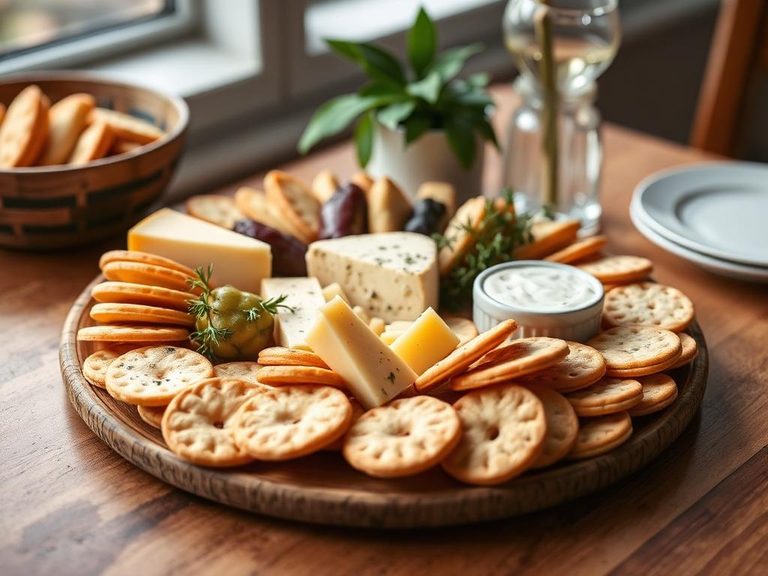
People love it for its reliable, sturdy crunch that doesn't get soggy quickly, making it the perfect vehicle for dips, pâtés, and cheeses. Its mild flavor and satisfying texture have made it a classic, versatile staple in pantries and on appetizer platters worldwide.
⚠️ Watch-outs & how to enjoy it better
Its dry, crisp nature can be a choking hazard if eaten too quickly without moisture. As a refined wheat product, it can cause faster blood-sugar spikes compared to whole-grain alternatives. To counteract this, always pair it with protein (like hummus or cheese) or healthy fats (like avocado or olive tapenade) to slow digestion, and practice portion control.
Key benefits
- High in complex carbohydrates for sustained energy.
- Good source of dietary fiber (7.4g/100g) for digestive health.
- Provides plant-based protein (12.9g/100g).
- Very low in fat and contains no sugar.
- Long shelf life due to the double-baking process.
🍽️ Popular dishes

🌍 Where it's eaten
💡 Did you know?
The toast was created in the 1890s by chef Auguste Escoffier for the famous Australian soprano Nellie Melba, to help soothe her sore throat during an illness.
Full nutrition (scales with serving)
| Water | 5.5 g |
| Energy | 374 kcal |
| Energy | 1565 kj |
| Protein | 12.9 g |
| Total lipid (fat) | 2.3 g |
| Ash | 2.9 g |
| Carbohydrate, by difference | 76.4 g |
| Fiber, total dietary | 7.4 g |
| Calcium, Ca | 43.0 mg |
| Iron, Fe | 4.5 mg |
| Magnesium, Mg | 56.0 mg |
| Phosphorus, P | 165 mg |
| Potassium, K | 148 mg |
| Sodium, Na | 837 mg |
| Zinc, Zn | 1.5 mg |
| Copper, Cu | 0.27 mg |
| Manganese, Mn | 1.1 mg |
| Selenium, Se | 55.0 ug |
| Vitamin C, total ascorbic acid | 0.00 mg |
| Thiamin | 0.42 mg |
| Riboflavin | 0.30 mg |
| Niacin | 5.1 mg |
| Pantothenic acid | 0.52 mg |
| Vitamin B-6 | 0.10 mg |
| Folate, total | 132 ug |
| Folic acid | 108 ug |
| Folate, food | 24.0 ug |
| Folate, DFE | 208 ug |
| Vitamin B-12 | 0.00 ug |
| Vitamin A, RAE | 0.00 ug |
| Retinol | 0.00 ug |
| Vitamin A, IU | 0.00 iu |
Fat & fatty acid profile (per 100g)
| Fatty acids, total saturated | 0.34 g |
| SFA 12:0 | 0.00 g |
| SFA 14:0 | 0.00 g |
| SFA 16:0 | 0.28 g |
| SFA 18:0 | 0.06 g |
| Fatty acids, total monounsaturated | 0.54 g |
| MUFA 16:1 | 0.02 g |
| MUFA 18:1 | 0.53 g |
| Fatty acids, total polyunsaturated | 0.91 g |
| PUFA 18:2 | 0.86 g |
| PUFA 18:3 | 0.05 g |
| PUFA 20:4 | 0.00 g |
| Cholesterol | 0.00 mg |
Amino acid profile (per 100g)
| Tryptophan | 0.17 g |
| Threonine | 0.37 g |
| Isoleucine | 0.49 g |
| Leucine | 0.88 g |
| Lysine | 0.34 g |
| Methionine | 0.21 g |
| Cystine | 0.28 g |
| Phenylalanine | 0.61 g |
| Tyrosine | 0.37 g |
| Valine | 0.57 g |
| Arginine | 0.53 g |
| Histidine | 0.29 g |
| Alanine | 0.45 g |
| Aspartic acid | 0.63 g |
| Glutamic acid | 4.1 g |
| Glycine | 0.48 g |
| Proline | 1.4 g |
| Serine | 0.61 g |
FAQ
What's the difference between melba toast and regular toast?
Melba toast is sliced thinner, baked twice (first as bread, then as slices), resulting in a much drier, crispier, and sturdier product with a longer shelf life than standard single-baked toast.
Is melba toast gluten-free?
No, traditional wheat melba toast contains gluten. However, gluten-free versions made from rice, corn, or other flours are available in stores.
How should I store it to keep it crisp?
Keep it in a cool, dry place in an airtight container or its original sealed packaging. Exposure to humidity will cause it to lose its signature crunch.