

Infant formula, premature, powder, made with water
Common food

Photo: Wikipedia
This is a specialized, nutrient-dense powder designed to be mixed with water to create a life-sustaining liquid for premature infants. It has a mild, slightly sweet taste and a smooth, thin liquid texture once prepared, with a higher concentration of calories, protein, and fat than standard formula to support rapid growth. Nutritionally, it's engineered to mimic the high-energy composition of breast milk for vulnerable newborns.
Calorie split: 11% protein · 41% carbs · 48% fat
↓ Full nutrition💚 Why it's loved
Parents and medical staff rely on it for its proven ability to help fragile babies gain strength and reach developmental milestones. Its standardized, sterile formulation provides peace of mind and a critical nutritional safety net in the NICU.
⚠️ Watch-outs & how to enjoy it better
It is not suitable for full-term infants or general use, as its nutrient profile is overly concentrated and could strain a healthy baby's kidneys. It should only be used under strict medical guidance, as improper mixing or use can lead to nutritional imbalances or dehydration.
Key benefits
- Provides concentrated calories for accelerated growth
- Contains higher protein for tissue and organ development
- Offers balanced fats for brain and nervous system maturation
- Formulated for easy digestion in underdeveloped systems
- Delivers essential vitamins and minerals for immune support
🍽️ Popular dishes
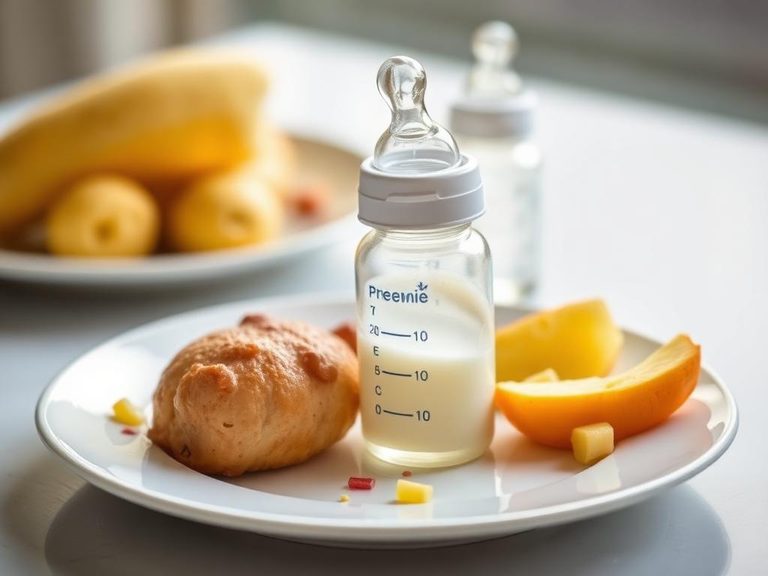

🌍 Where it's eaten
💡 Did you know?
The calorie density of premature formula (71 kcal/100g) is about 25% higher than standard infant formula (approx. 67 kcal/100g), reflecting the immense energy needs of a baby born weeks or months early.
Full nutrition (USDA data · scales with serving)
| Water | 86.5 g |
| Energy | 71.0 kcal |
| Protein | 2.0 g |
| Total lipid (fat) | 3.8 g |
| Carbohydrate, by difference | 7.3 g |
| Fiber, total dietary | 0.00 g |
| Total Sugars | 7.2 g |
| Calcium, Ca | 79.0 mg |
| Iron, Fe | 1.3 mg |
| Magnesium, Mg | 6.0 mg |
| Phosphorus, P | 45.0 mg |
| Potassium, K | 86.0 mg |
| Sodium, Na | 25.0 mg |
| Zinc, Zn | 0.77 mg |
| Copper, Cu | 0.07 mg |
| Selenium, Se | 1.8 ug |
| Vitamin C, total ascorbic acid | 10.9 mg |
| Thiamin | 0.14 mg |
| Riboflavin | 0.12 mg |
| Niacin | 1.0 mg |
| Vitamin B-6 | 0.06 mg |
| Folate, total | 18.0 ug |
| Folic acid | 18.0 ug |
| Folate, food | 0.00 ug |
| Folate, DFE | 30.0 ug |
| Choline, total | 14.2 mg |
| Vitamin B-12 | 0.24 ug |
| Vitamin B-12, added | 0.24 ug |
| Vitamin A, RAE | 96.0 ug |
| Retinol | 96.0 ug |
| Carotene, beta | 0.00 ug |
| Carotene, alpha | 0.00 ug |
| Cryptoxanthin, beta | 0.00 ug |
| Lycopene | 0.00 ug |
| Lutein + zeaxanthin | 0.00 ug |
| Vitamin E (alpha-tocopherol) | 1.2 mg |
| Vitamin E, added | 1.2 mg |
| Vitamin D (D2 + D3) | 1.3 ug |
| Vitamin K (phylloquinone) | 7.0 ug |
| Alcohol, ethyl | 0.00 g |
| Caffeine | 0.00 mg |
| Theobromine | 0.00 mg |
Fat & fatty acid profile (per 100g)
| Fatty acids, total saturated | 2.0 g |
| SFA 4:0 | 0.00 g |
| SFA 6:0 | 0.01 g |
| SFA 8:0 | 0.81 g |
| SFA 10:0 | 0.41 g |
| SFA 12:0 | 0.30 g |
| SFA 14:0 | 0.13 g |
| SFA 16:0 | 0.23 g |
| SFA 18:0 | 0.12 g |
| Fatty acids, total monounsaturated | 0.86 g |
| MUFA 16:1 | 0.00 g |
| MUFA 18:1 | 0.84 g |
| MUFA 20:1 | 0.00 g |
| MUFA 22:1 | 0.00 g |
| Fatty acids, total polyunsaturated | 0.85 g |
| PUFA 18:2 | 0.70 g |
| PUFA 18:3 | 0.07 g |
| PUFA 18:4 | 0.00 g |
| PUFA 20:4 | 0.02 g |
| PUFA 20:5 n-3 (EPA) | 0.00 g |
| PUFA 22:5 n-3 (DPA) | 0.00 g |
| PUFA 22:6 n-3 (DHA) | 0.01 g |
| Cholesterol | 2.0 mg |
FAQ
How is this different from regular baby formula?
It has a higher concentration of calories, protein, fat, and specific nutrients like calcium and phosphorus to meet the intense metabolic demands of a premature baby's growth outside the womb.
Can I use this to make my full-term baby gain weight faster?
No. Using it without medical supervision is dangerous. The nutrient load is too high for a healthy infant's digestive and renal systems, potentially causing serious health issues.
What does the 'made with water' mean?
It indicates the nutritional values are for the final prepared liquid after mixing the powder with water, not for the dry powder alone. The ratio is specified on the product's packaging.
Nutrient density (calculated · NRF9.3)
Nutrient Rich Foods index: beneficial nutrients (protein, fiber, vitamins, minerals) minus saturated fat, added sugar & sodium, per 100 kcal.
NRF9.3 index — Fulgoni, Keast & Drewnowski, 2009. Computed from USDA nutrients.
Weight-loss friendliness (composite index)
Energy density 0.71 kcal/g · 11% calories from protein · 0.0 g fiber · 7.2 g sugar per 100 g.
Composite of energy density (Rolls et al., 1999), protein & fiber satiety, minus sugar. A calculated heuristic — ranks satiety-per-calorie, not a clinical measure.
Dietary load (calculated from USDA values)
Potential renal acid load. Positive = acid-forming, negative = alkaline-forming.
Sodium-to-potassium ratio: 0.29 (lower is better — aim for ≤ 1)
Sodium:potassium per WHO potassium guidance. Computed from USDA nutrients.