

Puddings, rice, dry mix
Whole food · Sweets

Photo: Wikipedia
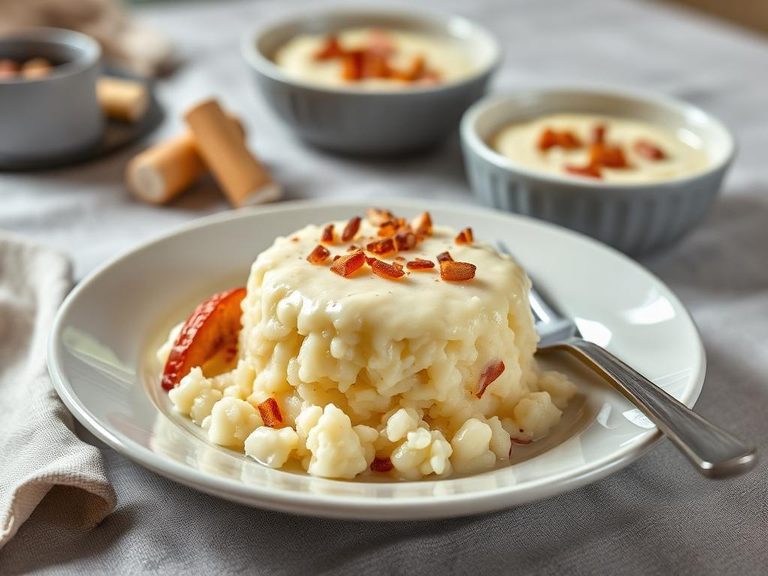
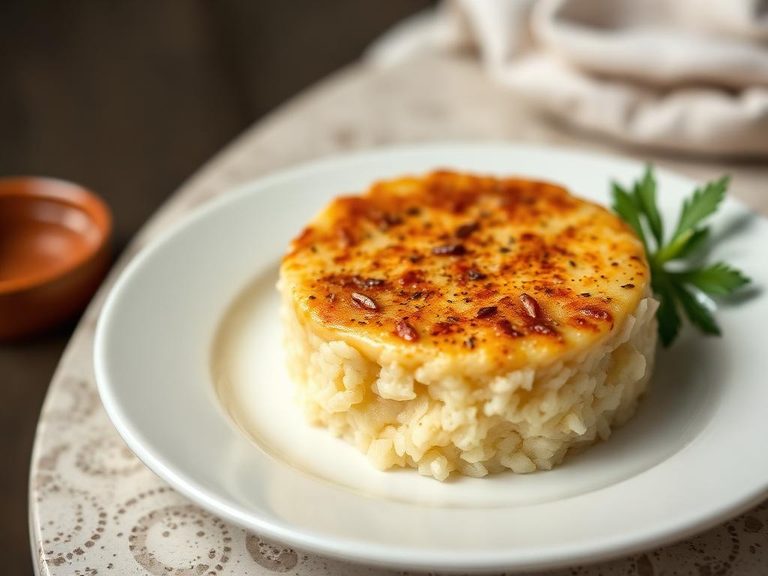
Puddings, rice, dry mix is a shelf-stable, pre-blended powder of rice flour, starches, and flavorings designed to create a classic creamy dessert with minimal effort. When cooked with milk or water, it transforms into a smooth, comforting pudding with a distinct, starchy sweetness. Nutritionally, it is a high-carbohydrate energy source, providing over 91g of carbs per 100g of dry mix.
Calorie split: 3% protein · 97% carbs · 0% fat
↓ Full nutrition💚 Why it's loved
People love it for its nostalgic, comforting simplicity and the creamy, familiar sweetness it delivers with almost no culinary skill required. Its versatility allows for easy customization with spices, fruits, or extracts to suit any palate.
⚠️ Watch-outs & how to enjoy it better
The primary downside is its very high glycemic load, which can cause rapid blood-sugar spikes, making it less suitable for individuals managing diabetes or insulin resistance. To counteract this, pair a modest portion with a source of protein (like nuts or a dollop of Greek yogurt) or healthy fat to slow digestion. Also, check labels for added sodium or artificial flavors.
Key benefits
- Provides quick energy from its high carbohydrate content.
- Extremely low in fat (0.1g per 100g dry mix).
- Long shelf life makes it a convenient pantry staple.
- Simple to prepare with just liquid and heat.
- Offers a consistent, predictable texture and flavor.
🍽️ Popular dishes


🌍 Where it's eaten
💡 Did you know?
The 'rice' in many commercial dry mixes is primarily rice flour and starch, not whole grains, which is why it cooks into such a uniformly smooth pudding without the texture of individual rice kernels.
Full nutrition (USDA data · scales with serving)
| Water | 4.8 g |
| Energy | 376 kcal |
| Energy | 1573 kj |
| Protein | 2.7 g |
| Total lipid (fat) | 0.10 g |
| Ash | 1.1 g |
| Carbohydrate, by difference | 91.2 g |
| Fiber, total dietary | 0.70 g |
| Calcium, Ca | 14.0 mg |
| Iron, Fe | 1.8 mg |
| Magnesium, Mg | 8.0 mg |
| Phosphorus, P | 39.0 mg |
| Potassium, K | 5.0 mg |
| Sodium, Na | 366 mg |
| Zinc, Zn | 0.31 mg |
| Copper, Cu | 0.06 mg |
| Manganese, Mn | 0.30 mg |
| Selenium, Se | 0.50 ug |
| Vitamin C, total ascorbic acid | 0.00 mg |
| Thiamin | 0.25 mg |
| Riboflavin | 0.01 mg |
| Niacin | 2.0 mg |
| Pantothenic acid | 0.11 mg |
| Vitamin B-6 | 0.01 mg |
| Folate, total | 1.0 ug |
| Folic acid | 0.00 ug |
| Folate, food | 1.0 ug |
| Folate, DFE | 1.0 ug |
| Vitamin B-12 | 0.00 ug |
| Vitamin B-12, added | 0.00 ug |
| Vitamin A, RAE | 0.00 ug |
| Retinol | 0.00 ug |
| Vitamin A, IU | 0.00 iu |
Fat & fatty acid profile (per 100g)
| Cholesterol | 0.00 mg |
Amino acid profile (per 100g)
Estimated from Puddings, rice, dry mix, prepared with 2% milk — USDA does not publish this profile for Puddings.
| Tryptophan | 0.04 g |
| Threonine | 0.13 g |
| Isoleucine | 0.17 g |
| Leucine | 0.27 g |
| Lysine | 0.22 g |
| Methionine | 0.07 g |
| Cystine | 0.03 g |
| Phenylalanine | 0.14 g |
| Tyrosine | 0.14 g |
| Valine | 0.19 g |
| Arginine | 0.10 g |
| Histidine | 0.07 g |
| Alanine | 0.10 g |
| Aspartic acid | 0.21 g |
| Glutamic acid | 0.58 g |
| Glycine | 0.06 g |
| Proline | 0.27 g |
| Serine | 0.15 g |
FAQ
Is this the same as making rice pudding from scratch?
No. A dry mix is a pre-made blend of refined rice flour, starches, sugar, and flavorings that cooks quickly into a smooth pudding. Scratch-made rice pudding uses whole rice grains, which require longer cooking and result in a textured, grainy pudding.
Can I use water instead of milk?
Yes, you can use water, but the pudding will be significantly less creamy and rich in flavor and texture. Using milk (dairy or plant-based) is recommended for the best result.
Why is there 0g of sugar listed if it's a sweet pudding?
The nutritional data provided is for the dry mix. The sweetness typically comes from added sugars or sweeteners in the mix, but they may be categorized under 'total carbohydrates' on some labels or the specific data source may not break them out. Always check the ingredients list for sugar, corn syrup, or other sweeteners.
Nutrient density (calculated · NRF9.3)
Nutrient Rich Foods index: beneficial nutrients (protein, fiber, vitamins, minerals) minus saturated fat, added sugar & sodium, per 100 kcal.
NRF9.3 index — Fulgoni, Keast & Drewnowski, 2009. Computed from USDA nutrients.
Weight-loss friendliness (composite index)
Energy density 3.76 kcal/g · 3% calories from protein · 0.7 g fiber · 0.0 g sugar per 100 g.
Composite of energy density (Rolls et al., 1999), protein & fiber satiety, minus sugar. A calculated heuristic — ranks satiety-per-calorie, not a clinical measure.
Dietary load (calculated from USDA values)
Potential renal acid load. Positive = acid-forming, negative = alkaline-forming.
Sodium-to-potassium ratio: 73.20 (lower is better — aim for ≤ 1)
Sodium:potassium per WHO potassium guidance. Computed from USDA nutrients.