

Puddings, lemon, dry mix, regular
Whole food · Sweets
This is a powdered mix designed to create a bright, zesty lemon pudding with a smooth, creamy texture when prepared with milk. It delivers a concentrated burst of citrus flavor and a vibrant yellow color, making it a nostalgic and quick dessert staple. Nutritionally, it is a significant source of carbohydrates, providing quick energy but minimal protein or fat.
Calorie split: 0% protein · 99% carbs · 1% fat
↓ Full nutrition💚 Why it's loved
People love it for its nostalgic, sunny citrus flavor and the comforting, smooth texture of the finished pudding. Its versatility makes it a go-to for quick treats, from a simple bowl to layered parfaits and pie fillings.
⚠️ Watch-outs & how to enjoy it better
As a high-carb, low-nutrient mix, it can cause rapid blood-sugar spikes and offers little satiating protein or fiber. To counteract this, pair a small portion with a source of protein or healthy fat, like a handful of nuts or a dollop of Greek yogurt, to slow digestion and add nutritional balance.
Key benefits
- Quick and convenient dessert preparation
- Provides a rapid source of carbohydrate energy
- Shelf-stable and long-lasting in the pantry
- Offers a consistent, familiar lemon flavor
- Can be used as a component in other no-bake desserts
🍽️ Popular dishes

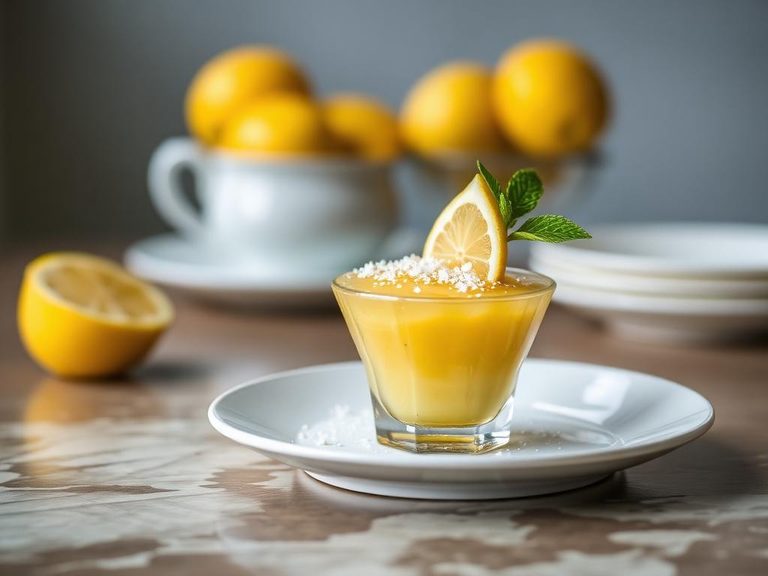

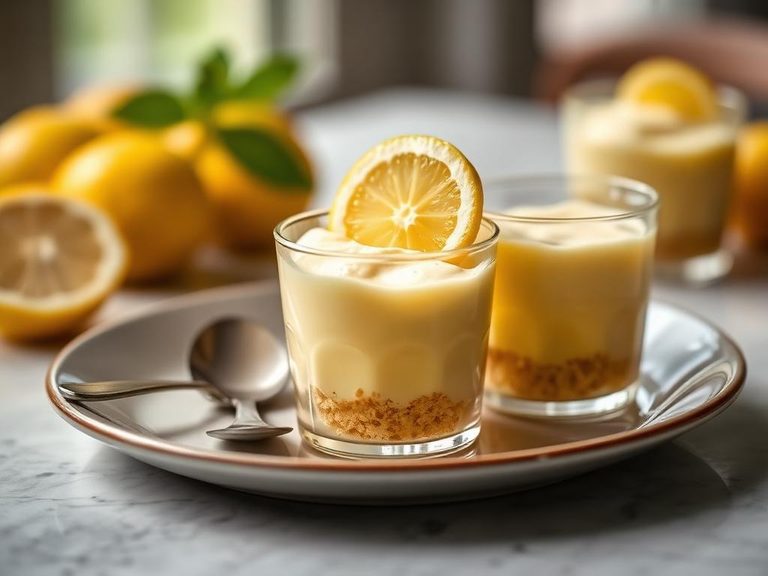

🌍 Where it's eaten
💡 Did you know?
The bright yellow color of lemon pudding mix is almost entirely from artificial food dyes, as the actual lemon content is typically minimal flavoring and citric acid.
Full nutrition (USDA data · scales with serving)
| Water | 5.2 g |
| Energy | 363 kcal |
| Energy | 1519 kj |
| Protein | 0.10 g |
| Total lipid (fat) | 0.50 g |
| Ash | 2.4 g |
| Carbohydrate, by difference | 91.8 g |
| Fiber, total dietary | 0.10 g |
| Calcium, Ca | 5.0 mg |
| Iron, Fe | 0.17 mg |
| Magnesium, Mg | 4.0 mg |
| Phosphorus, P | 3.0 mg |
| Potassium, K | 5.0 mg |
| Sodium, Na | 506 mg |
| Zinc, Zn | 0.02 mg |
| Copper, Cu | 0.02 mg |
| Manganese, Mn | 0.03 mg |
| Selenium, Se | 1.1 ug |
| Vitamin C, total ascorbic acid | 0.00 mg |
| Thiamin | 0.01 mg |
| Riboflavin | 0.02 mg |
| Niacin | 0.02 mg |
| Pantothenic acid | 0.03 mg |
| Vitamin B-6 | 0.01 mg |
| Folate, total | 0.00 ug |
| Folic acid | 0.00 ug |
| Folate, food | 0.00 ug |
| Folate, DFE | 0.00 ug |
| Vitamin B-12 | 0.00 ug |
| Vitamin B-12, added | 0.00 ug |
| Vitamin A, RAE | 0.00 ug |
| Retinol | 0.00 ug |
| Vitamin A, IU | 0.00 iu |
| Caffeine | 0.00 mg |
| Theobromine | 0.00 mg |
Fat & fatty acid profile (per 100g)
| Cholesterol | 0.00 mg |
Amino acid profile (per 100g)
| Tryptophan | 0.00 g |
| Threonine | 0.00 g |
| Isoleucine | 0.00 g |
| Leucine | 0.01 g |
| Lysine | 0.00 g |
| Methionine | 0.00 g |
| Cystine | 0.00 g |
| Phenylalanine | 0.00 g |
| Tyrosine | 0.00 g |
| Valine | 0.00 g |
| Arginine | 0.00 g |
| Histidine | 0.00 g |
| Alanine | 0.00 g |
| Aspartic acid | 0.00 g |
| Glutamic acid | 0.01 g |
| Glycine | 0.00 g |
| Proline | 0.01 g |
| Serine | 0.00 g |
FAQ
Can I use water instead of milk to prepare it?
Yes, but the pudding will be less creamy, thinner, and lack the rich flavor and nutritional benefits (like calcium and protein) that milk provides. The texture will be more gelatinous.
How can I make it taste more like real lemon?
Enhance the flavor by adding freshly grated lemon zest and a small squeeze of real lemon juice to the prepared pudding. This adds authentic citrus oils and brightness.
Is this the same as instant lemon pudding?
Essentially, yes. 'Dry mix, regular' typically refers to the standard instant pudding mix that sets in the refrigerator, as opposed to a 'cook-and-serve' variety that requires heating.
Nutrient density (calculated · NRF9.3)
Nutrient Rich Foods index: beneficial nutrients (protein, fiber, vitamins, minerals) minus saturated fat, added sugar & sodium, per 100 kcal.
NRF9.3 index — Fulgoni, Keast & Drewnowski, 2009. Computed from USDA nutrients.
Weight-loss friendliness (composite index)
Energy density 3.63 kcal/g · 0% calories from protein · 0.1 g fiber · 0.0 g sugar per 100 g.
Composite of energy density (Rolls et al., 1999), protein & fiber satiety, minus sugar. A calculated heuristic — ranks satiety-per-calorie, not a clinical measure.
Dietary load (calculated from USDA values)
Potential renal acid load. Positive = acid-forming, negative = alkaline-forming.
Sodium-to-potassium ratio: 101.20 (lower is better — aim for ≤ 1)
Sodium:potassium per WHO potassium guidance. Computed from USDA nutrients.