Chewing gum
Common food
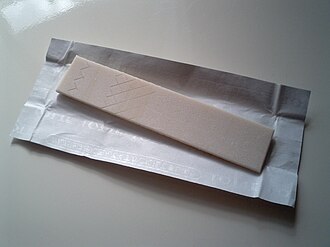
Photo: Wikipedia
Chewing gum is a soft, rubbery confection designed for chewing without swallowing, often delivering a burst of sweet or minty flavor. Its texture is uniquely elastic and resilient, providing a satisfying chew that can last for minutes. Nutritionally, it is almost entirely carbohydrate, primarily from sugar or sweeteners, offering a quick energy hit but little else.
💚 Why it's loved
People love it for the immediate, long-lasting flavor burst and the satisfying, stress-relieving rhythm of chewing. It's a versatile habit—used to freshen breath, curb cravings, or simply pass the time.
⚠️ Watch-outs & how to enjoy it better
The primary downside is the high sugar content in many varieties, which can contribute to dental cavities and blood sugar spikes. Sugar-free gums often contain sugar alcohols like sorbitol, which can cause digestive discomfort (bloating, laxative effect) in sensitive individuals if consumed in large amounts. Tip: Opt for xylitol-sweetened gums, which are less likely to cause GI issues and are actually beneficial for dental health, and practice moderation.
Key benefits
- May improve focus and alertness through the act of chewing
- Can stimulate saliva production, which helps neutralize mouth acids
- Provides a sugar-free option for freshening breath
- Offers a convenient, portable, and portion-controlled treat
🍽️ Popular dishes
🌍 Where it's eaten
💡 Did you know?
The world's largest bubble blown with bubble gum measured 50.8 cm (20 inches) in diameter.
Full nutrition (scales with serving)
| Water | 2.6 g |
| Energy | 360 kcal |
| Protein | 0.00 g |
| Total lipid (fat) | 0.30 g |
| Carbohydrate, by difference | 96.7 g |
| Fiber, total dietary | 2.4 g |
| Total Sugars | 66.1 g |
| Calcium, Ca | 0.00 mg |
| Iron, Fe | 0.00 mg |
| Magnesium, Mg | 0.00 mg |
| Phosphorus, P | 0.00 mg |
| Potassium, K | 2.0 mg |
| Sodium, Na | 1.0 mg |
| Zinc, Zn | 0.00 mg |
| Copper, Cu | 0.00 mg |
| Selenium, Se | 0.60 ug |
| Vitamin C, total ascorbic acid | 0.00 mg |
| Thiamin | 0.00 mg |
| Riboflavin | 0.00 mg |
| Niacin | 0.00 mg |
| Vitamin B-6 | 0.00 mg |
| Folate, total | 0.00 ug |
| Folic acid | 0.00 ug |
| Folate, food | 0.00 ug |
| Folate, DFE | 0.00 ug |
| Choline, total | 0.00 mg |
| Vitamin B-12 | 0.00 ug |
| Vitamin B-12, added | 0.00 ug |
| Vitamin A, RAE | 0.00 ug |
| Retinol | 0.00 ug |
| Carotene, beta | 0.00 ug |
| Carotene, alpha | 0.00 ug |
| Cryptoxanthin, beta | 0.00 ug |
| Lycopene | 0.00 ug |
| Lutein + zeaxanthin | 0.00 ug |
| Vitamin E (alpha-tocopherol) | 0.00 mg |
| Vitamin E, added | 0.00 mg |
| Vitamin D (D2 + D3) | 0.00 ug |
| Vitamin K (phylloquinone) | 0.00 ug |
| Fatty acids, total saturated | 0.04 g |
| SFA 4:0 | 0.00 g |
| SFA 6:0 | 0.00 g |
| SFA 8:0 | 0.00 g |
| SFA 10:0 | 0.00 g |
| SFA 12:0 | 0.00 g |
| SFA 14:0 | 0.00 g |
| SFA 16:0 | 0.04 g |
| SFA 18:0 | 0.01 g |
| Fatty acids, total monounsaturated | 0.08 g |
| MUFA 16:1 | 0.00 g |
| MUFA 18:1 | 0.08 g |
| MUFA 20:1 | 0.00 g |
| MUFA 22:1 | 0.00 g |
| Fatty acids, total polyunsaturated | 0.14 g |
| PUFA 18:2 | 0.13 g |
| PUFA 18:3 | 0.00 g |
| PUFA 18:4 | 0.00 g |
| PUFA 20:4 | 0.00 g |
| PUFA 20:5 n-3 (EPA) | 0.00 g |
| PUFA 22:5 n-3 (DPA) | 0.00 g |
| PUFA 22:6 n-3 (DHA) | 0.00 g |
| Cholesterol | 0.00 mg |
| Alcohol, ethyl | 0.00 g |
| Caffeine | 0.00 mg |
| Theobromine | 0.00 mg |
FAQ
Is chewing gum digested if swallowed?
No. The gum base is indigestible and will pass through your digestive system intact, though it's not recommended to swallow it regularly.
Does sugar-free gum really help prevent cavities?
Yes, especially if sweetened with xylitol. It stimulates saliva flow (which protects enamel) and xylitol itself can inhibit the growth of cavity-causing bacteria.
Why does gum lose its flavor so quickly?
The flavoring agents are water-soluble and are quickly washed away by saliva. The gum base itself is designed to be flavorless and long-lasting for texture.