

Cheese, oaxaca, solid
Whole food · Dairy and Egg Products
Oaxaca cheese is a semi-soft, white Mexican cheese made by stretching curd into long, mozzarella-like strands, often sold wound into a ball. It has a mild, buttery flavor and a distinctive, stringy texture that melts beautifully into gooey, elastic strands. Nutritionally, it's a high-protein, high-fat dairy product with minimal carbs.
Calorie split: 30% protein · 3% carbs · 67% fat
↓ Full nutrition💚 Why it's loved
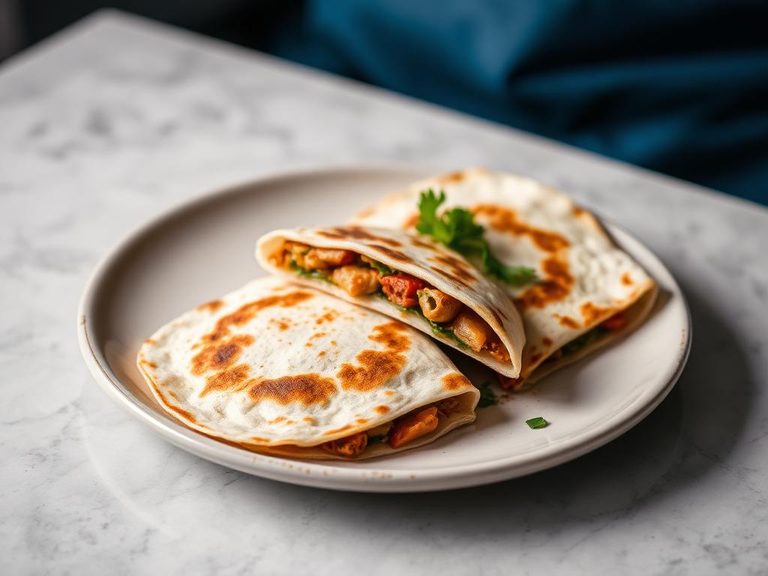
People adore Oaxaca cheese for its incredible meltability and satisfying, stringy pull, which makes it the ultimate cheese for quesadillas and baked dishes. Its mild, creamy flavor also acts as a perfect canvas for absorbing the vibrant spices and salsas of Mexican cuisine.
⚠️ Watch-outs & how to enjoy it better
As a full-fat cheese, it is calorie-dense, and its sodium content can be significant, which is a consideration for those monitoring salt intake. To enjoy it mindfully, practice portion control (stick to a 1-ounce serving) and pair it with fiber-rich vegetables like nopales or a side of beans to balance the meal.
Key benefits
- Excellent source of complete protein for muscle maintenance.
- Rich in calcium for bone health.
- Provides conjugated linoleic acid (CLA), a fatty acid linked to metabolic benefits.
- Naturally low in carbohydrates, making it suitable for low-carb diets.
- Contains vitamin B12, essential for nerve function.
🍽️ Popular dishes

🌍 Where it's eaten
💡 Did you know?
Oaxaca cheese is essentially Mexico's answer to mozzarella, as it was created by Italian cheesemakers who emigrated to the Oaxaca region in the early 20th century and adapted their pasta filata (stretched curd) technique.
Full nutrition (USDA data · scales with serving)
| Water | 49.8 g |
| Energy (Atwater General Factors) | 297 kcal |
| Energy (Atwater Specific Factors) | 298 kcal |
| Nitrogen | 3.5 g |
| Protein | 22.1 g |
| Total lipid (fat) | 22.1 g |
| Ash | 3.6 g |
| Carbohydrate, by difference | 2.4 g |
| Calcium, Ca | 532 mg |
| Iron, Fe | 0.00 mg |
| Magnesium, Mg | 21.6 mg |
| Phosphorus, P | 380 mg |
| Potassium, K | 80.7 mg |
| Sodium, Na | 734 mg |
| Zinc, Zn | 3.5 mg |
| Copper, Cu | 0.00 mg |
| Manganese, Mn | 0.02 mg |
| Iodine, I | 45.7 ug |
| Retinol | 135 ug |
| Vitamin D (D2 + D3), International Units | 0.00 iu |
| Vitamin D (D2 + D3) | 0.00 ug |
| Vitamin D2 (ergocalciferol) | 0.00 ug |
| Vitamin D3 (cholecalciferol) | 0.00 ug |
Fat & fatty acid profile (per 100g)
| Fatty acids, total saturated | 12.7 g |
| SFA 12:0 | 0.63 g |
| SFA 14:0 | 1.9 g |
| SFA 16:0 | 6.3 g |
| SFA 18:0 | 2.0 g |
| Fatty acids, total monounsaturated | 4.7 g |
| PUFA 18:2 | 0.59 g |
| Cholesterol | 65.5 mg |
Amino acid profile (per 100g)
Estimated from Cheese, cottage, with vegetables — USDA does not publish this profile for Cheese.
| Tryptophan | 0.13 g |
| Threonine | 0.53 g |
| Isoleucine | 0.70 g |
| Leucine | 1.2 g |
| Lysine | 0.97 g |
| Methionine | 0.36 g |
| Cystine | 0.11 g |
| Phenylalanine | 0.65 g |
| Tyrosine | 0.64 g |
| Valine | 0.74 g |
| Arginine | 0.55 g |
| Histidine | 0.40 g |
| Alanine | 0.62 g |
| Aspartic acid | 0.82 g |
| Glutamic acid | 2.6 g |
| Glycine | 0.27 g |
| Proline | 1.4 g |
| Serine | 0.67 g |
FAQ
What is the difference between Oaxaca and mozzarella?
While both are stretched-curd cheeses, Oaxaca is traditionally made from raw cow's milk and has a slightly tangier, more buttery flavor. Mozzarella is often made from pasteurized milk and has a milder, milkier taste.
Can I use Oaxaca cheese in non-Mexican dishes?
Absolutely! Its excellent melting properties make it a fantastic substitute for mozzarella in pizza, lasagna, or baked pasta dishes, adding a subtly richer flavor.
How should I store Oaxaca cheese?
Keep it wrapped tightly in plastic wrap or an airtight container in the refrigerator. It's best used within a week of opening for optimal texture and flavor.
Nutrient density (calculated · NRF9.3)
Nutrient Rich Foods index: beneficial nutrients (protein, fiber, vitamins, minerals) minus saturated fat, added sugar & sodium, per 100 kcal.
NRF9.3 index — Fulgoni, Keast & Drewnowski, 2009. Computed from USDA nutrients.
Weight-loss friendliness (composite index)
Energy density 2.97 kcal/g · 30% calories from protein · 0.0 g fiber · 0.0 g sugar per 100 g.
Composite of energy density (Rolls et al., 1999), protein & fiber satiety, minus sugar. A calculated heuristic — ranks satiety-per-calorie, not a clinical measure.
Dietary load (calculated from USDA values)
Potential renal acid load. Positive = acid-forming, negative = alkaline-forming.
Sodium-to-potassium ratio: 9.09 (lower is better — aim for ≤ 1)
Sodium:potassium per WHO potassium guidance. Computed from USDA nutrients.