

Fast foods, cheeseburger; double, large patty; with condiments
Whole food · Fast Foods
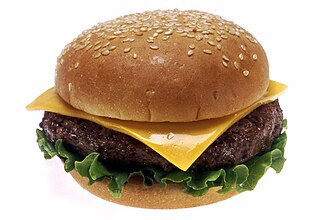
Photo: Wikipedia
A double-patty cheeseburger is a hearty, savory sandwich featuring two seasoned beef patties, melted cheese, and condiments nestled in a soft bun. Each bite delivers a satisfying contrast of juicy, umami-rich meat, creamy cheese, and tangy or sweet sauces. At 272 kcal per 100g, it's a calorie-dense source of protein (16.96g) and fat (16.22g), with a moderate amount of carbohydrates.
Calorie split: 25% protein · 21% carbs · 54% fat
↓ Full nutrition💚 Why it's loved
People love it for the classic, craveable combination of savory beef, melted cheese, and soft bread, which delivers a powerful hit of umami and fat. It's a cultural icon of fast food, representing comfort, indulgence, and a quick, satisfying meal.
⚠️ Watch-outs & how to enjoy it better
Its high calorie, saturated fat, and sodium content can be problematic for heart health and blood pressure. The refined carbohydrates in the bun can cause blood-sugar spikes. To counteract, pair it with a fiber-rich side salad or vegetable sticks, choose whole-grain buns if available, and practice portion control by sharing or opting for a single patty.
Key benefits
- High-quality protein for muscle maintenance and satiety.
- Provides essential nutrients like iron, zinc, and B12 from beef.
- Convenient and quick source of energy and calories.
- Customizable with various condiments and toppings.
🍽️ Popular dishes





🌍 Where it's eaten
💡 Did you know?
The cheeseburger is said to have been trademarked in 1935 by Louis Ballast of the Humpty Dumpty Drive-In in Denver, Colorado.
Full nutrition (USDA data · scales with serving)
| Water | 50.3 g |
| Energy | 272 kcal |
| Energy | 1136 kj |
| Protein | 17.0 g |
| Total lipid (fat) | 16.2 g |
| Ash | 2.0 g |
| Carbohydrate, by difference | 14.4 g |
| Fiber, total dietary | 1.0 g |
| Total Sugars | 3.5 g |
| Sucrose | 0.14 g |
| Glucose | 1.2 g |
| Fructose | 1.4 g |
| Lactose | 0.39 g |
| Maltose | 0.45 g |
| Galactose | 0.00 g |
| Calcium, Ca | 106 mg |
| Iron, Fe | 2.2 mg |
| Magnesium, Mg | 21.0 mg |
| Phosphorus, P | 165 mg |
| Potassium, K | 242 mg |
| Sodium, Na | 480 mg |
| Zinc, Zn | 3.3 mg |
| Copper, Cu | 0.09 mg |
| Manganese, Mn | 0.13 mg |
| Vitamin C, total ascorbic acid | 0.60 mg |
| Thiamin | 0.13 mg |
| Riboflavin | 0.30 mg |
| Niacin | 4.2 mg |
| Folate, total | 45.0 ug |
| Vitamin B-12 | 1.7 ug |
| Vitamin A, IU | 200 iu |
Fat & fatty acid profile (per 100g)
| Fatty acids, total saturated | 6.5 g |
| Fatty acids, total monounsaturated | 5.9 g |
| Fatty acids, total polyunsaturated | 0.48 g |
| Fatty acids, total trans | 1.0 g |
| Cholesterol | 57.0 mg |
Amino acid profile (per 100g)
Estimated from Fast foods, miniature cinnamon rolls — USDA does not publish this profile for Fast foods.
| Tryptophan | 0.05 g |
| Threonine | 0.22 g |
| Isoleucine | 0.28 g |
| Leucine | 0.51 g |
| Lysine | 0.18 g |
| Methionine | 0.11 g |
| Cystine | 0.16 g |
| Phenylalanine | 0.33 g |
| Tyrosine | 0.21 g |
| Valine | 0.33 g |
| Arginine | 0.26 g |
| Histidine | 0.16 g |
| Alanine | 0.25 g |
| Aspartic acid | 0.36 g |
| Glutamic acid | 2.2 g |
| Glycine | 0.25 g |
| Proline | 0.71 g |
| Serine | 0.37 g |
FAQ
How does the protein content compare to a single-patty burger?
A double-patty cheeseburger typically offers about 1.5 to 2 times the protein of a single-patty version, making it more satiating, but also significantly higher in calories and fat.
Is the cheese a significant source of calcium?
Yes, the processed American or cheddar cheese on a cheeseburger is a good source of calcium, contributing roughly 15-20% of the daily value per serving, though it also adds saturated fat and sodium.
What's the best way to reduce the sodium intake?
You can reduce sodium by requesting no added salt on the patties, choosing lower-sodium condiments like mustard over ketchup, and skipping high-sodium pickles or bacon.
Nutrient density (calculated · NRF9.3)
Nutrient Rich Foods index: beneficial nutrients (protein, fiber, vitamins, minerals) minus saturated fat, added sugar & sodium, per 100 kcal.
NRF9.3 index — Fulgoni, Keast & Drewnowski, 2009. Computed from USDA nutrients.
Weight-loss friendliness (composite index)
Energy density 2.72 kcal/g · 25% calories from protein · 1.0 g fiber · 3.5 g sugar per 100 g.
Composite of energy density (Rolls et al., 1999), protein & fiber satiety, minus sugar. A calculated heuristic — ranks satiety-per-calorie, not a clinical measure.
Dietary load (calculated from USDA values)
Potential renal acid load. Positive = acid-forming, negative = alkaline-forming.
Sodium-to-potassium ratio: 1.98 (lower is better — aim for ≤ 1)
Sodium:potassium per WHO potassium guidance. Computed from USDA nutrients.