

Gelatin desserts, dry mix, reduced calorie, with aspartame, added phosphorus, potassium, sodium, vitamin C
Whole food · Sweets

Photo: Wikipedia
This is a dehydrated, low-calorie powder that transforms into a firm, jiggly, and translucent dessert when mixed with water. It delivers a clean, sweet flavor profile—often fruit-inspired—with a smooth, melt-in-the-mouth texture. Nutritionally, it's a high-protein, zero-fat option fortified with key electrolytes and vitamin C.
Calorie split: 62% protein · 38% carbs · 0% fat
↓ Full nutrition💚 Why it's loved
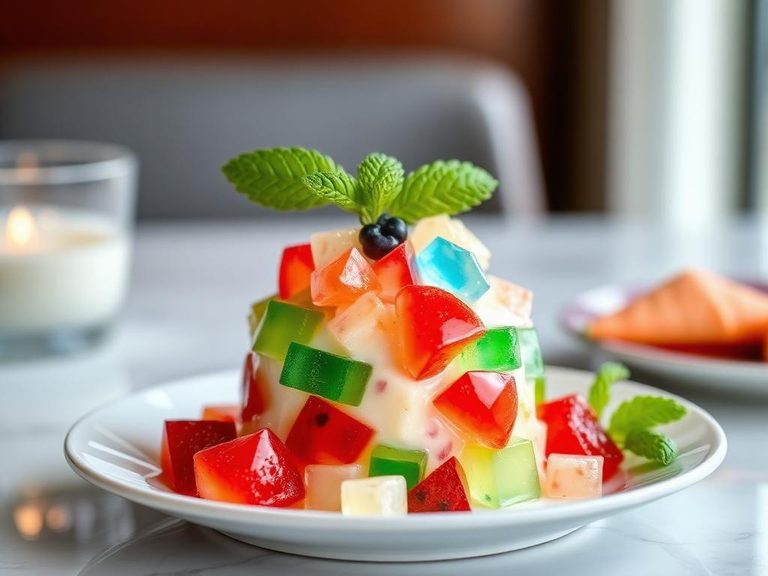
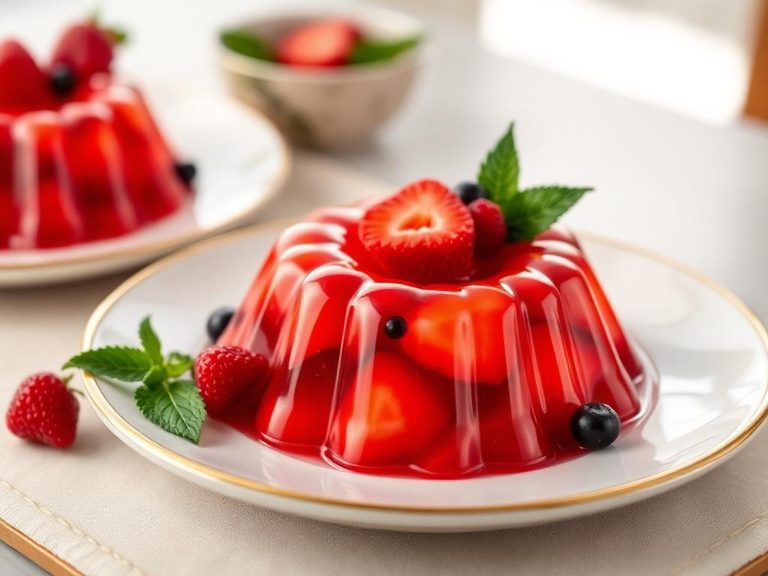
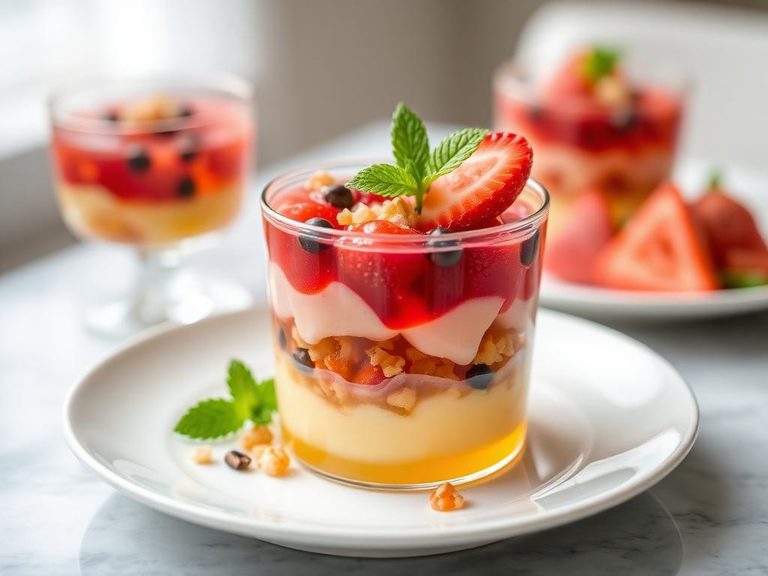
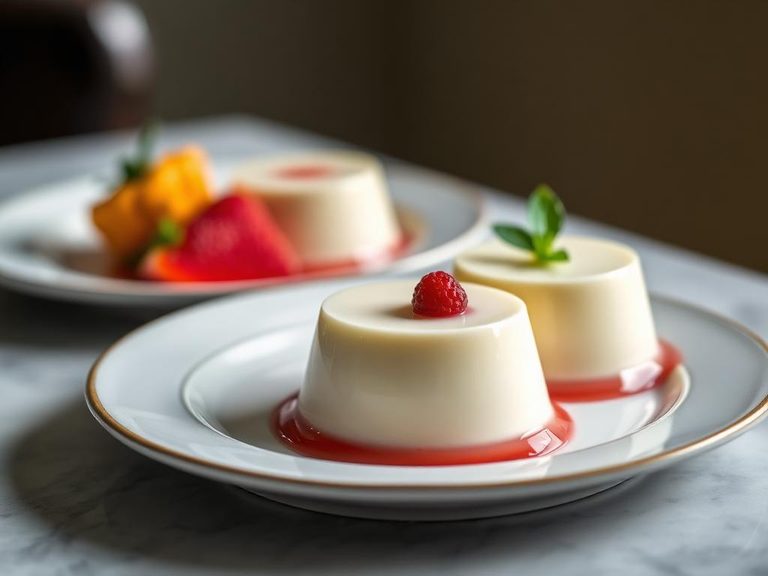
People love it for its nostalgic, playful texture and the ability to create vibrant, flavorful treats with minimal effort. It's incredibly versatile, serving as a base for everything from simple wobbly desserts to elaborate layered creations and fruit-filled molds.
⚠️ Watch-outs & how to enjoy it better
The high sodium content (from added salts) can be a concern for those monitoring intake, and the use of aspartame may be avoided by some individuals. To counteract the sodium, pair it with potassium-rich foods like bananas or spinach, and consider it an occasional treat rather than a daily staple.
Key benefits
- High protein content (55.3g per 100g dry mix)
- Zero fat and zero sugar
- Fortified with electrolytes (sodium, potassium, phosphorus)
- Contains added vitamin C
- Low-calorie dessert alternative (345 kcal per 100g dry mix)
🍽️ Popular dishes

🌍 Where it's eaten
💡 Did you know?
The first commercially successful powdered gelatin dessert was developed in 1897 by Pearle Bixby Wait, a carpenter and cough syrup manufacturer, who trademarked the name 'Jell-O'.
Full nutrition (USDA data · scales with serving)
| Water | 6.7 g |
| Energy | 345 kcal |
| Energy | 1443 kj |
| Protein | 55.3 g |
| Total lipid (fat) | 0.00 g |
| Ash | 4.7 g |
| Carbohydrate, by difference | 33.3 g |
| Fiber, total dietary | 0.00 g |
| Calcium, Ca | 2.0 mg |
| Iron, Fe | 0.02 mg |
| Magnesium, Mg | 1.0 mg |
| Phosphorus, P | 0.00 mg |
| Potassium, K | 1985 mg |
| Sodium, Na | 2751 mg |
| Zinc, Zn | 0.07 mg |
| Copper, Cu | 1.0 mg |
| Manganese, Mn | 0.05 mg |
| Selenium, Se | 25.5 ug |
| Vitamin C, total ascorbic acid | 490 mg |
| Thiamin | 0.01 mg |
| Riboflavin | 0.11 mg |
| Niacin | 0.04 mg |
| Pantothenic acid | 0.06 mg |
| Vitamin B-6 | 0.05 mg |
| Folate, total | 14.0 ug |
| Folic acid | 0.00 ug |
| Folate, food | 14.0 ug |
| Folate, DFE | 14.0 ug |
| Vitamin B-12 | 0.00 ug |
| Vitamin A, RAE | 0.00 ug |
| Retinol | 0.00 ug |
| Vitamin A, IU | 0.00 iu |
| Caffeine | 0.00 mg |
| Theobromine | 0.00 mg |
Fat & fatty acid profile (per 100g)
| Fatty acids, total saturated | 0.00 g |
| Cholesterol | 0.00 mg |
Amino acid profile (per 100g)
| Tryptophan | 0.00 g |
| Threonine | 1.1 g |
| Isoleucine | 0.84 g |
| Leucine | 1.8 g |
| Lysine | 2.5 g |
| Methionine | 0.44 g |
| Cystine | 0.00 g |
| Phenylalanine | 1.3 g |
| Tyrosine | 0.22 g |
| Valine | 1.5 g |
| Arginine | 4.8 g |
| Histidine | 0.48 g |
| Alanine | 5.8 g |
| Aspartic acid | 3.8 g |
| Glutamic acid | 6.3 g |
| Glycine | 13.8 g |
| Proline | 8.9 g |
| Serine | 1.9 g |
FAQ
How is the dry mix different from regular gelatin powder?
This specific mix is formulated to be reduced-calorie and sugar-free, using aspartame as a sweetener. It's also fortified with electrolytes (phosphorus, potassium, sodium) and vitamin C, unlike plain gelatin which is just protein.
Can I use this to make savory dishes?
While possible, it's not ideal. The added sweetener (aspartame) and specific flavoring agents are designed for sweet applications. For savory aspics, unflavored, unsweetened gelatin is the standard choice.
Why does it have added electrolytes?
The electrolytes (sodium, potassium, phosphorus) are often added in reduced-calorie or 'diet' formulations to mimic the mineral profile lost when sugar is removed, and to potentially aid in hydration, though the primary purpose is often flavor and mouthfeel enhancement.
Nutrient density (calculated · NRF9.3)
Nutrient Rich Foods index: beneficial nutrients (protein, fiber, vitamins, minerals) minus saturated fat, added sugar & sodium, per 100 kcal.
NRF9.3 index — Fulgoni, Keast & Drewnowski, 2009. Computed from USDA nutrients.
Weight-loss friendliness (composite index)
Energy density 3.45 kcal/g · 64% calories from protein · 0.0 g fiber · 0.0 g sugar per 100 g.
Composite of energy density (Rolls et al., 1999), protein & fiber satiety, minus sugar. A calculated heuristic — ranks satiety-per-calorie, not a clinical measure.
Dietary load (calculated from USDA values)
Potential renal acid load. Positive = acid-forming, negative = alkaline-forming.
Sodium-to-potassium ratio: 1.39 (lower is better — aim for ≤ 1)
Sodium:potassium per WHO potassium guidance. Computed from USDA nutrients.