

Flan, caramel custard, dry mix
Whole food · Sweets
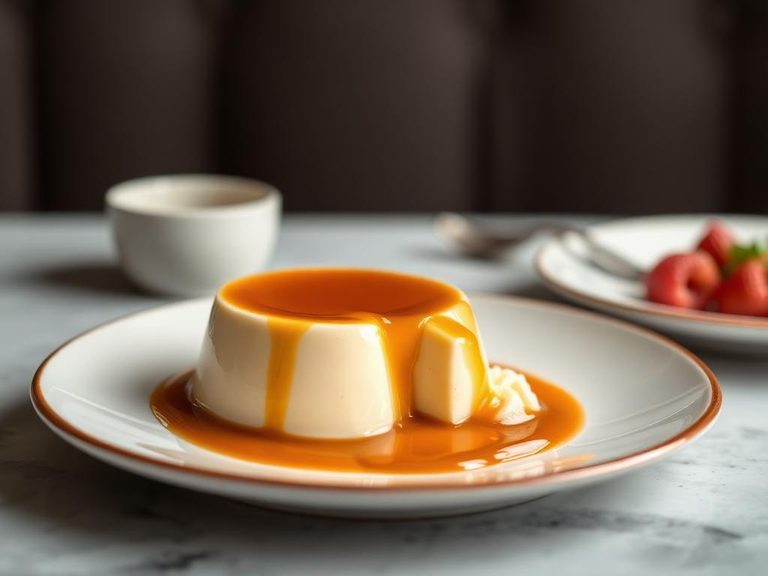
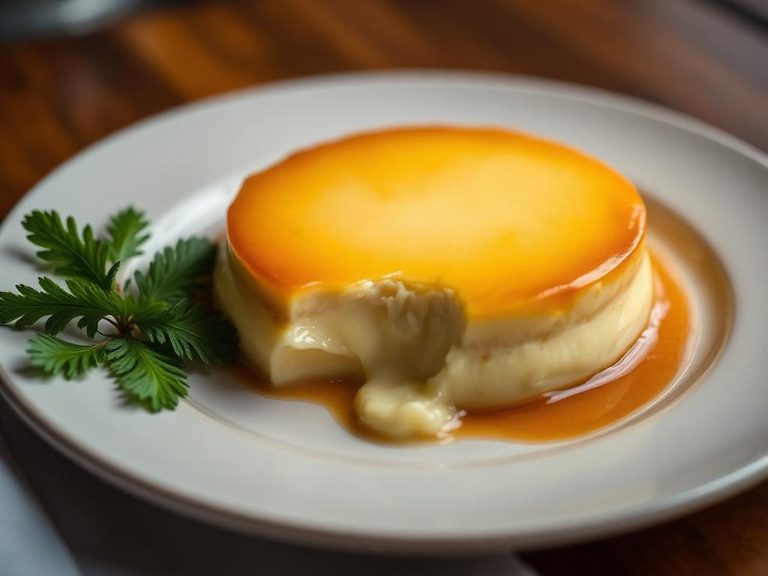
This is a powdered, shelf-stable base for a classic custard dessert, requiring only the addition of milk and eggs before baking or steaming. The dry mix itself is a fine, pale-yellow powder that transforms into a silky, wobbly custard with a deep, amber caramel sauce pooling at the bottom. Nutritionally, it's a concentrated source of carbohydrates, primarily from sugar and starch, providing quick energy but offering little else.
Calorie split: 0% protein · 100% carbs · 0% fat
↓ Full nutrition💚 Why it's loved
People adore it for the nostalgic comfort of a creamy, sweet custard paired with the bittersweet crunch of caramel, all achievable with minimal effort. Its versatility makes it a go-to for both everyday treats and elegant dinner party finales.
⚠️ Watch-outs & how to enjoy it better
As a high-carb, low-protein, low-fiber food, it can cause rapid blood-sugar spikes and offers little satiety. To counteract this, enjoy a modest portion alongside a source of protein (like nuts) or healthy fat (like a dollop of unsweetened cream) to slow sugar absorption and increase fullness.
Key benefits
- Provides a quick, convenient source of energy from carbohydrates.
- Offers a consistent, foolproof base for a beloved dessert.
- Shelf-stable format reduces food waste and is always pantry-ready.
- Allows for easy customization with added flavors like citrus zest or vanilla.
🍽️ Popular dishes

🌍 Where it's eaten
💡 Did you know?
The 'dry mix' version is a modern convenience; traditionally, the caramel is made separately by melting sugar in a pan until it turns a deep amber liquid before the custard is poured in.
Full nutrition (USDA data · scales with serving)
| Water | 7.8 g |
| Energy | 348 kcal |
| Energy | 1456 kj |
| Protein | 0.00 g |
| Total lipid (fat) | 0.00 g |
| Ash | 0.61 g |
| Carbohydrate, by difference | 91.6 g |
| Fiber, total dietary | 0.00 g |
| Calcium, Ca | 24.0 mg |
| Iron, Fe | 0.08 mg |
| Magnesium, Mg | 0.00 mg |
| Phosphorus, P | 1.0 mg |
| Potassium, K | 153 mg |
| Sodium, Na | 432 mg |
| Zinc, Zn | 0.04 mg |
| Copper, Cu | 0.01 mg |
| Manganese, Mn | 0.01 mg |
| Selenium, Se | 21.3 ug |
| Vitamin C, total ascorbic acid | 0.00 mg |
| Thiamin | 0.00 mg |
| Riboflavin | 0.00 mg |
| Niacin | 0.00 mg |
| Pantothenic acid | 0.00 mg |
| Vitamin B-6 | 0.00 mg |
| Folate, total | 0.00 ug |
| Folic acid | 0.00 ug |
| Folate, food | 0.00 ug |
| Folate, DFE | 0.00 ug |
| Vitamin B-12 | 0.00 ug |
| Vitamin B-12, added | 0.00 ug |
| Vitamin A, RAE | 0.00 ug |
| Retinol | 0.00 ug |
| Vitamin A, IU | 0.00 iu |
| Caffeine | 0.00 mg |
| Theobromine | 0.00 mg |
Fat & fatty acid profile (per 100g)
| Cholesterol | 0.00 mg |
Amino acid profile (per 100g)
Estimated from Flan, caramel custard, dry mix, prepared with whole milk — USDA does not publish this profile for Flan.
| Tryptophan | 0.04 g |
| Threonine | 0.13 g |
| Isoleucine | 0.18 g |
| Leucine | 0.29 g |
| Lysine | 0.23 g |
| Methionine | 0.07 g |
| Cystine | 0.03 g |
| Phenylalanine | 0.14 g |
| Tyrosine | 0.14 g |
| Valine | 0.20 g |
| Arginine | 0.11 g |
| Histidine | 0.08 g |
| Alanine | 0.10 g |
| Aspartic acid | 0.22 g |
| Glutamic acid | 0.62 g |
| Glycine | 0.06 g |
| Proline | 0.29 g |
| Serine | 0.16 g |
FAQ
What's the difference between flan and crème caramel?
They are essentially the same dessert, but the name 'flan' is more common in Spanish-speaking countries and the Philippines, while 'crème caramel' is the French term. The technique and final product are identical.
Why does my flan have holes or a 'honeycomb' texture?
This is caused by overcooking or cooking at too high a temperature, which makes the egg proteins curdle and separate. The solution is to bake it in a water bath (bain-marie) at a lower temperature for gentle, even heat.
Can I use the dry mix without eggs?
No. Eggs are the essential structural ingredient that sets the custard. The mix provides sugar, flavor, and starch, but the eggs provide the protein matrix that solidifies upon cooking.
Nutrient density (calculated · NRF9.3)
Nutrient Rich Foods index: beneficial nutrients (protein, fiber, vitamins, minerals) minus saturated fat, added sugar & sodium, per 100 kcal.
NRF9.3 index — Fulgoni, Keast & Drewnowski, 2009. Computed from USDA nutrients.
Weight-loss friendliness (composite index)
Energy density 3.48 kcal/g · 0% calories from protein · 0.0 g fiber · 0.0 g sugar per 100 g.
Composite of energy density (Rolls et al., 1999), protein & fiber satiety, minus sugar. A calculated heuristic — ranks satiety-per-calorie, not a clinical measure.
Dietary load (calculated from USDA values)
Potential renal acid load. Positive = acid-forming, negative = alkaline-forming.
Sodium-to-potassium ratio: 2.82 (lower is better — aim for ≤ 1)
Sodium:potassium per WHO potassium guidance. Computed from USDA nutrients.