

Fruit salad, (peach and pear and apricot and pineapple and cherry), canned, light syrup, solids and liquids
Whole food · Fruits and Fruit Juices

Photo: Wikipedia
This is a vibrant, ready-to-eat medley of canned peach, pear, apricot, pineapple, and cherry, all bathed in a light syrup. The texture is uniformly soft and yielding, with a sweet, tangy, and floral flavor profile from the mixed fruits. Nutritionally, it's a low-calorie, virtually fat-free source of quick energy from carbohydrates.
Calorie split: 2% protein · 97% carbs · 1% fat
↓ Full nutrition💚 Why it's loved
People love it for its nostalgic, comforting sweetness and the effortless convenience of having a ready-made fruit mix. It's a versatile staple that can be a standalone snack, a dessert topping, or a bright addition to savory dishes.
⚠️ Watch-outs & how to enjoy it better
The light syrup adds significant sugar, which can cause blood-sugar spikes, making it less ideal for those monitoring glucose levels. To counteract this, pair a small portion with a source of protein or healthy fat (like cottage cheese or nuts) to slow sugar absorption. Alternatively, rinse the fruit under water before serving to reduce the syrup.
Key benefits
- Provides quick, easily digestible energy from natural fruit sugars.
- Contains dietary fiber, which supports digestive health.
- Offers a convenient way to consume a variety of fruit servings.
- Low in fat and cholesterol-free.
- A good source of vitamin C from the pineapple and cherries.
🍽️ Popular dishes
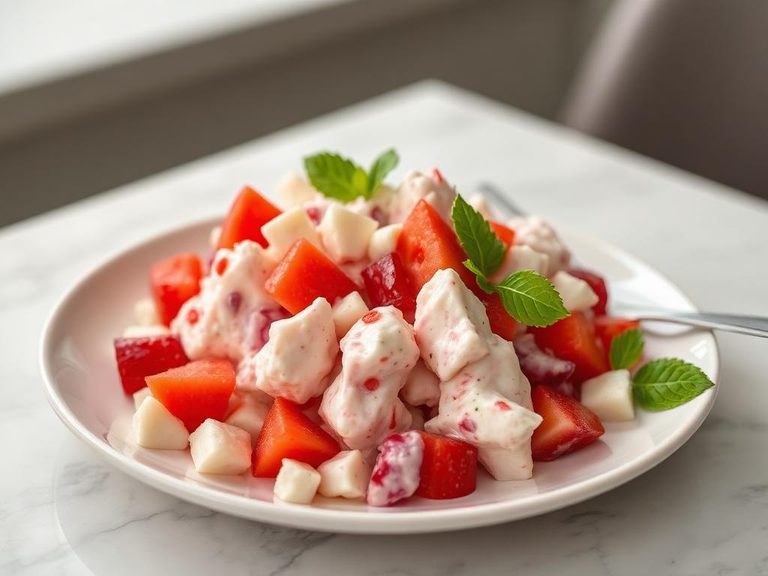



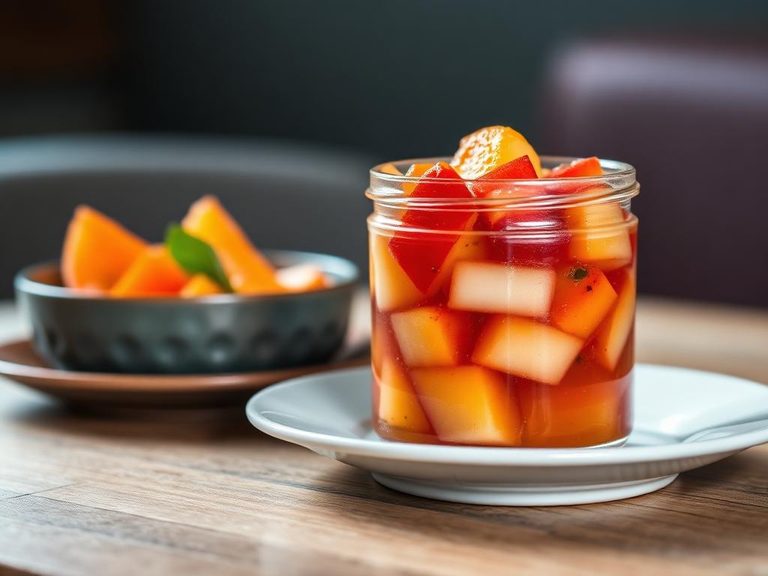
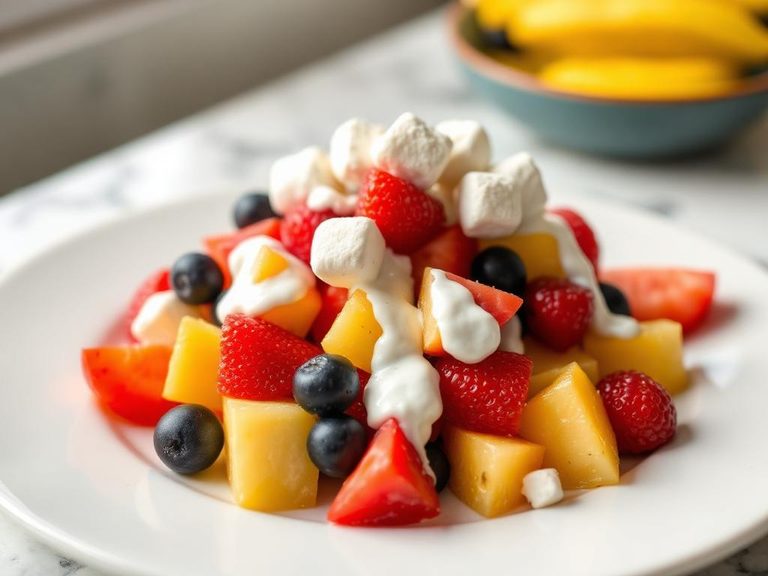
🌍 Where it's eaten
💡 Did you know?
The specific combination of these five fruits in a can is a classic product known simply as 'Fruit Cocktail,' a standard that was popularized in the United States in the early 20th century.
Full nutrition (USDA data · scales with serving)
| Water | 84.2 g |
| Energy | 58.0 kcal |
| Energy | 243 kj |
| Protein | 0.34 g |
| Total lipid (fat) | 0.07 g |
| Ash | 0.21 g |
| Carbohydrate, by difference | 15.1 g |
| Fiber, total dietary | 1.0 g |
| Calcium, Ca | 7.0 mg |
| Iron, Fe | 0.29 mg |
| Magnesium, Mg | 5.0 mg |
| Phosphorus, P | 9.0 mg |
| Potassium, K | 82.0 mg |
| Sodium, Na | 6.0 mg |
| Zinc, Zn | 0.07 mg |
| Copper, Cu | 0.07 mg |
| Manganese, Mn | 0.15 mg |
| Vitamin C, total ascorbic acid | 2.5 mg |
| Thiamin | 0.01 mg |
| Riboflavin | 0.02 mg |
| Niacin | 0.36 mg |
| Pantothenic acid | 0.05 mg |
| Vitamin B-6 | 0.03 mg |
| Folate, total | 3.0 ug |
| Folic acid | 0.00 ug |
| Folate, food | 3.0 ug |
| Folate, DFE | 3.0 ug |
| Vitamin B-12 | 0.00 ug |
| Vitamin A, RAE | 21.0 ug |
| Retinol | 0.00 ug |
| Vitamin A, IU | 429 iu |
| Vitamin D (D2 + D3), International Units | 0.00 iu |
| Vitamin D (D2 + D3) | 0.00 ug |
Fat & fatty acid profile (per 100g)
| Fatty acids, total saturated | 0.01 g |
| SFA 16:0 | 0.01 g |
| SFA 18:0 | 0.00 g |
| Fatty acids, total monounsaturated | 0.01 g |
| MUFA 18:1 | 0.01 g |
| Fatty acids, total polyunsaturated | 0.03 g |
| PUFA 18:2 | 0.02 g |
| PUFA 18:3 | 0.00 g |
| Fatty acids, total trans | 0.00 g |
| Cholesterol | 0.00 mg |
FAQ
Is canned fruit salad as nutritious as fresh?
Canning preserves most minerals and fiber, but some heat-sensitive vitamins like vitamin C can be reduced. The main nutritional difference is the added sugar from the syrup. Choosing fruit canned in water or juice is a healthier alternative.
Can I use this in baking?
Absolutely. It's a key ingredient in classic recipes like fruit cocktail cake or as a filling for pastries. The canned fruit is already soft and sweet, making it perfect for baking.
What's the difference between 'light syrup' and 'heavy syrup'?
'Light syrup' is a sugar-water solution with a lower sugar concentration than 'heavy syrup.' It adds sweetness but is less caloric and sugary than the heavy variety. 'In its own juices' or 'in water' are the lowest-sugar options.
Nutrient density (calculated · NRF9.3)
Nutrient Rich Foods index: beneficial nutrients (protein, fiber, vitamins, minerals) minus saturated fat, added sugar & sodium, per 100 kcal.
NRF9.3 index — Fulgoni, Keast & Drewnowski, 2009. Computed from USDA nutrients.
Weight-loss friendliness (composite index)
Energy density 0.58 kcal/g · 2% calories from protein · 1.0 g fiber · 0.0 g sugar per 100 g.
Composite of energy density (Rolls et al., 1999), protein & fiber satiety, minus sugar. A calculated heuristic — ranks satiety-per-calorie, not a clinical measure.
Dietary load (calculated from USDA values)
Potential renal acid load. Positive = acid-forming, negative = alkaline-forming.
Sodium-to-potassium ratio: 0.07 (lower is better — aim for ≤ 1)
Sodium:potassium per WHO potassium guidance. Computed from USDA nutrients.