

Flour, coconut
Whole food · Nut and Seed Products
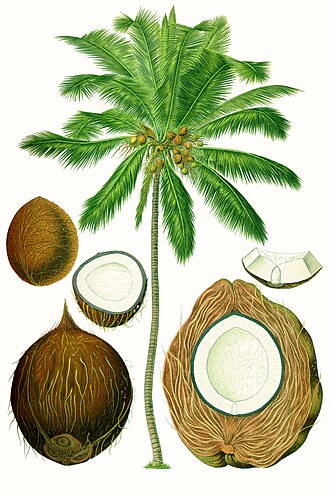
Photo: Wikipedia
Coconut flour is a finely milled, creamy-white powder made from dried, defatted coconut meat. It has a mild, sweet coconut aroma and a dense, absorbent texture that creates a tender, slightly crumbly crumb in baked goods. Nutritionally, it's a powerhouse of dietary fiber and plant-based protein, with significantly fewer net carbs than grain-based flours.
Calorie split: 15% protein · 54% carbs · 31% fat
↓ Full nutrition💚 Why it's loved
People love coconut flour for its unique, subtly sweet flavor that enhances both sweet and savory dishes without being overpowering. Its exceptional absorbency allows for gluten-free and low-carb baking that doesn't have the gummy texture of some other alternative flours, making it a staple in paleo and keto kitchens.
⚠️ Watch-outs & how to enjoy it better
Its extreme absorbency can lead to dry, dense, or crumbly results if recipes aren't specifically formulated for it, requiring significantly more liquid and eggs. Those with coconut allergies must avoid it entirely, and its high fiber content can cause digestive discomfort (bloating, gas) if introduced too quickly. Counteract this by starting with small portions, increasing water intake, and always using tested coconut flour recipes.
Key benefits
- Extremely high in dietary fiber (34g per 100g)
- Good source of plant-based protein (16g per 100g)
- Naturally gluten-free and grain-free
- Low in digestible carbohydrates
- Rich in iron and medium-chain triglycerides (MCTs)
🍽️ Popular dishes





🌍 Where it's eaten
💡 Did you know?
Because it's so absorbent, you typically need only 1/4 to 1/3 cup of coconut flour to replace 1 cup of wheat flour, along with a corresponding large increase in eggs and liquid.
Full nutrition (USDA data · scales with serving)
| Water | 4.7 g |
| Energy (Atwater General Factors) | 438 kcal |
| Energy (Atwater Specific Factors) | 424 kcal |
| Nitrogen | 3.0 g |
| Protein | 16.1 g |
| Total lipid (fat) | 15.3 g |
| Ash | 5.0 g |
| Carbohydrate, by difference | 58.9 g |
| Fiber, total dietary | 34.2 g |
| Calcium, Ca | 36.0 mg |
| Iron, Fe | 8.0 mg |
| Magnesium, Mg | 248 mg |
| Phosphorus, P | 507 mg |
| Potassium, K | 2088 mg |
| Sodium, Na | 46.9 mg |
| Zinc, Zn | 3.7 mg |
| Copper, Cu | 2.1 mg |
| Manganese, Mn | 5.3 mg |
| Selenium, Se | 26.8 ug |
Fat & fatty acid profile (per 100g)
| Fatty acids, total saturated | 14.0 g |
| Fatty acids, total monounsaturated | 0.81 g |
| Fatty acids, total polyunsaturated | 0.11 g |
Amino acid profile (per 100g)
Estimated from Seeds, cottonseed flour, low fat (glandless) — USDA does not publish this profile for Flour.
| Tryptophan | 0.75 g |
| Threonine | 1.8 g |
| Isoleucine | 1.8 g |
| Leucine | 3.4 g |
| Lysine | 2.5 g |
| Methionine | 0.81 g |
| Cystine | 1.3 g |
| Phenylalanine | 3.1 g |
| Tyrosine | 1.8 g |
| Valine | 2.6 g |
| Arginine | 6.7 g |
| Histidine | 1.6 g |
| Alanine | 2.3 g |
| Aspartic acid | 5.4 g |
| Glutamic acid | 12.5 g |
| Glycine | 2.4 g |
| Proline | 2.1 g |
| Serine | 2.5 g |
FAQ
Can I substitute coconut flour 1:1 for wheat flour?
No, absolutely not. Coconut flour is highly absorbent. A standard substitution ratio is 1/4 to 1/3 cup coconut flour for 1 cup wheat flour, with a significant increase in eggs and liquid (often 1 egg per 2 tbsp of coconut flour).
Why does my coconut flour baked good taste eggy?
This is a common issue because coconut flour recipes require a high number of eggs for moisture, structure, and binding. To mitigate this, ensure you're using a tested recipe, and consider adding strong flavors like vanilla, cocoa, or spices.
Is coconut flour keto-friendly?
Yes, it's one of the most popular flours for ketogenic diets. With about 34g of fiber and only 16g of net carbs per 100g, it has a very low impact on blood sugar compared to grain flours.
Nutrient density (calculated · NRF9.3)
Nutrient Rich Foods index: beneficial nutrients (protein, fiber, vitamins, minerals) minus saturated fat, added sugar & sodium, per 100 kcal.
NRF9.3 index — Fulgoni, Keast & Drewnowski, 2009. Computed from USDA nutrients.
Weight-loss friendliness (composite index)
Energy density 4.38 kcal/g · 15% calories from protein · 34.2 g fiber · 0.0 g sugar per 100 g.
Composite of energy density (Rolls et al., 1999), protein & fiber satiety, minus sugar. A calculated heuristic — ranks satiety-per-calorie, not a clinical measure.
Dietary load (calculated from USDA values)
Potential renal acid load. Positive = acid-forming, negative = alkaline-forming.
Sodium-to-potassium ratio: 0.02 (lower is better — aim for ≤ 1)
Sodium:potassium per WHO potassium guidance. Computed from USDA nutrients.