Yogurt, plain, whole milk
Whole food · Dairy and Egg Products
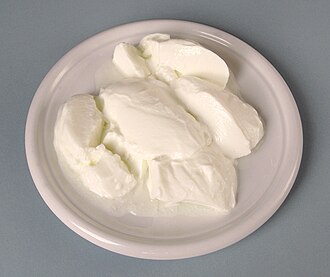
Photo: Wikipedia
Plain whole-milk yogurt is a thick, creamy fermented dairy product with a smooth, velvety texture and a mild, tangy flavor. It boasts a balanced macronutrient profile, offering a solid 3.8g of protein and 4.5g of healthy fats per 100g, making it a satisfying and nutrient-dense food. Its simplicity makes it a foundational ingredient in countless cuisines worldwide.
💚 Why it's loved
People love its versatile, clean canvas—its subtle tang enriches both sweet and savory dishes, from breakfast bowls to marinades. It's also a beloved comfort food in many cultures, enjoyed simply chilled or as a base for traditional drinks and sauces.
⚠️ Watch-outs & how to enjoy it better
Its tanginess can be off-putting to those unaccustomed to fermented flavors, and its dairy content makes it unsuitable for vegans or those with a milk allergy. For individuals sensitive to lactose, even the reduced amount can cause discomfort; pairing it with fiber-rich foods like oats or fruit can help mitigate any digestive issues.
Key benefits
- Excellent source of high-quality protein for muscle maintenance.
- Provides probiotics that support a healthy gut microbiome.
- Rich in calcium and phosphorus for bone health.
- Contains conjugated linoleic acid (CLA), a beneficial fatty acid.
- Naturally low in lactose due to fermentation.
🍽️ Popular dishes






🌍 Where it's eaten
💡 Did you know?
The bacterial cultures used in yogurt, primarily Lactobacillus bulgaricus and Streptococcus thermophilus, were first scientifically described by Bulgarian physician Stamen Grigorov in 1905.
Full nutrition (scales with serving)
| Water | 85.3 g |
| Energy (Atwater General Factors) | 78.0 kcal |
| Energy (Atwater Specific Factors) | 77.3 kcal |
| Nitrogen | 0.60 g |
| Protein | 3.8 g |
| Total lipid (fat) | 4.5 g |
| Ash | 0.85 g |
| Carbohydrate, by difference | 5.6 g |
| Sugars, Total | 4.1 g |
| Sucrose | 0.00 g |
| Glucose | 0.00 g |
| Fructose | 0.00 g |
| Lactose | 3.3 g |
| Maltose | 0.00 g |
| Galactose | 0.75 g |
| Calcium, Ca | 127 mg |
| Iron, Fe | 0.00 mg |
| Magnesium, Mg | 11.4 mg |
| Phosphorus, P | 101 mg |
| Potassium, K | 164 mg |
| Sodium, Na | 41.8 mg |
| Zinc, Zn | 0.43 mg |
| Copper, Cu | 0.00 mg |
| Manganese, Mn | 0.00 mg |
| Iodine, I | 32.3 ug |
| Thiamin | 0.06 mg |
| Riboflavin | 0.24 mg |
| Niacin | 0.14 mg |
| Vitamin B-6 | 0.05 mg |
| Biotin | 0.00 ug |
| Retinol | 48.2 ug |
| Vitamin D (D2 + D3), International Units | 31.1 iu |
| Vitamin D (D2 + D3) | 0.78 ug |
| Vitamin D2 (ergocalciferol) | 0.00 ug |
| Vitamin D3 (cholecalciferol) | 0.78 ug |
| Vitamin K (phylloquinone) | 0.20 ug |
| Vitamin K (Dihydrophylloquinone) | 0.00 ug |
| Vitamin K (Menaquinone-4) | 0.90 ug |
| Fatty acids, total saturated | 2.3 g |
| SFA 12:0 | 0.11 g |
| SFA 14:0 | 0.38 g |
| SFA 16:0 | 1.1 g |
| SFA 18:0 | 0.37 g |
| Fatty acids, total monounsaturated | 0.87 g |
| MUFA 18:1 c | 0.77 g |
| PUFA 18:2 n-6 c,c | 0.08 g |
| Cholesterol | 14.2 mg |
FAQ
What's the difference between plain and Greek yogurt?
Greek yogurt is simply plain yogurt that has been strained to remove most of the liquid whey, resulting in a thicker, creamier texture and a higher concentration of protein per serving.
Is the fat in whole-milk yogurt unhealthy?
No. The fat in whole-milk yogurt is primarily saturated, but it's part of a complex food matrix. It provides satiety, helps absorb fat-soluble vitamins, and contains beneficial fatty acids like CLA. For most people, it's a healthy part of a balanced diet.
Can I use plain yogurt in baking?
Absolutely. It adds moisture, a tender crumb, and a subtle tang to cakes, muffins, and breads. It can also be used as a substitute for buttermilk or sour cream in many recipes.