

Pork, chop, center cut, raw
Whole food · Pork Products
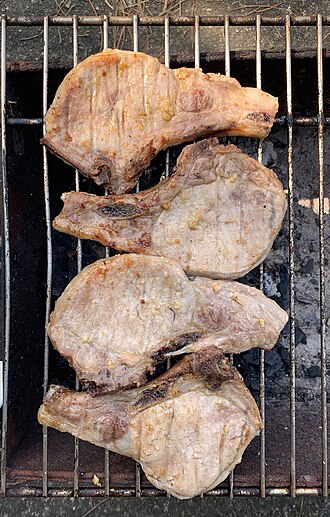
Photo: Wikipedia
A center-cut pork chop is a lean, bone-in or boneless cut from the loin, prized for its tender, fine-grained texture and mild, savory flavor. It is a powerhouse of high-quality protein, providing over 22 grams per 100 grams with minimal carbohydrates. When cooked properly, it develops a golden-brown crust while remaining juicy inside, making it a staple of home cooking.
Calorie split: 65% protein · 0% carbs · 35% fat
↓ Full nutrition💚 Why it's loved
People love center-cut pork chops for their versatility and satisfying, meaty flavor that pairs well with countless seasonings and sides. They are a cultural comfort food in many households, often associated with family dinners and hearty, home-cooked meals.
⚠️ Watch-outs & how to enjoy it better
Some may find pork chops lean and prone to drying out if overcooked, which can lead to a tough texture. To counteract this, use a meat thermometer to cook to an internal temperature of 145°F (63°C), let it rest for 3 minutes before slicing, and consider brining or marinating to retain moisture. Those monitoring saturated fat intake should opt for trimming visible fat or pairing with fiber-rich vegetables.
Key benefits
- Excellent source of complete protein for muscle maintenance.
- Very low in carbohydrates, suitable for low-carb diets.
- Rich in B vitamins like thiamine and niacin for energy metabolism.
- Contains essential minerals such as selenium and phosphorus.
- Lean cut with moderate fat content compared to other pork parts.
🍽️ Popular dishes
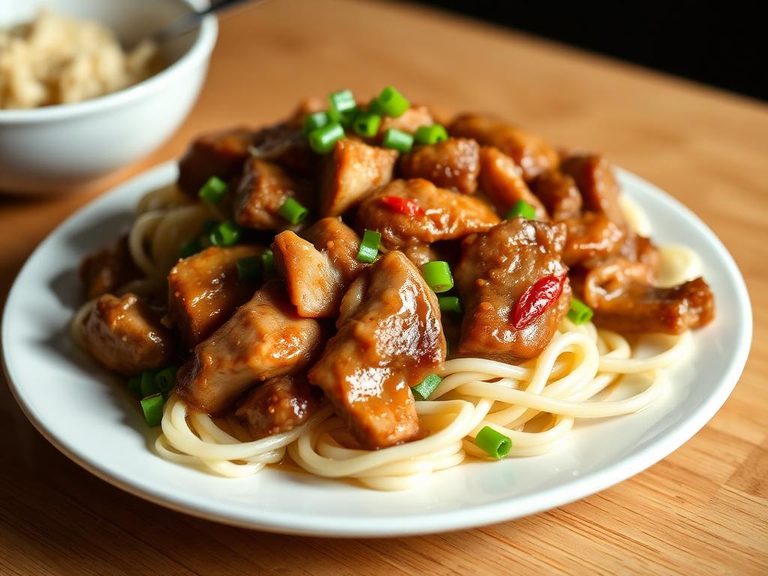

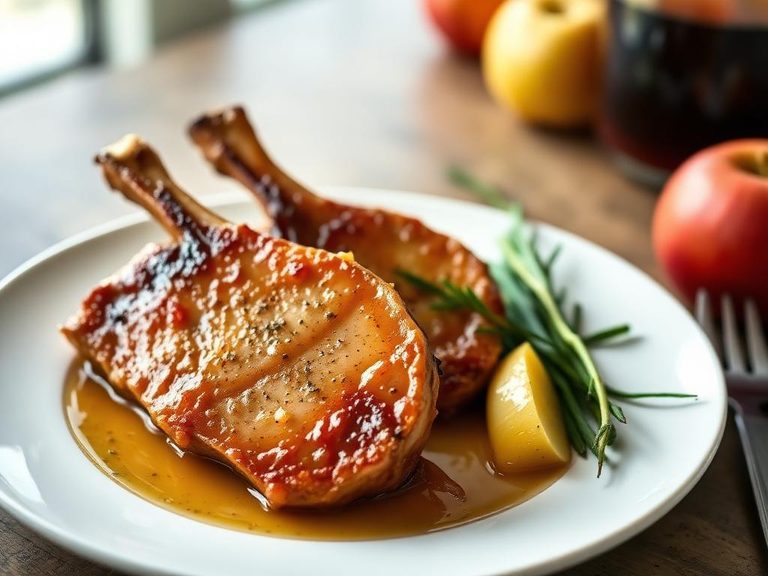


🌍 Where it's eaten
💡 Did you know?
The term 'chop' comes from the Indian English word 'chāp', which originally referred to a slice of meat, and was adopted by British colonists in the 17th century.
Full nutrition (USDA data · scales with serving)
| Water | 71.2 g |
| Energy (Atwater General Factors) | 138 kcal |
| Energy (Atwater Specific Factors) | 145 kcal |
| Nitrogen | 3.6 g |
| Protein | 22.8 g |
| Total lipid (fat) | 5.5 g |
| Ash | 1.1 g |
| Carbohydrate, by difference | -0.56 g |
| Calcium, Ca | 4.1 mg |
| Iron, Fe | 0.42 mg |
| Magnesium, Mg | 23.4 mg |
| Phosphorus, P | 202 mg |
| Potassium, K | 367 mg |
| Sodium, Na | 39.3 mg |
| Zinc, Zn | 1.3 mg |
| Copper, Cu | 0.03 mg |
| Manganese, Mn | 0.00 mg |
Fat & fatty acid profile (per 100g)
| Cholesterol | 57.3 mg |
Amino acid profile (per 100g)
Estimated from Pork, cured, salt pork, raw — USDA does not publish this profile for Pork.
| Tryptophan | 0.02 g |
| Threonine | 0.17 g |
| Isoleucine | 0.13 g |
| Leucine | 0.35 g |
| Lysine | 0.42 g |
| Methionine | 0.07 g |
| Cystine | 0.04 g |
| Phenylalanine | 0.19 g |
| Tyrosine | 0.08 g |
| Valine | 0.24 g |
| Arginine | 0.52 g |
| Histidine | 0.06 g |
| Alanine | 0.28 g |
| Aspartic acid | 0.42 g |
| Glutamic acid | 0.69 g |
| Glycine | 0.36 g |
| Proline | 0.27 g |
| Serine | 0.19 g |
FAQ
What is the difference between a center-cut and a regular pork chop?
A center-cut pork chop comes from the middle of the loin, making it more tender and uniform in shape compared to chops from the shoulder or rib end, which can be fattier and less consistent.
How should I store raw pork chops?
Keep them in the coldest part of the refrigerator at 40°F (4°C) or below, and use within 3-5 days. For longer storage, freeze them in airtight packaging for up to 6 months.
Can I eat pork chops if I'm on a low-carb diet?
Yes, pork chops are an excellent low-carb protein source, with virtually no carbohydrates. They are ideal for keto and other low-carb eating plans.
Nutrient density (calculated · NRF9.3)
Nutrient Rich Foods index: beneficial nutrients (protein, fiber, vitamins, minerals) minus saturated fat, added sugar & sodium, per 100 kcal.
NRF9.3 index — Fulgoni, Keast & Drewnowski, 2009. Computed from USDA nutrients.
Weight-loss friendliness (composite index)
Energy density 1.38 kcal/g · 66% calories from protein · 0.0 g fiber · 0.0 g sugar per 100 g.
Composite of energy density (Rolls et al., 1999), protein & fiber satiety, minus sugar. A calculated heuristic — ranks satiety-per-calorie, not a clinical measure.
Dietary load (calculated from USDA values)
Potential renal acid load. Positive = acid-forming, negative = alkaline-forming.
Sodium-to-potassium ratio: 0.11 (lower is better — aim for ≤ 1)
Sodium:potassium per WHO potassium guidance. Computed from USDA nutrients.