

Candies, MARS SNACKFOOD US, COCOAVIA Blueberry and Almond Chocolate Bar
Whole food · Sweets

Photo: Wikipedia
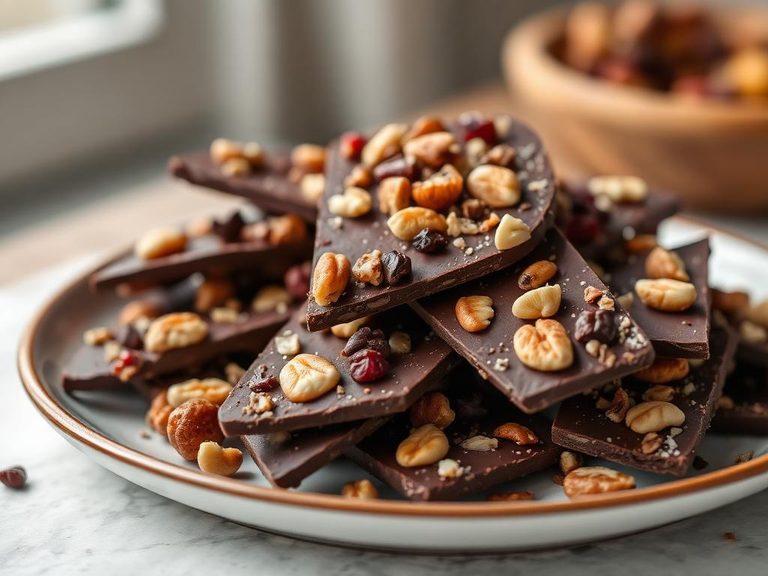
This is a dark chocolate bar infused with blueberry pieces and crunchy almond slivers, offering a rich cocoa base with bursts of tart-sweet fruit and a satisfying nutty crunch. The nutrition profile is notable for its high fiber content (9.1g per 100g) and significant protein (6.35g), making it a more substantial treat than many standard candy bars.
Calorie split: 5% protein · 46% carbs · 49% fat
↓ Full nutrition💚 Why it's loved
People love it for the sophisticated flavor combination where the deep, slightly bitter dark chocolate is perfectly balanced by the sweet, chewy blueberries and the toasty, crunchy almonds. It's often seen as a permissible indulgence that feels more like a gourmet snack than a simple candy bar.
⚠️ Watch-outs & how to enjoy it better
With 38.99g of sugar per 100g, it can cause blood-sugar spikes, especially if eaten alone on an empty stomach. To counteract this, pair a single serving with a source of protein or healthy fat (like a handful of nuts or a cheese stick) to slow sugar absorption, and practice strict portion control by breaking off a few squares instead of eating the whole bar.
Key benefits
- High in dietary fiber for a candy bar
- Contains plant-based protein from almonds and cocoa
- Provides antioxidants from dark chocolate and blueberries
- Offers a more satisfying, textured eating experience than plain chocolate
🍽️ Popular dishes


🌍 Where it's eaten
💡 Did you know?
The COCOAVIA line is specifically marketed by Mars as a 'better-for-you' chocolate, with a focus on cocoa flavanols, which are compounds studied for potential cardiovascular benefits.
Full nutrition (USDA data · scales with serving)
| Water | 2.9 g |
| Energy | 525 kcal |
| Energy | 2197 kj |
| Protein | 6.3 g |
| Total lipid (fat) | 28.7 g |
| Ash | 1.7 g |
| Carbohydrate, by difference | 60.4 g |
| Fiber, total dietary | 9.1 g |
| Total Sugars | 39.0 g |
| Calcium, Ca | 985 mg |
| Iron, Fe | 3.2 mg |
| Sodium, Na | 8.0 mg |
| Vitamin C, total ascorbic acid | 34.2 mg |
| Vitamin B-6 | 1.4 mg |
| Folate, total | 182 ug |
| Folate, food | 182 ug |
| Vitamin B-12 | 2.7 ug |
| Vitamin A, IU | 25.0 iu |
| Vitamin E (alpha-tocopherol) | 9.2 mg |
Fat & fatty acid profile (per 100g)
| Fatty acids, total saturated | 13.1 g |
| Fatty acids, total trans | 0.00 g |
| Cholesterol | 0.00 mg |
Amino acid profile (per 100g)
Estimated from Candies, honey-combed, with peanut butter — USDA does not publish this profile for Candies.
| Tryptophan | 0.09 g |
| Threonine | 0.21 g |
| Isoleucine | 0.24 g |
| Leucine | 0.61 g |
| Lysine | 0.27 g |
| Methionine | 0.10 g |
| Cystine | 0.09 g |
| Phenylalanine | 0.47 g |
| Tyrosine | 0.33 g |
| Valine | 0.31 g |
| Arginine | 1.1 g |
| Histidine | 0.22 g |
| Alanine | 0.36 g |
| Aspartic acid | 1.2 g |
| Glutamic acid | 2.0 g |
| Glycine | 0.56 g |
| Proline | 0.55 g |
| Serine | 0.58 g |
FAQ
Is this a healthy snack?
While it contains beneficial nutrients like fiber and antioxidants from its dark chocolate, blueberries, and almonds, it is still a candy bar with a high sugar and calorie content. It's best enjoyed as an occasional treat within a balanced diet, not as a health food.
How does it differ from a regular chocolate bar?
It typically has a higher cocoa content (dark chocolate), includes functional ingredients like blueberries and almonds, and is formulated to have more fiber and protein while often containing less sugar than a standard milk chocolate candy bar.
What are the main allergens?
The primary allergens are **milk** (in the chocolate) and **tree nuts (almonds)**. It may also contain traces of peanuts, wheat, and soy due to shared manufacturing equipment.
Nutrient density (calculated · NRF9.3)
Nutrient Rich Foods index: beneficial nutrients (protein, fiber, vitamins, minerals) minus saturated fat, added sugar & sodium, per 100 kcal.
NRF9.3 index — Fulgoni, Keast & Drewnowski, 2009. Computed from USDA nutrients.
Weight-loss friendliness (composite index)
Energy density 5.25 kcal/g · 5% calories from protein · 9.1 g fiber · 39.0 g sugar per 100 g.
Composite of energy density (Rolls et al., 1999), protein & fiber satiety, minus sugar. A calculated heuristic — ranks satiety-per-calorie, not a clinical measure.