

CAMPBELL'S CHUNKY, Old Fashioned Vegetable Beef Soup
Whole food · Soups, Sauces, and Gravies
Campbell's Chunky Old Fashioned Vegetable Beef Soup is a hearty, canned soup featuring tender chunks of beef and a medley of vegetables like potatoes, carrots, and green beans in a savory, seasoned broth. It delivers a comforting, homestyle taste with a satisfyingly chunky texture, making it a quick meal that feels substantial. Nutritionally, it's a low-calorie option (49 kcal per 100g) with a modest protein boost from the beef.
Calorie split: 26% protein · 51% carbs · 23% fat
↓ Full nutrition💚 Why it's loved
People love it for its comforting, nostalgic flavor that evokes a homemade, old-fashioned kitchen feel, and its convenience as a quick, filling meal straight from the can. It's a versatile staple that can be eaten alone or paired with a sandwich.
⚠️ Watch-outs & how to enjoy it better
A common downside is the high sodium content typical of canned soups, which can be a concern for those monitoring blood pressure. To counteract this, pair it with a low-sodium side or rinse the contents lightly before heating. Additionally, the carbohydrate content (6.24g per 100g) includes added sugars (1.15g per 100g), so individuals managing blood sugar should practice portion control and consider pairing it with extra protein or healthy fats to slow absorption.
Key benefits
- Low in calories (49 kcal per 100g)
- Contains protein from beef (3.16g per 100g)
- Provides dietary fiber (1.3g per 100g)
- Convenient, shelf-stable meal
- Includes a mix of vegetables
🍽️ Popular dishes
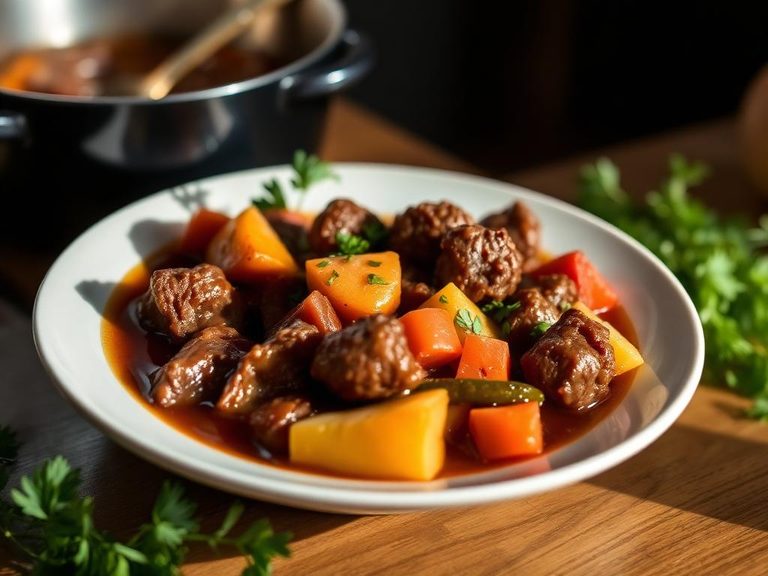
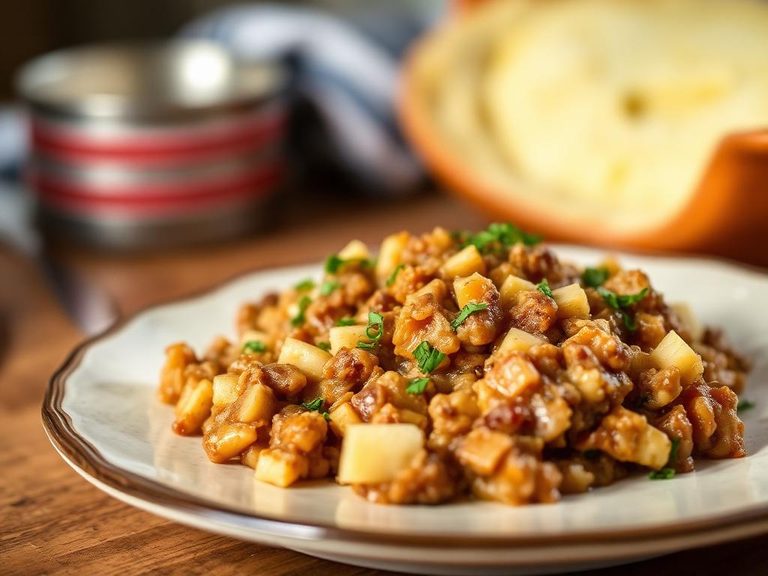


🌍 Where it's eaten
💡 Did you know?
Campbell's introduced its Chunky line in 1970, specifically targeting men with the marketing slogan 'the soup that eats like a meal.'
Full nutrition (USDA data · scales with serving)
| Water | 88.1 g |
| Energy | 49.0 kcal |
| Energy | 204 kj |
| Protein | 3.2 g |
| Total lipid (fat) | 1.2 g |
| Ash | 1.3 g |
| Carbohydrate, by difference | 6.2 g |
| Fiber, total dietary | 1.3 g |
| Total Sugars | 1.1 g |
| Sucrose | 0.51 g |
| Glucose | 0.31 g |
| Fructose | 0.33 g |
| Lactose | 0.00 g |
| Maltose | 0.00 g |
| Galactose | 0.00 g |
| Starch | 3.0 g |
| Calcium, Ca | 17.0 mg |
| Iron, Fe | 0.54 mg |
| Magnesium, Mg | 10.0 mg |
| Phosphorus, P | 48.0 mg |
| Potassium, K | 163 mg |
| Sodium, Na | 346 mg |
| Zinc, Zn | 0.59 mg |
| Copper, Cu | 0.03 mg |
| Manganese, Mn | 0.07 mg |
| Selenium, Se | 3.0 ug |
| Vitamin C, total ascorbic acid | 0.00 mg |
| Thiamin | 0.01 mg |
| Riboflavin | 0.02 mg |
| Niacin | 1.0 mg |
| Choline, total | 12.0 mg |
| Betaine | 0.70 mg |
| Carotene, beta | 1255 ug |
| Carotene, alpha | 605 ug |
| Cryptoxanthin, beta | 0.00 ug |
| Vitamin A, IU | 2595 iu |
| Lycopene | 675 ug |
| Lutein + zeaxanthin | 137 ug |
Fat & fatty acid profile (per 100g)
| Fatty acids, total saturated | 0.41 g |
| Fatty acids, total trans | 0.00 g |
| Cholesterol | 6.0 mg |
FAQ
Is this soup a good source of protein?
It provides a moderate amount of protein (3.16g per 100g) from the beef, making it a decent contributor to a meal, though not a high-protein food on its own.
Can I use this soup as a cooking ingredient?
Yes, its chunky texture and savory base make it excellent as a shortcut for stews, pot pies, or as a sauce for casseroles.
How does the fiber content compare?
With 1.3g of fiber per 100g, it offers some dietary fiber from the vegetables, which can help with satiety.
Nutrient density (calculated · NRF9.3)
Nutrient Rich Foods index: beneficial nutrients (protein, fiber, vitamins, minerals) minus saturated fat, added sugar & sodium, per 100 kcal.
NRF9.3 index — Fulgoni, Keast & Drewnowski, 2009. Computed from USDA nutrients.
Weight-loss friendliness (composite index)
Energy density 0.49 kcal/g · 26% calories from protein · 1.3 g fiber · 1.1 g sugar per 100 g.
Composite of energy density (Rolls et al., 1999), protein & fiber satiety, minus sugar. A calculated heuristic — ranks satiety-per-calorie, not a clinical measure.
Dietary load (calculated from USDA values)
Potential renal acid load. Positive = acid-forming, negative = alkaline-forming.
Sodium-to-potassium ratio: 2.12 (lower is better — aim for ≤ 1)
Sodium:potassium per WHO potassium guidance. Computed from USDA nutrients.