

Beverages, V8 V-FUSION Juices, Strawberry Banana
Whole food · Beverages
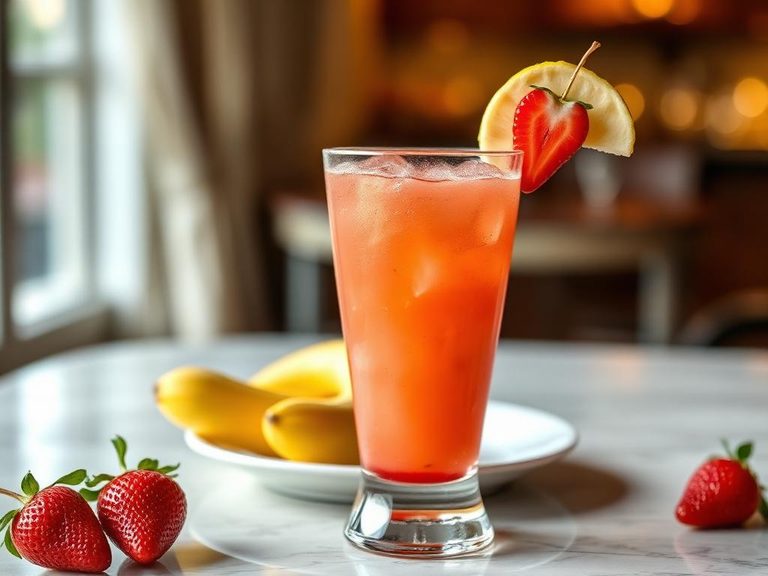
This is a smooth, drinkable fruit blend that captures the sunny sweetness of ripe strawberries and the creamy, tropical notes of banana in a vibrant, ruby-pink juice. The texture is light and refreshing, not pulpy, making it an easy sipper. With only 49 calories per 100g and a notable 10.16g of naturally occurring sugars, it's a quick source of fruit-derived energy.
Calorie split: 3% protein · 97% carbs · 0% fat
↓ Full nutrition💚 Why it's loved
People love it for its perfectly balanced, crowd-pleasing flavor—the tartness of strawberry cuts through the mellow sweetness of banana for a taste that's both nostalgic and refreshing. It's a versatile drink, enjoyed chilled on its own, as a breakfast accompaniment, or even as a base for smoothies.
⚠️ Watch-outs & how to enjoy it better
The primary downside is the high sugar content (over 10g per 100g), which can cause rapid blood-sugar spikes, making it less ideal for those monitoring glucose levels or seeking low-sugar options. To counteract this, pair it with a source of protein or healthy fat (like a handful of nuts or a yogurt dip) to slow sugar absorption, and practice portion control by sticking to a single 118g serving.
Key benefits
- Provides a quick source of natural fruit sugars for energy.
- Contains potassium from banana for normal muscle and nerve function.
- Offers vitamin C from strawberries, which supports immune health.
- A convenient way to increase fruit intake on the go.
- Fat-free and cholesterol-free beverage option.
🍽️ Popular dishes


🌍 Where it's eaten
💡 Did you know?
The classic strawberry-banana flavor pairing was popularized in the 1970s by the creation of the 'Strawberry Banana Smoothie' by Jamba Juice founders, cementing it as a staple in the smoothie and juice industry.
Full nutrition (USDA data · scales with serving)
| Water | 87.9 g |
| Energy | 49.0 kcal |
| Energy | 204 kj |
| Protein | 0.41 g |
| Total lipid (fat) | 0.00 g |
| Ash | 0.10 g |
| Carbohydrate, by difference | 11.8 g |
| Fiber, total dietary | 0.00 g |
| Total Sugars | 10.2 g |
| Calcium, Ca | 8.0 mg |
| Iron, Fe | 0.15 mg |
| Magnesium, Mg | 7.0 mg |
| Potassium, K | 102 mg |
| Sodium, Na | 28.0 mg |
| Vitamin C, total ascorbic acid | 24.4 mg |
| Vitamin B-6 | 0.02 mg |
| Folate, total | 3.0 ug |
| Folate, food | 3.0 ug |
| Vitamin A, IU | 813 iu |
| Vitamin E (alpha-tocopherol) | 0.55 mg |
Fat & fatty acid profile (per 100g)
| Fatty acids, total trans | 0.00 g |
Amino acid profile (per 100g)
Estimated from Beverages, carbonated, tonic water — USDA does not publish this profile for Beverages.
| Tryptophan | 0.00 g |
| Threonine | 0.00 g |
| Isoleucine | 0.00 g |
| Leucine | 0.00 g |
| Lysine | 0.00 g |
| Methionine | 0.00 g |
| Cystine | 0.00 g |
| Phenylalanine | 0.00 g |
| Tyrosine | 0.00 g |
| Valine | 0.00 g |
| Arginine | 0.00 g |
| Histidine | 0.00 g |
| Alanine | 0.00 g |
| Aspartic acid | 0.00 g |
| Glutamic acid | 0.00 g |
| Glycine | 0.00 g |
| Proline | 0.00 g |
| Serine | 0.00 g |
FAQ
Is this juice a good source of fiber?
No, it contains 0g of fiber per 100g. The juicing process removes the insoluble fiber found in whole fruit.
Can I use this as a cooking ingredient?
Absolutely. Its sweet-tart profile makes it excellent for marinades, glazes for chicken or pork, salad dressings, or as a liquid base for oatmeal or pancake batter.
How does it compare nutritionally to whole strawberries and bananas?
While it provides similar vitamins and minerals, it lacks the fiber of whole fruit and concentrates the natural sugars, making it more calorie-dense and quicker to digest.
Nutrient density (calculated · NRF9.3)
Nutrient Rich Foods index: beneficial nutrients (protein, fiber, vitamins, minerals) minus saturated fat, added sugar & sodium, per 100 kcal.
NRF9.3 index — Fulgoni, Keast & Drewnowski, 2009. Computed from USDA nutrients.
Weight-loss friendliness (composite index)
Energy density 0.49 kcal/g · 3% calories from protein · 0.0 g fiber · 10.2 g sugar per 100 g.
Composite of energy density (Rolls et al., 1999), protein & fiber satiety, minus sugar. A calculated heuristic — ranks satiety-per-calorie, not a clinical measure.
Dietary load (calculated from USDA values)
Sodium-to-potassium ratio: 0.27 (lower is better — aim for ≤ 1)
Sodium:potassium per WHO potassium guidance. Computed from USDA nutrients.