

Beverages, SNAPPLE, tea, black and green, ready to drink, peach, diet
Whole food · Beverages

Photo: Wikipedia
This is a diet, ready-to-drink iced tea that blends the robust, malty notes of black tea with the lighter, grassy freshness of green tea, all infused with a sweet peach aroma. Its texture is crisp and clean, with a light body and no sugary aftertaste. Nutritionally, it is an ultra-low-calorie beverage, providing just 2 kcal per 100g, making it a near-zero-calorie option for hydration and flavor.
Calorie split: 50% protein · 50% carbs · 0% fat
↓ Full nutrition💚 Why it's loved
People love it for the refreshing and familiar taste of peach iced tea without the guilt of added sugar. It's a versatile, thirst-quenching pick-me-up that satisfies a sweet craving while fitting easily into calorie-conscious lifestyles.
⚠️ Watch-outs & how to enjoy it better
The artificial sweeteners used to achieve the diet profile may not appeal to everyone and can leave a lingering aftertaste for some palates. Those sensitive to caffeine should note that black and green teas naturally contain it, though typically in moderate amounts. Tip: If you're sensitive, consider it a daytime beverage and monitor your personal response.
Key benefits
- Extremely low in calories (2 kcal per 100g)
- Contains zero sugar and zero fat
- Provides a source of hydration
- Offers the potential antioxidant benefits of tea
- Convenient, shelf-stable, and ready to drink
🍽️ Popular dishes
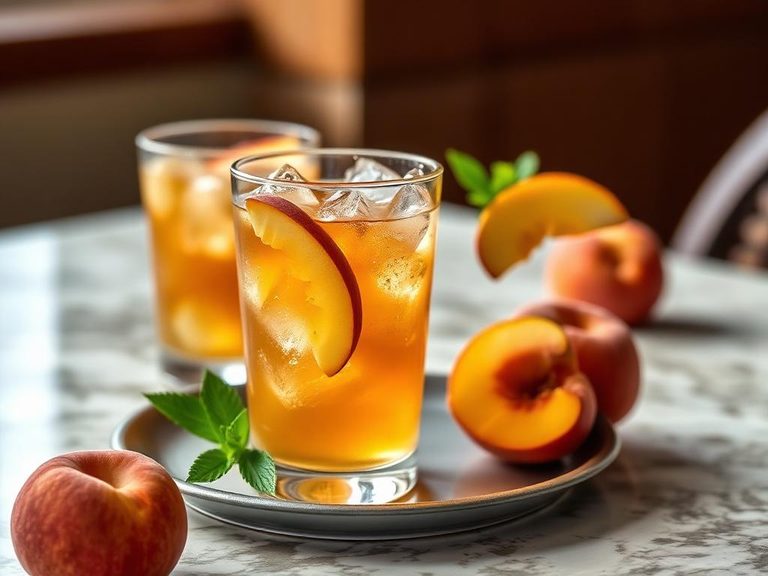
🌍 Where it's eaten
💡 Did you know?
Snapple was famously started by three guys who wanted to make 'better drinks,' and its name is a portmanteau of 'snappy' and 'apple,' though this particular flavor is peach.
Full nutrition (USDA data · scales with serving)
| Water | 99.8 g |
| Energy | 2.0 kcal |
| Energy | 8.0 kj |
| Protein | 0.10 g |
| Total lipid (fat) | 0.00 g |
| Carbohydrate, by difference | 0.10 g |
| Fiber, total dietary | 0.00 g |
| Total Sugars | 0.00 g |
| Calcium, Ca | 0.00 mg |
| Iron, Fe | 0.00 mg |
| Potassium, K | 19.0 mg |
| Sodium, Na | 3.0 mg |
| Vitamin C, total ascorbic acid | 0.00 mg |
| Vitamin A, IU | 3.0 iu |
| Caffeine | 8.0 mg |
Fat & fatty acid profile (per 100g)
| Fatty acids, total saturated | 0.00 g |
| Fatty acids, total trans | 0.00 g |
| Cholesterol | 0.00 mg |
Amino acid profile (per 100g)
Estimated from Beverages, carbonated, tonic water — USDA does not publish this profile for Beverages.
| Tryptophan | 0.00 g |
| Threonine | 0.00 g |
| Isoleucine | 0.00 g |
| Leucine | 0.00 g |
| Lysine | 0.00 g |
| Methionine | 0.00 g |
| Cystine | 0.00 g |
| Phenylalanine | 0.00 g |
| Tyrosine | 0.00 g |
| Valine | 0.00 g |
| Arginine | 0.00 g |
| Histidine | 0.00 g |
| Alanine | 0.00 g |
| Aspartic acid | 0.00 g |
| Glutamic acid | 0.00 g |
| Glycine | 0.00 g |
| Proline | 0.00 g |
| Serine | 0.00 g |
FAQ
Is this tea actually made with real tea leaves?
Yes, the ingredients list typically includes both black and green tea concentrate, which is brewed from actual tea leaves.
Why is it so low in calories if it tastes sweet?
The sweetness comes from zero-calorie artificial sweeteners like sucralose and acesulfame potassium, which provide the sweet taste without the sugar or calories.
Does it contain caffeine?
Yes, because it is made from black and green tea, it contains caffeine, though the exact amount can vary by batch and serving size.
Nutrient density (calculated · NRF9.3)
Nutrient Rich Foods index: beneficial nutrients (protein, fiber, vitamins, minerals) minus saturated fat, added sugar & sodium, per 100 kcal.
NRF9.3 index — Fulgoni, Keast & Drewnowski, 2009. Computed from USDA nutrients.
Weight-loss friendliness (composite index)
Energy density 0.02 kcal/g · 20% calories from protein · 0.0 g fiber · 0.0 g sugar per 100 g.
Composite of energy density (Rolls et al., 1999), protein & fiber satiety, minus sugar. A calculated heuristic — ranks satiety-per-calorie, not a clinical measure.
Dietary load (calculated from USDA values)
Sodium-to-potassium ratio: 0.16 (lower is better — aim for ≤ 1)
Sodium:potassium per WHO potassium guidance. Computed from USDA nutrients.