

McDONALD'S, Fruit 'n Yogurt Parfait (without granola)
Whole food · Fast Foods
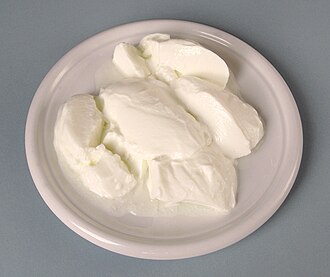
Photo: Wikipedia
This is a light, creamy yogurt-based dessert served in a clear cup, featuring layers of smooth vanilla yogurt and mixed fruit (typically strawberries and blueberries). The texture is soft and cool, with a sweet, tangy flavor profile from the yogurt and natural fruit sugars. Nutritionally, it's a low-calorie, low-fat option with a modest protein boost from the dairy.
Calorie split: 11% protein · 78% carbs · 11% fat
↓ Full nutrition💚 Why it's loved
People love it for its refreshing, sweet-tart balance and the satisfying contrast between creamy yogurt and juicy fruit. It's seen as a 'guilt-free' indulgence, often enjoyed as a breakfast on-the-go or a light dessert, fitting into a casual, health-conscious lifestyle.
⚠️ Watch-outs & how to enjoy it better
The main concern is the added sugar from the flavored yogurt and fruit syrup, which can cause blood-sugar spikes, especially for those with diabetes or insulin resistance. To counteract this, pair it with a source of protein or healthy fat (like a handful of nuts) to slow sugar absorption, and be mindful of portion size as a treat, not a staple.
Key benefits
- Provides a quick source of calcium and protein from yogurt
- Low in fat and calories, suitable for light snacking
- Contains natural fruit for vitamins and a small amount of fiber
- Offers a sweet treat with less sugar than many desserts
- Convenient, pre-portioned, and portable
🍽️ Popular dishes




🌍 Where it's eaten
💡 Did you know?
The McDonald's Fruit 'n Yogurt Parfait was a popular menu item for years, often chosen as the 'healthy' option in Happy Meals before being discontinued in many U.S. locations in 2020.
Full nutrition (USDA data · scales with serving)
| Water | 78.2 g |
| Energy | 90.0 kcal |
| Energy | 377 kj |
| Protein | 2.5 g |
| Total lipid (fat) | 1.1 g |
| Ash | 0.56 g |
| Carbohydrate, by difference | 17.7 g |
| Fiber, total dietary | 0.90 g |
| Total Sugars | 11.9 g |
| Sucrose | 7.0 g |
| Glucose | 0.75 g |
| Fructose | 1.8 g |
| Lactose | 2.2 g |
| Maltose | 0.00 g |
| Galactose | 0.18 g |
| Calcium, Ca | 87.0 mg |
| Iron, Fe | 0.36 mg |
| Magnesium, Mg | 12.0 mg |
| Phosphorus, P | 71.0 mg |
| Potassium, K | 165 mg |
| Sodium, Na | 38.0 mg |
| Zinc, Zn | 0.30 mg |
| Copper, Cu | 0.04 mg |
| Manganese, Mn | 0.12 mg |
| Vitamin C, total ascorbic acid | 14.5 mg |
| Thiamin | 0.03 mg |
| Riboflavin | 0.12 mg |
| Niacin | 0.19 mg |
| Pantothenic acid | 0.40 mg |
| Folate, total | 11.0 ug |
| Folate, food | 11.0 ug |
| Vitamin B-12 | 0.20 ug |
| Vitamin A, IU | 62.0 iu |
Fat & fatty acid profile (per 100g)
| Fatty acids, total saturated | 0.00 g |
| Fatty acids, total monounsaturated | 0.01 g |
| Fatty acids, total polyunsaturated | 0.03 g |
| Fatty acids, total trans | 0.05 g |
| Cholesterol | 5.0 mg |
FAQ
Is this parfait a good source of protein?
It provides a modest amount of protein (about 2.5g per 100g) from the yogurt, but it's not a high-protein food. For a more substantial protein boost, consider adding nuts or seeds.
Does it contain live cultures?
The yogurt used is typically a processed, flavored variety, which may not contain the live active cultures found in traditional yogurts. Check the specific product details for confirmation.
Can I make a healthier version at home?
Absolutely. Use plain, unsweetened Greek yogurt for more protein and less sugar, and top with fresh, whole fruits instead of syrupy ones. This gives you control over ingredients and nutrition.
Nutrient density (calculated · NRF9.3)
Nutrient Rich Foods index: beneficial nutrients (protein, fiber, vitamins, minerals) minus saturated fat, added sugar & sodium, per 100 kcal.
NRF9.3 index — Fulgoni, Keast & Drewnowski, 2009. Computed from USDA nutrients.
Weight-loss friendliness (composite index)
Energy density 0.90 kcal/g · 11% calories from protein · 0.9 g fiber · 11.9 g sugar per 100 g.
Composite of energy density (Rolls et al., 1999), protein & fiber satiety, minus sugar. A calculated heuristic — ranks satiety-per-calorie, not a clinical measure.
Dietary load (calculated from USDA values)
Potential renal acid load. Positive = acid-forming, negative = alkaline-forming.
Sodium-to-potassium ratio: 0.23 (lower is better — aim for ≤ 1)
Sodium:potassium per WHO potassium guidance. Computed from USDA nutrients.