

McDONALD'S, Fruit 'n Yogurt Parfait
Whole food · Fast Foods

Photo: Wikipedia
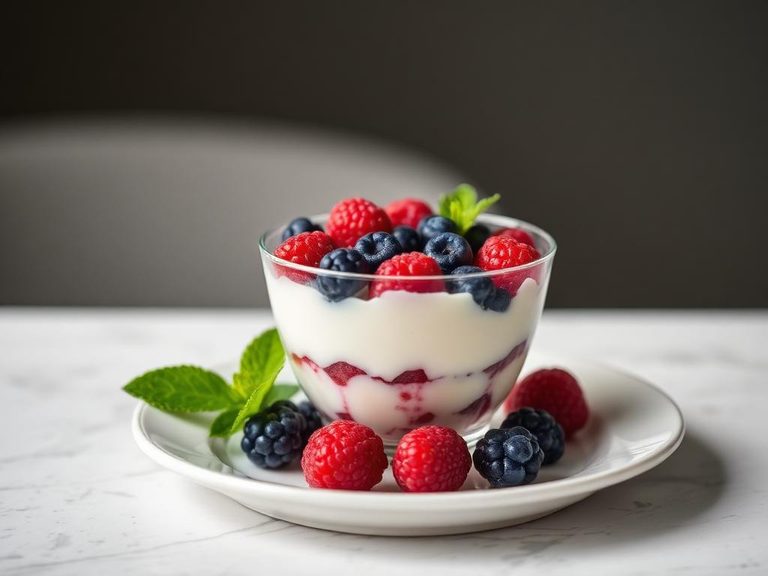
A layered McDonald's dessert featuring vanilla yogurt, mixed berries (strawberries, blueberries, raspberries), and a crunchy granola topping. It offers a sweet-tart, creamy, and textured experience, with a relatively light calorie profile for a fast-food treat.
Calorie split: 10% protein · 79% carbs · 11% fat
↓ Full nutrition💚 Why it's loved
People enjoy it for its refreshing, not-too-heavy sweetness and the satisfying contrast between the smooth yogurt, juicy fruit, and crunchy granola. It's often seen as a 'healthier' indulgence or a quick breakfast-on-the-go.
⚠️ Watch-outs & how to enjoy it better
The high sugar content (over 12g per 100g) can lead to a rapid blood-sugar spike, especially without significant protein or fat to slow absorption. To counteract this, pair it with a source of protein (like a hard-boiled egg) or eat it as part of a balanced meal. Those monitoring sugar intake should be mindful of the portion.
Key benefits
- Provides calcium and probiotics from the yogurt component
- Contains antioxidants from the mixed berry blend
- Offers a source of quick energy from carbohydrates
- Lighter calorie option compared to many fast-food desserts
- Combines protein, carbs, and a small amount of fat for some satiety
🍽️ Popular dishes




🌍 Where it's eaten
💡 Did you know?
The granola in the parfait is specifically formulated to maintain its crunch even when sitting atop the moist yogurt for a period of time.
Full nutrition (USDA data · scales with serving)
| Water | 74.6 g |
| Energy | 105 kcal |
| Energy | 439 kj |
| Protein | 2.7 g |
| Total lipid (fat) | 1.3 g |
| Ash | 0.64 g |
| Carbohydrate, by difference | 20.7 g |
| Fiber, total dietary | 1.0 g |
| Total Sugars | 12.8 g |
| Sucrose | 7.9 g |
| Glucose | 0.78 g |
| Fructose | 1.8 g |
| Lactose | 2.1 g |
| Maltose | 0.07 g |
| Galactose | 0.17 g |
| Calcium, Ca | 86.0 mg |
| Iron, Fe | 0.45 mg |
| Magnesium, Mg | 14.0 mg |
| Phosphorus, P | 84.0 mg |
| Potassium, K | 167 mg |
| Sodium, Na | 58.0 mg |
| Zinc, Zn | 0.36 mg |
| Copper, Cu | 0.05 mg |
| Manganese, Mn | 0.20 mg |
| Vitamin C, total ascorbic acid | 13.9 mg |
| Thiamin | 0.05 mg |
| Riboflavin | 0.12 mg |
| Niacin | 0.24 mg |
| Pantothenic acid | 0.42 mg |
| Folate, total | 13.0 ug |
| Folate, food | 13.0 ug |
| Vitamin B-12 | 0.19 ug |
| Vitamin A, IU | 59.0 iu |
Fat & fatty acid profile (per 100g)
| Fatty acids, total saturated | 0.04 g |
| Fatty acids, total monounsaturated | 0.11 g |
| Fatty acids, total polyunsaturated | 0.10 g |
| Fatty acids, total trans | 0.05 g |
| Cholesterol | 5.0 mg |
FAQ
Is the Fruit 'n Yogurt Parfait a healthy choice?
It can be a better option than many fast-food desserts due to its lower fat and calorie content, and the inclusion of yogurt and fruit. However, it is high in added sugar, so it's best enjoyed occasionally as a treat.
What are the main ingredients?
The primary components are vanilla-flavored low-fat yogurt, a blend of berries (typically strawberries, blueberries, and raspberries), and a crunchy oat-based granola topping.
Does it contain any common allergens?
Yes. The granola typically contains wheat (gluten) and may be produced in facilities that handle nuts, soy, and milk. The yogurt contains milk. Always check the latest allergen information from McDonald's for your region.
Nutrient density (calculated · NRF9.3)
Nutrient Rich Foods index: beneficial nutrients (protein, fiber, vitamins, minerals) minus saturated fat, added sugar & sodium, per 100 kcal.
NRF9.3 index — Fulgoni, Keast & Drewnowski, 2009. Computed from USDA nutrients.
Weight-loss friendliness (composite index)
Energy density 1.05 kcal/g · 10% calories from protein · 1.0 g fiber · 12.8 g sugar per 100 g.
Composite of energy density (Rolls et al., 1999), protein & fiber satiety, minus sugar. A calculated heuristic — ranks satiety-per-calorie, not a clinical measure.
Dietary load (calculated from USDA values)
Potential renal acid load. Positive = acid-forming, negative = alkaline-forming.
Sodium-to-potassium ratio: 0.35 (lower is better — aim for ≤ 1)
Sodium:potassium per WHO potassium guidance. Computed from USDA nutrients.