

McDONALD'S, Sausage McMUFFIN with Egg
Whole food · Fast Foods
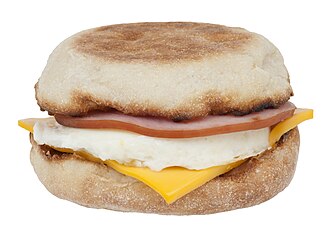
Photo: Wikipedia
The McDonald's Sausage McMuffin with Egg is a hearty, savory breakfast sandwich featuring a seasoned pork sausage patty, a folded egg, and a slice of American cheese, all nestled within a toasted English muffin. It delivers a satisfying combination of salty, meaty, and rich flavors with a soft, slightly chewy texture from the muffin and a crisp edge from the sausage. Nutritionally, it provides a substantial protein boost (around 12.6g per 100g) but is also high in fat and sodium, making it a filling yet calorie-dense option.
Calorie split: 18% protein · 25% carbs · 57% fat
↓ Full nutrition💚 Why it's loved
People love it for its iconic, nostalgic taste that combines savory sausage, creamy egg, and melted cheese in a portable format. It's a staple of American fast-food culture, often enjoyed as a quick, satisfying breakfast on the go.
⚠️ Watch-outs & how to enjoy it better
The sandwich is high in sodium and saturated fat, which may concern those managing blood pressure or cholesterol levels. To mitigate, pair it with a side of fruit or vegetables for fiber, and consider a smaller portion or a lower-sodium alternative if sensitive. Additionally, the refined carbs from the English muffin can cause blood-sugar spikes; balancing with protein and fat helps stabilize energy.
Key benefits
- High protein content supports muscle maintenance and satiety
- Convenient and widely available for quick breakfasts
- Provides a balanced mix of protein, carbs, and fat for energy
- Contains iron and B vitamins from the sausage and egg
- Offers a familiar, comforting flavor profile for many
🍽️ Popular dishes





🌍 Where it's eaten
💡 Did you know?
The McMuffin was inspired by Eggs Benedict and was first introduced by McDonald's in 1972, making it one of the earliest fast-food breakfast items to gain widespread popularity.
Full nutrition (USDA data · scales with serving)
| Water | 50.0 g |
| Energy | 274 kcal |
| Energy | 1146 kj |
| Protein | 12.6 g |
| Total lipid (fat) | 17.8 g |
| Ash | 2.3 g |
| Carbohydrate, by difference | 17.3 g |
| Fiber, total dietary | 0.90 g |
| Total Sugars | 1.6 g |
| Sucrose | 0.09 g |
| Glucose | 0.38 g |
| Fructose | 0.24 g |
| Lactose | 0.33 g |
| Maltose | 0.51 g |
| Galactose | 0.03 g |
| Calcium, Ca | 172 mg |
| Iron, Fe | 2.0 mg |
| Magnesium, Mg | 18.0 mg |
| Phosphorus, P | 171 mg |
| Potassium, K | 171 mg |
| Sodium, Na | 572 mg |
| Zinc, Zn | 1.2 mg |
| Copper, Cu | 0.09 mg |
| Manganese, Mn | 0.19 mg |
| Vitamin C, total ascorbic acid | 0.00 mg |
| Thiamin | 0.26 mg |
| Riboflavin | 0.34 mg |
| Niacin | 2.9 mg |
| Pantothenic acid | 0.82 mg |
| Vitamin B-6 | 0.15 mg |
| Vitamin B-12 | 0.70 ug |
| Vitamin A, IU | 335 iu |
| Vitamin E (alpha-tocopherol) | 0.50 mg |
Fat & fatty acid profile (per 100g)
| Fatty acids, total saturated | 6.0 g |
| Fatty acids, total monounsaturated | 6.6 g |
| Fatty acids, total polyunsaturated | 2.8 g |
| Fatty acids, total trans | 0.34 g |
| Cholesterol | 154 mg |
FAQ
How many calories are in a Sausage McMuffin with Egg?
A standard serving contains approximately 274 calories per 100g, with a typical sandwich weighing around 118g, totaling about 323 calories.
Is the Sausage McMuffin with Egg a good source of protein?
Yes, it provides about 12.6g of protein per 100g, which is beneficial for muscle repair and satiety.
What are the main ingredients in a Sausage McMuffin with Egg?
The main ingredients include a pork sausage patty, egg, American cheese, and an English muffin.
Can I make a healthier version at home?
Yes, you can use whole-grain English muffins, lean turkey sausage, and fresh eggs to reduce fat and sodium while increasing fiber.
Is this sandwich suitable for people with gluten intolerance?
No, the English muffin contains gluten, so it's not suitable for those with celiac disease or gluten sensitivity unless a gluten-free version is used.
Nutrient density (calculated · NRF9.3)
Nutrient Rich Foods index: beneficial nutrients (protein, fiber, vitamins, minerals) minus saturated fat, added sugar & sodium, per 100 kcal.
NRF9.3 index — Fulgoni, Keast & Drewnowski, 2009. Computed from USDA nutrients.
Weight-loss friendliness (composite index)
Energy density 2.74 kcal/g · 18% calories from protein · 0.9 g fiber · 1.6 g sugar per 100 g.
Composite of energy density (Rolls et al., 1999), protein & fiber satiety, minus sugar. A calculated heuristic — ranks satiety-per-calorie, not a clinical measure.
Dietary load (calculated from USDA values)
Potential renal acid load. Positive = acid-forming, negative = alkaline-forming.
Sodium-to-potassium ratio: 3.35 (lower is better — aim for ≤ 1)
Sodium:potassium per WHO potassium guidance. Computed from USDA nutrients.