

Cereals ready-to-eat, QUAKER, MOTHER'S GRAHAM BUMPERS
Whole food · Breakfast Cereals

Photo: Wikipedia
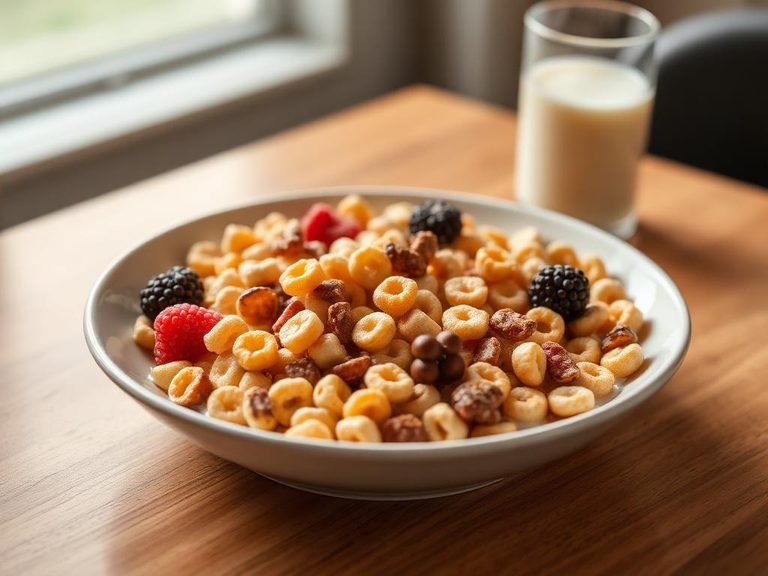
Quaker Mother's Graham Bumpers are a nostalgic, crunchy, honey-sweetened graham cereal shaped like small, bite-sized pillows or bumps. They deliver a satisfying, crumbly texture with a distinct, toasty sweetness reminiscent of classic graham crackers. Nutritionally, they are a high-carbohydrate, sugar-dense cereal, providing quick energy but minimal protein or fat.
Calorie split: 5% protein · 92% carbs · 3% fat
↓ Full nutrition💚 Why it's loved
People love these for their satisfying crunch and the comforting, honey-kissed graham flavor that evokes childhood memories. They are often enjoyed as a quick, sweet snack or a simple breakfast, appreciated for their straightforward, no-fuss taste and texture.
⚠️ Watch-outs & how to enjoy it better
The high sugar content (over 44g per 100g) can lead to rapid blood-sugar spikes and subsequent energy crashes, making it a poor choice for sustained energy or for those managing blood sugar levels. To mitigate this, pair a smaller portion (about 1/2 cup) with a source of protein or healthy fat, like Greek yogurt or a handful of nuts, to slow sugar absorption and increase satiety.
Key benefits
- Provides a quick source of energy from carbohydrates.
- Offers a small amount of dietary fiber.
- Convenient, ready-to-eat breakfast or snack.
- Contains a modest amount of iron and B vitamins (fortified).
- Nostalgic comfort food with a familiar, sweet flavor.
🍽️ Popular dishes

🌍 Where it's eaten
💡 Did you know?
Graham crackers, the inspiration for this cereal, were originally created in the 1820s by a Presbyterian minister named Sylvester Graham, who believed a bland, high-fiber diet could curb 'immoral urges.'
Full nutrition (USDA data · scales with serving)
| Water | 2.5 g |
| Energy | 379 kcal |
| Energy | 1587 kj |
| Protein | 4.5 g |
| Total lipid (fat) | 1.4 g |
| Ash | 2.6 g |
| Carbohydrate, by difference | 88.9 g |
| Fiber, total dietary | 2.6 g |
| Total Sugars | 44.3 g |
| Calcium, Ca | 18.0 mg |
| Iron, Fe | 1.9 mg |
| Magnesium, Mg | 57.0 mg |
| Phosphorus, P | 156 mg |
| Potassium, K | 199 mg |
| Sodium, Na | 758 mg |
| Zinc, Zn | 1.0 mg |
| Vitamin C, total ascorbic acid | 0.30 mg |
| Thiamin | 0.16 mg |
| Riboflavin | 0.05 mg |
| Niacin | 1.1 mg |
| Vitamin B-6 | 0.06 mg |
| Folate, total | 15.0 ug |
| Folic acid | 0.00 ug |
| Folate, food | 15.0 ug |
| Folate, DFE | 15.0 ug |
| Vitamin B-12 | 0.00 ug |
| Vitamin A, RAE | 8.0 ug |
| Retinol | 0.00 ug |
| Vitamin A, IU | 162 iu |
| Vitamin E (alpha-tocopherol) | 2.5 mg |
Fat & fatty acid profile (per 100g)
| Fatty acids, total saturated | 0.28 g |
| Fatty acids, total monounsaturated | 0.33 g |
| Fatty acids, total polyunsaturated | 0.69 g |
| Fatty acids, total trans | 0.00 g |
| Cholesterol | 0.00 mg |
FAQ
What is the main flavor profile of Mother's Graham Bumpers?
They have a distinct, sweet, honey-like graham flavor with a toasty, slightly nutty undertone, similar to a graham cracker.
Is this cereal a good source of protein?
No, with only 4.55g of protein per 100g, it is a low-protein food. It's best paired with a protein-rich food like milk, yogurt, or nuts to create a more balanced meal.
Can I use this cereal in baking?
Yes, it can be crushed and used as a base for pie crusts or as a topping for desserts, similar to how graham crackers are used.
What is the sugar content like?
It is very high in sugar, with 44.33g per 100g. This makes it a sweet treat rather than a nutritionally balanced staple.
Nutrient density (calculated · NRF9.3)
Nutrient Rich Foods index: beneficial nutrients (protein, fiber, vitamins, minerals) minus saturated fat, added sugar & sodium, per 100 kcal.
NRF9.3 index — Fulgoni, Keast & Drewnowski, 2009. Computed from USDA nutrients.
Weight-loss friendliness (composite index)
Energy density 3.79 kcal/g · 5% calories from protein · 2.6 g fiber · 44.3 g sugar per 100 g.
Composite of energy density (Rolls et al., 1999), protein & fiber satiety, minus sugar. A calculated heuristic — ranks satiety-per-calorie, not a clinical measure.
Dietary load (calculated from USDA values)
Potential renal acid load. Positive = acid-forming, negative = alkaline-forming.
Sodium-to-potassium ratio: 3.81 (lower is better — aim for ≤ 1)
Sodium:potassium per WHO potassium guidance. Computed from USDA nutrients.