

Cereals ready-to-eat, MOM'S BEST, Sweetened WHEAT-FULS
Whole food · Breakfast Cereals

Photo: Wikipedia
Mom's Best Sweetened Wheat-Fuls are crunchy, bite-sized pillows of toasted whole wheat cereal, glazed with a light, sweet coating that delivers a satisfying, honey-kissed crunch. Nutritionally, they are a standout for their high fiber content (10g per 100g), which supports digestive health, and their relatively high protein for a cereal (8.18g per 100g).
Calorie split: 9% protein · 87% carbs · 4% fat
↓ Full nutrition💚 Why it's loved
People love it for its addictive, crunchy texture and the perfect balance of wheaty, toasty flavor with a subtle, not-too-cloying sweetness. It's a versatile staple, enjoyed as a quick breakfast, a satisfying snack straight from the box, or a crunchy topping for yogurt and fruit.
⚠️ Watch-outs & how to enjoy it better
The primary downside is its high sugar content (20.29g per 100g), which can lead to a rapid blood-sugar spike, especially if eaten alone. To counteract this, pair a measured portion (about 1 cup) with a source of protein and healthy fat, like Greek yogurt, milk, or a handful of nuts, to slow sugar absorption and increase satiety.
Key benefits
- Excellent source of dietary fiber (10g per 100g).
- Good plant-based protein content (8.18g per 100g).
- Made from whole wheat, providing complex carbohydrates.
- Low in fat (1.83g per 100g).
- Provides quick energy from its carbohydrate content.
🍽️ Popular dishes
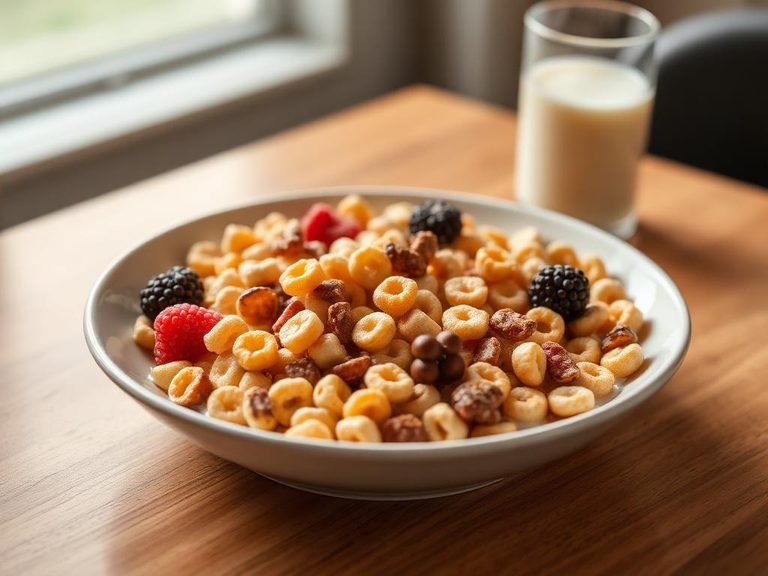

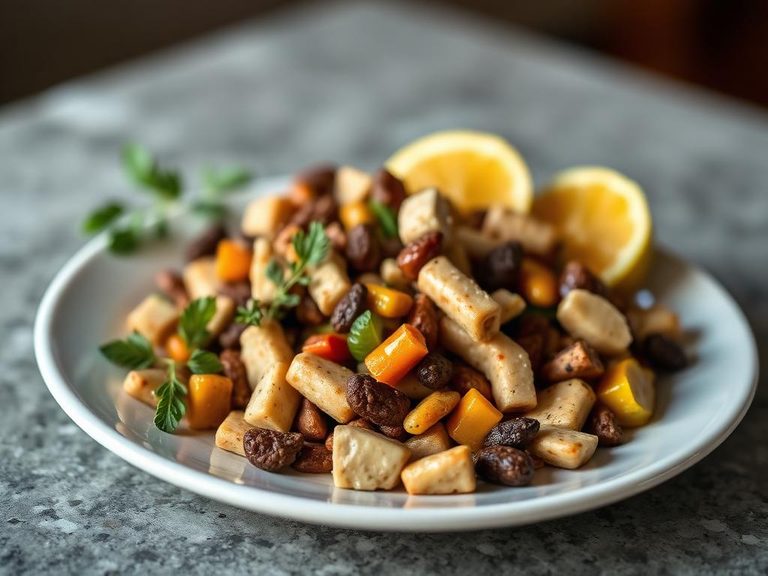
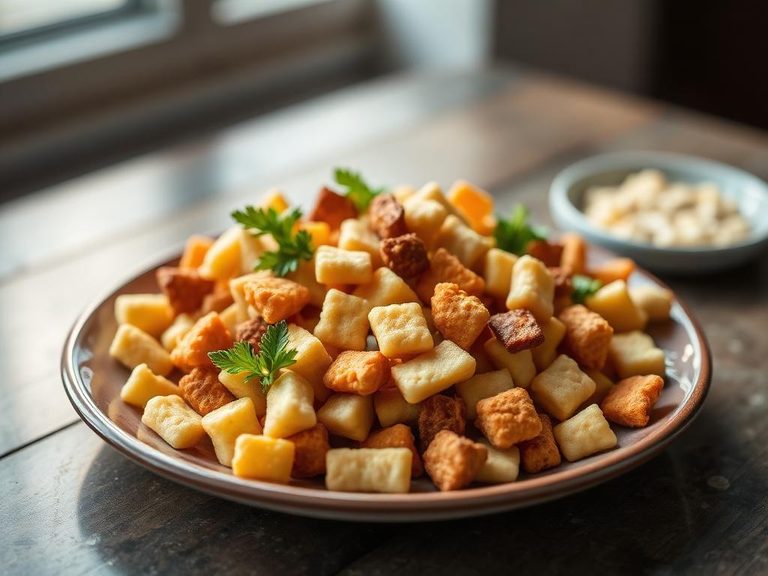
🌍 Where it's eaten
💡 Did you know?
The name 'Wheat-Fuls' is a playful portmanteau, suggesting both 'wheat' and 'mouthfuls,' perfectly describing the cereal's small, satisfying, bite-sized pieces.
Full nutrition (USDA data · scales with serving)
| Water | 6.0 g |
| Energy | 373 kcal |
| Energy | 1560 kj |
| Protein | 8.2 g |
| Total lipid (fat) | 1.8 g |
| Ash | 3.1 g |
| Carbohydrate, by difference | 80.9 g |
| Fiber, total dietary | 10.0 g |
| Total Sugars | 20.3 g |
| Calcium, Ca | 36.0 mg |
| Iron, Fe | 3.3 mg |
| Magnesium, Mg | 73.0 mg |
| Phosphorus, P | 273 mg |
| Potassium, K | 336 mg |
| Sodium, Na | 14.0 mg |
| Zinc, Zn | 2.8 mg |
| Vitamin C, total ascorbic acid | 0.00 mg |
| Thiamin | 0.21 mg |
| Riboflavin | 0.11 mg |
| Niacin | 5.4 mg |
| Vitamin B-6 | 0.28 mg |
| Folate, total | 30.0 ug |
| Folate, food | 30.0 ug |
| Vitamin B-12 | 0.21 ug |
| Vitamin A, IU | 0.00 iu |
| Vitamin E (alpha-tocopherol) | 0.81 mg |
| Vitamin D (D2 + D3), International Units | 0.00 iu |
| Vitamin D (D2 + D3) | 0.00 ug |
| Vitamin D3 (cholecalciferol) | 0.00 ug |
| Vitamin K (phylloquinone) | 1.5 ug |
| Caffeine | 0.00 mg |
Fat & fatty acid profile (per 100g)
| Fatty acids, total saturated | 0.00 g |
| Fatty acids, total monounsaturated | 0.00 g |
| Fatty acids, total polyunsaturated | 1.1 g |
| Fatty acids, total trans | 0.00 g |
| Cholesterol | 0.00 mg |
FAQ
Is this cereal gluten-free?
No. Since it is made from whole wheat, it contains gluten and is not suitable for individuals with celiac disease or gluten sensitivity.
How does it differ from granola?
Unlike granola, which is typically baked with oats, nuts, seeds, and oil, Wheat-Fuls are primarily made from wheat pieces that are toasted and sweetened, resulting in a lighter, crunchier texture without the clumping.
Can I use this in baking?
Yes, it can be crushed and used as a crunchy topping for casseroles, a binding agent in veggie burgers, or mixed into cookie dough for added texture.
Nutrient density (calculated · NRF9.3)
Nutrient Rich Foods index: beneficial nutrients (protein, fiber, vitamins, minerals) minus saturated fat, added sugar & sodium, per 100 kcal.
NRF9.3 index — Fulgoni, Keast & Drewnowski, 2009. Computed from USDA nutrients.
Weight-loss friendliness (composite index)
Energy density 3.73 kcal/g · 9% calories from protein · 10.0 g fiber · 20.3 g sugar per 100 g.
Composite of energy density (Rolls et al., 1999), protein & fiber satiety, minus sugar. A calculated heuristic — ranks satiety-per-calorie, not a clinical measure.
Dietary load (calculated from USDA values)
Potential renal acid load. Positive = acid-forming, negative = alkaline-forming.
Sodium-to-potassium ratio: 0.04 (lower is better — aim for ≤ 1)
Sodium:potassium per WHO potassium guidance. Computed from USDA nutrients.