

CAMPBELL'S, Tomato Soup, condensed
Whole food · Soups, Sauces, and Gravies
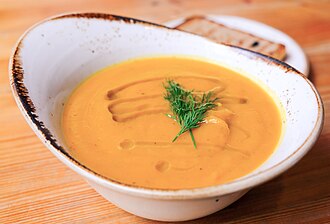
Photo: Wikipedia
Campbell's Condensed Tomato Soup is a smooth, velvety pantry staple with a bright, tangy tomato flavor and a hint of sweetness. It's designed to be diluted with water or milk, transforming from a thick concentrate into a comforting, sippable soup. Nutritionally, it's a low-calorie, virtually fat-free option that provides a quick source of energy from carbohydrates.
Calorie split: 8% protein · 86% carbs · 6% fat
↓ Full nutrition💚 Why it's loved
People love it for its nostalgic, comforting flavor and incredible versatility—it's a base for countless recipes, a cozy drink on its own, and a classic partner for grilled cheese sandwiches. Its sweet-tart profile and smooth texture make it a universally appealing comfort food.
⚠️ Watch-outs & how to enjoy it better
The condensed version can be high in sodium and contains added sugar, which may concern those monitoring blood sugar or salt intake. To counteract this, pair it with a protein-rich food (like cheese or beans) to slow sugar absorption, use a low-sodium version if available, or dilute it with water instead of milk to reduce overall calorie and sugar density per serving.
Key benefits
- Very low in calories (71 kcal per 100g)
- Virtually fat-free (0.44g per 100g)
- Good source of quick energy from carbohydrates
- Contains a small amount of dietary fiber
- Convenient, shelf-stable, and quick to prepare
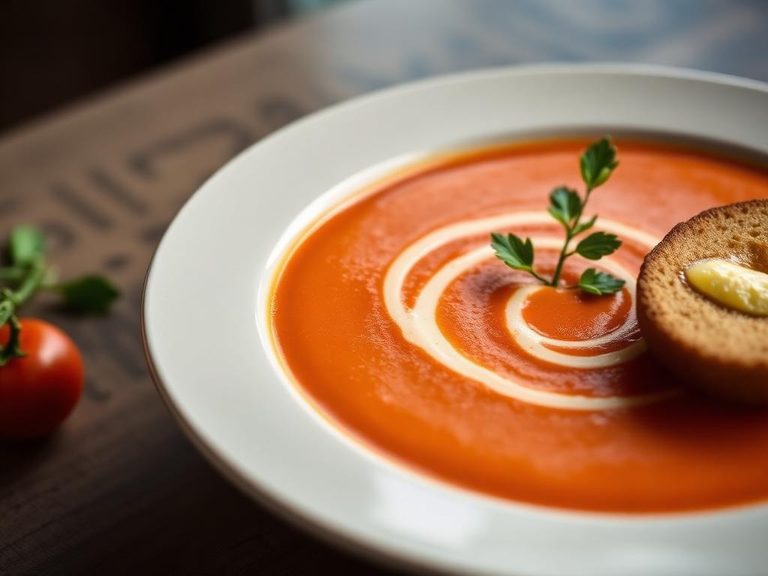
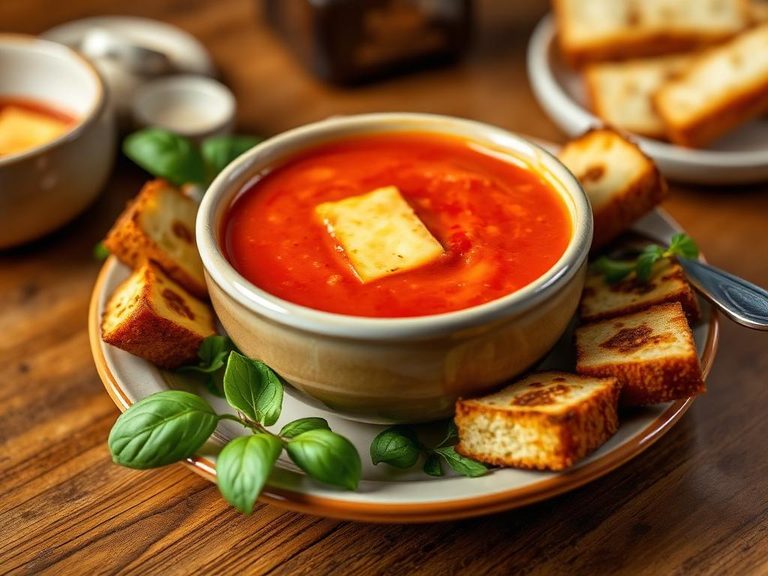
🍽️ Popular dishes



🌍 Where it's eaten
💡 Did you know?
Campbell's Tomato Soup was one of the first canned soups to be marketed as a 'meal in itself' when it was introduced in 1897, revolutionizing home cooking with its convenience.
Full nutrition (USDA data · scales with serving)
| Water | 80.8 g |
| Energy | 71.0 kcal |
| Energy | 296 kj |
| Protein | 1.5 g |
| Total lipid (fat) | 0.44 g |
| Ash | 2.1 g |
| Carbohydrate, by difference | 15.2 g |
| Fiber, total dietary | 1.1 g |
| Total Sugars | 8.2 g |
| Sucrose | 0.00 g |
| Glucose | 3.5 g |
| Fructose | 4.7 g |
| Lactose | 0.00 g |
| Maltose | 0.00 g |
| Galactose | 0.00 g |
| Starch | 4.0 g |
| Calcium, Ca | 13.0 mg |
| Iron, Fe | 0.59 mg |
| Magnesium, Mg | 14.0 mg |
| Phosphorus, P | 31.0 mg |
| Potassium, K | 562 mg |
| Sodium, Na | 377 mg |
| Zinc, Zn | 0.18 mg |
| Copper, Cu | 0.05 mg |
| Manganese, Mn | 0.14 mg |
| Selenium, Se | 3.0 ug |
| Vitamin C, total ascorbic acid | 4.8 mg |
| Thiamin | 0.04 mg |
| Riboflavin | 0.01 mg |
| Niacin | 0.86 mg |
| Vitamin A, IU | 323 iu |
Fat & fatty acid profile (per 100g)
| Fatty acids, total saturated | 0.00 g |
| Fatty acids, total monounsaturated | 0.00 g |
| Fatty acids, total polyunsaturated | 0.00 g |
| Fatty acids, total trans | 0.00 g |
| Cholesterol | 0.00 mg |
FAQ
How is condensed soup different from regular soup?
Condensed soup is cooked and reduced to remove most of the water, making it thick and concentrated. You typically add an equal amount of water (or milk) back to it before eating, which also stretches the can to serve more people.
Is it healthy to eat straight from the can?
While safe, eating it undiluted means you're consuming a much higher concentration of calories, sodium, and sugar per volume. Diluting it as directed creates a more balanced, lower-calorie soup.
Can I use it in recipes other than soup?
Absolutely! It's a secret weapon in the kitchen. Use it as a base for chili, a sauce for pasta or meatloaf, a braising liquid for meats, or even as a moistening agent in savory baked goods like the classic Tomato Soup Cake.
Nutrient density (calculated · NRF9.3)
Nutrient Rich Foods index: beneficial nutrients (protein, fiber, vitamins, minerals) minus saturated fat, added sugar & sodium, per 100 kcal.
NRF9.3 index — Fulgoni, Keast & Drewnowski, 2009. Computed from USDA nutrients.
Weight-loss friendliness (composite index)
Energy density 0.71 kcal/g · 8% calories from protein · 1.1 g fiber · 8.2 g sugar per 100 g.
Composite of energy density (Rolls et al., 1999), protein & fiber satiety, minus sugar. A calculated heuristic — ranks satiety-per-calorie, not a clinical measure.
Dietary load (calculated from USDA values)
Potential renal acid load. Positive = acid-forming, negative = alkaline-forming.
Sodium-to-potassium ratio: 0.67 (lower is better — aim for ≤ 1)
Sodium:potassium per WHO potassium guidance. Computed from USDA nutrients.