

McDONALD'S, Sausage, Egg & Cheese McGRIDDLES
Whole food · Fast Foods

Photo: Wikipedia
A McDonald's breakfast sandwich featuring a savory sausage patty, a fluffy folded egg, and melted American cheese, all sandwiched between two sweet, maple-flavored griddle cakes. The experience is a distinct sweet-and-savory contrast, with the soft, slightly sticky griddle cakes giving way to the salty, meaty sausage and creamy egg. Per 100g, it delivers a substantial 17.73g of fat, primarily from the sausage and cheese, alongside 10.77g of protein.
Calorie split: 15% protein · 30% carbs · 55% fat
↓ Full nutrition💚 Why it's loved
People love it for the iconic sweet-and-salty flavor combination, where the maple-sweetened griddle cakes perfectly offset the savory sausage. It's a beloved, nostalgic breakfast staple for many, representing a quick, indulgent start to the day.
⚠️ Watch-outs & how to enjoy it better
The high fat and sodium content, along with refined carbs and sugar (7.9g per 100g), can contribute to blood-sugar spikes and may not suit low-sodium or heart-healthy diets. To counteract, consider eating half, pairing it with a side of fruit or a black coffee, and drinking extra water throughout the morning.
Key benefits
- High in protein for a quick breakfast (10.77g per 100g)
- Provides quick energy from carbohydrates (22.04g per 100g)
- Convenient, portable, and widely available
- Contains calcium from the cheese
- A familiar, comforting flavor profile
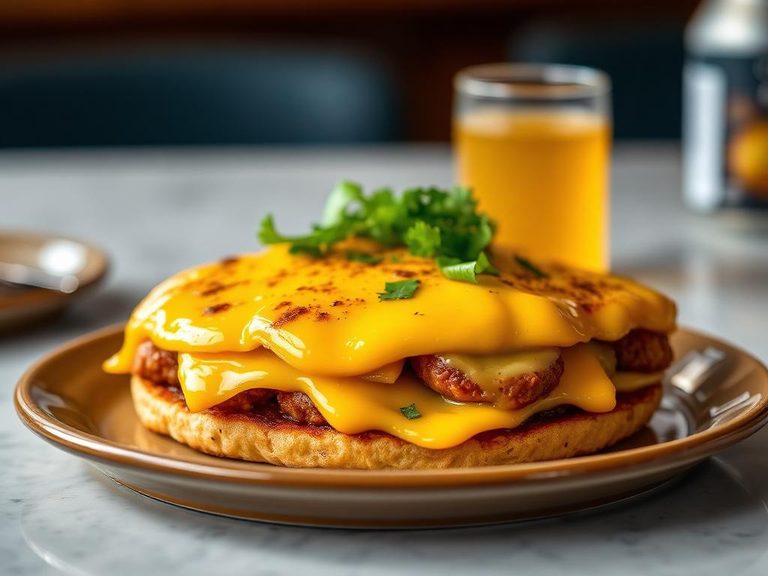
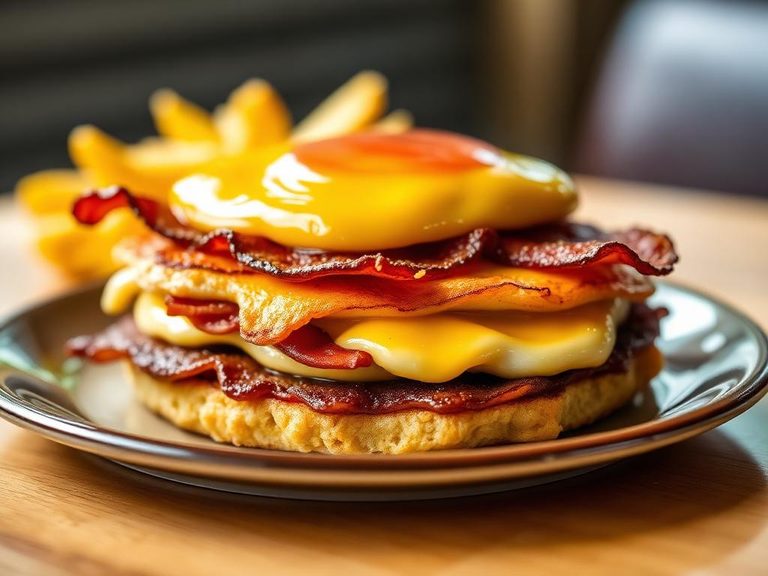
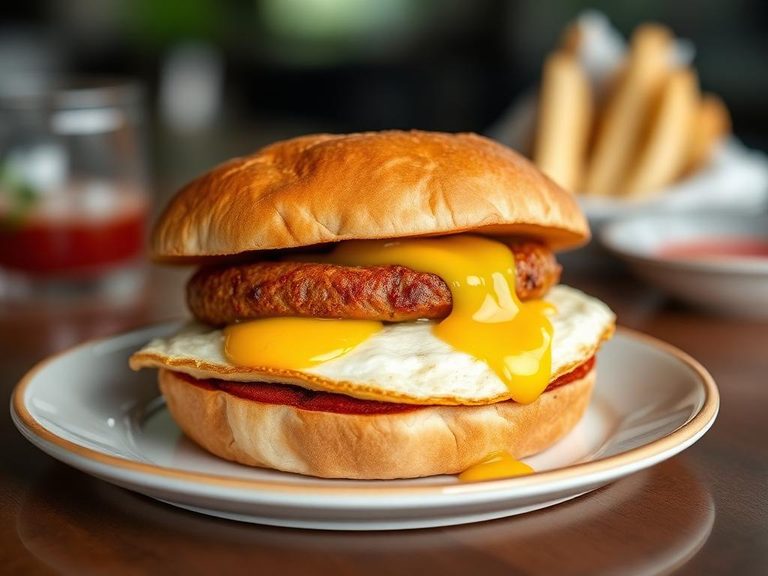
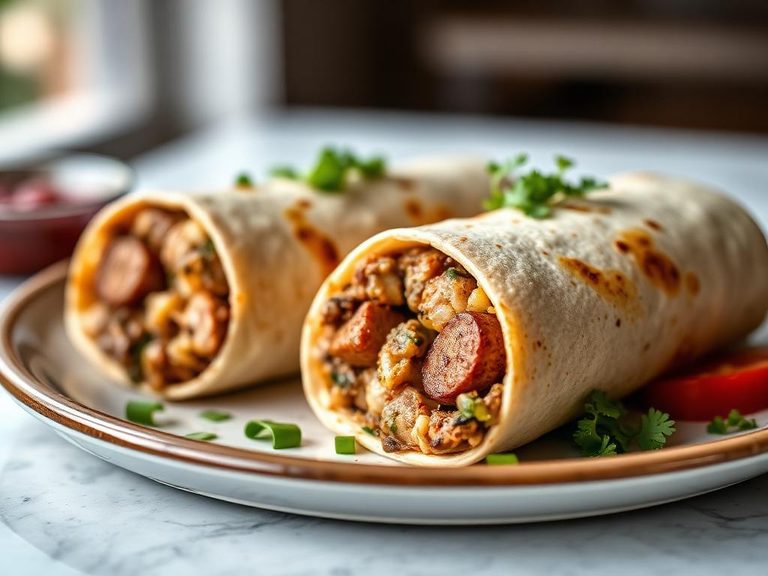
🍽️ Popular dishes

🌍 Where it's eaten
💡 Did you know?
The McGriddle's griddle cakes are infused with the flavor of maple syrup, but the sweet taste comes from a blend of artificial and natural flavors, not actual maple syrup.
Full nutrition (USDA data · scales with serving)
| Water | 47.0 g |
| Energy | 283 kcal |
| Energy | 1183 kj |
| Protein | 10.8 g |
| Total lipid (fat) | 17.7 g |
| Ash | 2.4 g |
| Carbohydrate, by difference | 22.0 g |
| Fiber, total dietary | 0.60 g |
| Total Sugars | 7.9 g |
| Sucrose | 4.2 g |
| Glucose | 2.7 g |
| Fructose | 0.09 g |
| Lactose | 0.61 g |
| Maltose | 0.32 g |
| Galactose | 0.00 g |
| Calcium, Ca | 96.0 mg |
| Iron, Fe | 1.5 mg |
| Magnesium, Mg | 14.0 mg |
| Phosphorus, P | 307 mg |
| Potassium, K | 146 mg |
| Sodium, Na | 652 mg |
| Zinc, Zn | 1.0 mg |
| Copper, Cu | 0.08 mg |
| Manganese, Mn | 0.14 mg |
| Vitamin C, total ascorbic acid | 0.00 mg |
| Thiamin | 0.17 mg |
| Riboflavin | 0.29 mg |
| Niacin | 2.1 mg |
| Pantothenic acid | 0.59 mg |
| Vitamin B-12 | 0.53 ug |
| Vitamin A, IU | 264 iu |
Fat & fatty acid profile (per 100g)
| Fatty acids, total saturated | 5.6 g |
| Fatty acids, total monounsaturated | 6.7 g |
| Fatty acids, total polyunsaturated | 2.3 g |
| Cholesterol | 132 mg |
FAQ
Is the McGriddle a pancake sandwich?
Yes, essentially. It uses two sweet, maple-flavored griddle cakes (similar to pancakes) as the 'bun' for a savory breakfast filling.
How does it differ from a McMuffin?
The primary difference is the 'bun.' A McGriddle uses sweet griddle cakes, while a McMuffin uses a savory English muffin. The fillings are often similar.
Can I customize it?
Yes, you can typically request no cheese, no egg, or add items like extra sausage, though menu customization varies by location.
Nutrient density (calculated · NRF9.3)
Nutrient Rich Foods index: beneficial nutrients (protein, fiber, vitamins, minerals) minus saturated fat, added sugar & sodium, per 100 kcal.
NRF9.3 index — Fulgoni, Keast & Drewnowski, 2009. Computed from USDA nutrients.
Weight-loss friendliness (composite index)
Energy density 2.83 kcal/g · 15% calories from protein · 0.6 g fiber · 7.9 g sugar per 100 g.
Composite of energy density (Rolls et al., 1999), protein & fiber satiety, minus sugar. A calculated heuristic — ranks satiety-per-calorie, not a clinical measure.
Dietary load (calculated from USDA values)
Potential renal acid load. Positive = acid-forming, negative = alkaline-forming.
Sodium-to-potassium ratio: 4.47 (lower is better — aim for ≤ 1)
Sodium:potassium per WHO potassium guidance. Computed from USDA nutrients.