

McDONALD'S, BIG MAC (without Big Mac Sauce)
Whole food · Fast Foods
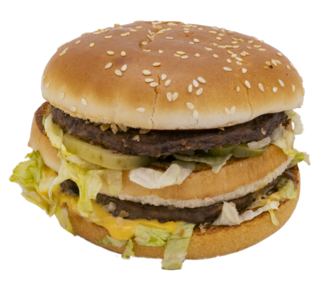
Photo: Wikipedia
A Big Mac without its iconic sauce is a deconstructed classic: two thin, seared beef patties layered with crisp iceberg lettuce, sliced onions, tangy pickles, and American cheese on a toasted sesame seed bun. The texture shifts from the familiar creamy, saucy bite to a more straightforward, savory, and slightly drier profile, highlighting the beef and cheese. Nutritionally, it becomes a more protein-focused meal with a notable reduction in sugar and fat compared to the sauced version.
Calorie split: 21% protein · 35% carbs · 44% fat
↓ Full nutrition💚 Why it's loved
People love it for the pure, unadulterated taste of the flame-grilled beef patties, melted cheese, and fresh crunch of the vegetables. It’s a customizable comfort food that satisfies a craving for a classic American burger experience without the extra richness of the signature sauce.
⚠️ Watch-outs & how to enjoy it better
It can be perceived as dry and less flavorful without the sauce, and the sodium content remains high from the cheese, pickles, and seasoned patties. To counteract dryness, add a side of mustard or a small amount of ketchup, and balance the meal with a side salad or fruit to manage sodium intake. Those monitoring blood sugar should be mindful of the refined white bun.
Key benefits
- Good source of complete protein from beef patties
- Provides calcium from American cheese
- Lower in added sugar and total fat without the sauce
- Contains some iron from the beef
- Familiar, convenient, and calorie-controlled portion
🍽️ Popular dishes
🌍 Where it's eaten
💡 Did you know?
The Big Mac was invented in 1968 by a Pennsylvania McDonald's franchisee named Jim Delligatti, who originally tested the concept with a different bun before settling on the now-iconic three-part sesame seed bun.
Full nutrition (USDA data · scales with serving)
| Water | 52.8 g |
| Energy | 234 kcal |
| Energy | 978 kj |
| Protein | 12.8 g |
| Total lipid (fat) | 11.6 g |
| Ash | 1.9 g |
| Carbohydrate, by difference | 21.0 g |
| Fiber, total dietary | 1.7 g |
| Total Sugars | 3.7 g |
| Sucrose | 0.21 g |
| Glucose | 0.96 g |
| Fructose | 1.7 g |
| Lactose | 0.35 g |
| Maltose | 0.47 g |
| Galactose | 0.00 g |
| Calcium, Ca | 124 mg |
| Iron, Fe | 2.1 mg |
| Magnesium, Mg | 21.0 mg |
| Phosphorus, P | 130 mg |
| Potassium, K | 192 mg |
| Sodium, Na | 454 mg |
| Zinc, Zn | 2.1 mg |
| Copper, Cu | 0.10 mg |
| Manganese, Mn | 0.22 mg |
| Vitamin C, total ascorbic acid | 0.40 mg |
| Thiamin | 0.19 mg |
| Riboflavin | 0.22 mg |
| Niacin | 3.7 mg |
| Folate, total | 50.0 ug |
| Vitamin B-12 | 0.94 ug |
| Vitamin A, IU | 186 iu |
Fat & fatty acid profile (per 100g)
| Fatty acids, total saturated | 4.2 g |
| Fatty acids, total monounsaturated | 3.8 g |
| Fatty acids, total polyunsaturated | 0.33 g |
| Cholesterol | 35.0 mg |
FAQ
How does the nutrition change without the Big Mac Sauce?
Removing the sauce significantly reduces the total fat, calories, and sugar content, making it a leaner option focused more on protein from the beef and cheese.
Is it still considered a balanced meal?
While it provides protein and some nutrients, it is high in sodium and refined carbohydrates from the bun. Pairing it with a vegetable side or fruit can create a more balanced plate.
Can I order this at any McDonald's?
Yes, you can typically order a Big Mac 'plain' or 'without sauce' at most locations. It's a common custom request.
Nutrient density (calculated · NRF9.3)
Nutrient Rich Foods index: beneficial nutrients (protein, fiber, vitamins, minerals) minus saturated fat, added sugar & sodium, per 100 kcal.
NRF9.3 index — Fulgoni, Keast & Drewnowski, 2009. Computed from USDA nutrients.
Weight-loss friendliness (composite index)
Energy density 2.34 kcal/g · 22% calories from protein · 1.7 g fiber · 3.7 g sugar per 100 g.
Composite of energy density (Rolls et al., 1999), protein & fiber satiety, minus sugar. A calculated heuristic — ranks satiety-per-calorie, not a clinical measure.
Dietary load (calculated from USDA values)
Potential renal acid load. Positive = acid-forming, negative = alkaline-forming.
Sodium-to-potassium ratio: 2.36 (lower is better — aim for ≤ 1)
Sodium:potassium per WHO potassium guidance. Computed from USDA nutrients.