

Cereals ready-to-eat, MOM'S BEST, Honey Nut TOASTY O'S
Whole food · Breakfast Cereals

Photo: Wikipedia
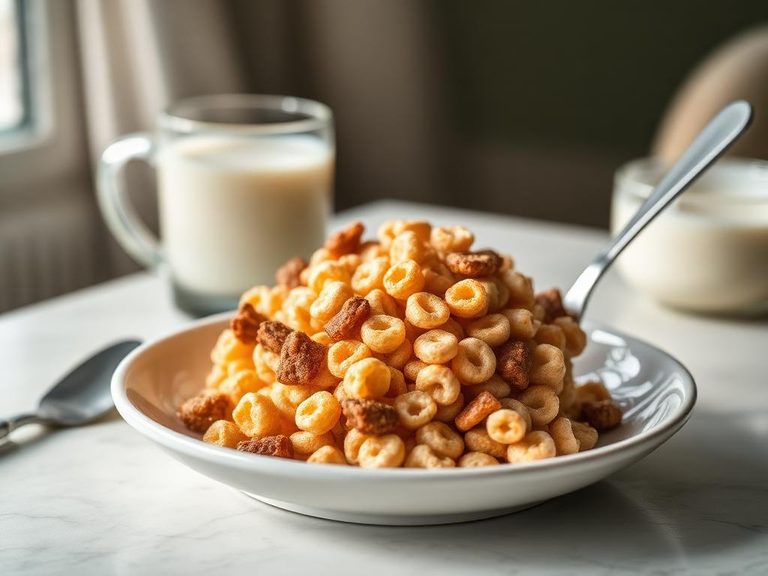
MOM'S BEST Honey Nut Toasty O's are a sweetened, toasted oat cereal with a satisfying crunch and a honey-nut flavor profile. They are a high-carbohydrate, low-fat option, providing 388 kcal per 100g, with a notable 30.17g of sugar. The cereal offers a quick energy boost, though its sugar content is a key consideration for balanced consumption.
Calorie split: 9% protein · 81% carbs · 10% fat
↓ Full nutrition💚 Why it's loved
People love the nostalgic, sweet honey-nut flavor and the satisfying, crunchy texture that holds up in milk. Its versatility makes it a quick breakfast, a snack, or a topping for yogurt and desserts.
⚠️ Watch-outs & how to enjoy it better
The high sugar content (30.17g per 100g) can lead to blood-sugar spikes, making it less ideal for those managing diabetes or seeking low-sugar options. To counteract this, pair it with a source of protein (like Greek yogurt or nuts) and healthy fat (like chia seeds or almond butter) to slow sugar absorption, and practice portion control by sticking to a single serving.
Key benefits
- Provides a quick source of energy from carbohydrates.
- Contains 8.6g of protein per 100g, supporting muscle maintenance.
- Offers 6.3g of dietary fiber per 100g for digestive health.
- Low in fat at 4.51g per 100g, suitable for low-fat diets.
- Convenient, ready-to-eat format for busy mornings.
🍽️ Popular dishes


🌍 Where it's eaten
💡 Did you know?
The 'Toasty O's' shape is designed to maximize surface area for honey-nut coating, ensuring each bite delivers a consistent flavor and crunch.
Full nutrition (USDA data · scales with serving)
| Water | 2.5 g |
| Energy | 388 kcal |
| Energy | 1623 kj |
| Protein | 8.6 g |
| Total lipid (fat) | 4.5 g |
| Ash | 4.1 g |
| Carbohydrate, by difference | 79.8 g |
| Fiber, total dietary | 6.3 g |
| Total Sugars | 30.2 g |
| Calcium, Ca | 380 mg |
| Iron, Fe | 3.0 mg |
| Magnesium, Mg | 92.0 mg |
| Phosphorus, P | 315 mg |
| Potassium, K | 241 mg |
| Sodium, Na | 683 mg |
| Zinc, Zn | 0.01 mg |
| Vitamin C, total ascorbic acid | 0.00 mg |
| Thiamin | 0.30 mg |
| Riboflavin | 0.10 mg |
| Niacin | 1.3 mg |
| Vitamin B-6 | 0.01 mg |
| Folate, total | 30.0 ug |
| Folate, food | 30.0 ug |
| Vitamin B-12 | 0.02 ug |
| Vitamin A, IU | 0.00 iu |
| Vitamin E (alpha-tocopherol) | 0.00 mg |
| Vitamin D (D2 + D3), International Units | 0.00 iu |
| Vitamin D (D2 + D3) | 0.00 ug |
| Vitamin D3 (cholecalciferol) | 0.00 ug |
| Vitamin K (phylloquinone) | 0.00 ug |
| Caffeine | 0.00 mg |
Fat & fatty acid profile (per 100g)
| Fatty acids, total saturated | 0.55 g |
| Fatty acids, total monounsaturated | 1.1 g |
| Fatty acids, total polyunsaturated | 1.1 g |
| Fatty acids, total trans | 0.00 g |
| Cholesterol | 0.00 mg |
FAQ
Is this cereal gluten-free?
Not necessarily. While oats are naturally gluten-free, they are often processed in facilities that handle wheat. Check the label for gluten-free certification if you have celiac disease or gluten sensitivity.
How does the sugar content compare to other cereals?
With 30.17g of sugar per 100g, it is on the higher end, similar to many sweetened cereals. For context, a typical unsweetened oat cereal might have less than 1g of sugar per 100g.
Can I eat this as part of a weight-loss diet?
It can fit in moderation, but its high sugar and calorie density (388 kcal per 100g) mean portion control is key. Pair it with protein and fiber to increase satiety and avoid overeating.
Nutrient density (calculated · NRF9.3)
Nutrient Rich Foods index: beneficial nutrients (protein, fiber, vitamins, minerals) minus saturated fat, added sugar & sodium, per 100 kcal.
NRF9.3 index — Fulgoni, Keast & Drewnowski, 2009. Computed from USDA nutrients.
Weight-loss friendliness (composite index)
Energy density 3.88 kcal/g · 9% calories from protein · 6.3 g fiber · 30.2 g sugar per 100 g.
Composite of energy density (Rolls et al., 1999), protein & fiber satiety, minus sugar. A calculated heuristic — ranks satiety-per-calorie, not a clinical measure.
Dietary load (calculated from USDA values)
Potential renal acid load. Positive = acid-forming, negative = alkaline-forming.
Sodium-to-potassium ratio: 2.83 (lower is better — aim for ≤ 1)
Sodium:potassium per WHO potassium guidance. Computed from USDA nutrients.