

Cereals ready-to-eat, MALT-O-MEAL, OAT BLENDERS with honey
Whole food · Breakfast Cereals

Photo: Wikipedia
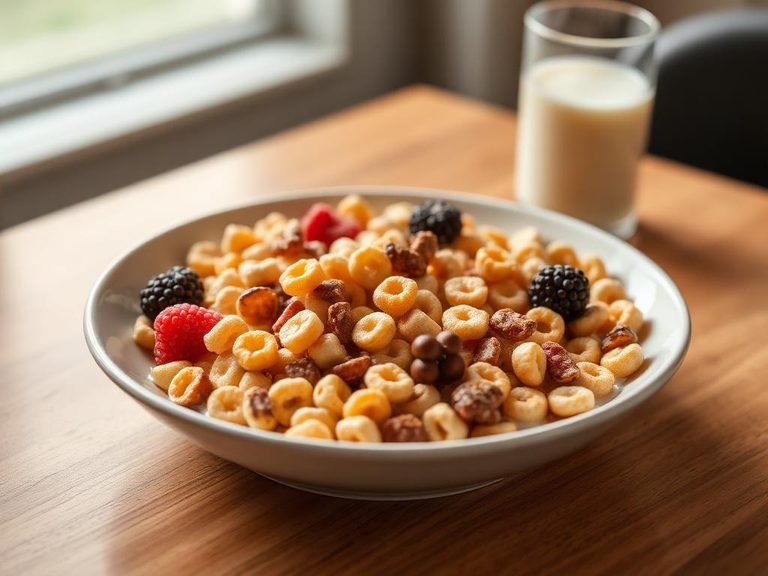
Malt-O-Meal Oat Blenders with Honey is a ready-to-eat cereal featuring toasted oat clusters and puffs, bound with a sweet honey glaze. It offers a satisfying crunch with a warm, malty sweetness and a light, airy texture. Nutritionally, it's a high-carbohydrate energy source with a notable sugar content.
Calorie split: 7% protein · 84% carbs · 9% fat
↓ Full nutrition💚 Why it's loved
People love it for its addictive honey-kissed sweetness and the satisfying crunch of the oat clusters, making it a comforting and quick breakfast staple. Its versatility allows it to be enjoyed with milk, yogurt, or even as a topping.
⚠️ Watch-outs & how to enjoy it better
The high sugar content (over 21g per 100g) can lead to blood-sugar spikes and subsequent energy crashes, making it less ideal for those managing diabetes or seeking sustained energy. To counteract this, pair it with a source of protein or healthy fat, like Greek yogurt, nuts, or seeds, and practice portion control by measuring a single serving.
Key benefits
- Provides quick energy from complex carbohydrates
- Contains dietary fiber for digestive health
- Fortified with essential vitamins and minerals
- Convenient, no-cook breakfast or snack option
- Offers a satisfying, crunchy texture
🍽️ Popular dishes


🌍 Where it's eaten
💡 Did you know?
The 'Malt-O-Meal' brand name is a registered trademark of Post Holdings, and the company was founded in 1919 in North Mankato, Minnesota, a region often called the 'Cereal Capital of the World.'
Full nutrition (USDA data · scales with serving)
| Water | 3.0 g |
| Energy | 396 kcal |
| Energy | 1658 kj |
| Protein | 6.8 g |
| Total lipid (fat) | 4.2 g |
| Ash | 1.1 g |
| Carbohydrate, by difference | 84.9 g |
| Fiber, total dietary | 5.0 g |
| Total Sugars | 21.6 g |
| Calcium, Ca | 23.0 mg |
| Iron, Fe | 27.0 mg |
| Magnesium, Mg | 27.0 mg |
| Phosphorus, P | 133 mg |
| Potassium, K | 200 mg |
| Sodium, Na | 515 mg |
| Zinc, Zn | 12.5 mg |
| Vitamin C, total ascorbic acid | 20.0 mg |
| Thiamin | 1.3 mg |
| Riboflavin | 1.4 mg |
| Niacin | 16.7 mg |
| Vitamin B-6 | 1.7 mg |
| Folate, total | 667 ug |
| Folic acid | 648 ug |
| Folate, food | 19.0 ug |
| Folate, DFE | 1121 ug |
| Vitamin B-12 | 5.0 ug |
| Vitamin A, IU | 1667 iu |
| Vitamin E (alpha-tocopherol) | 0.20 mg |
| Vitamin D (D2 + D3), International Units | 133 iu |
| Vitamin D (D2 + D3) | 3.3 ug |
| Vitamin D3 (cholecalciferol) | 3.3 ug |
| Vitamin K (phylloquinone) | 0.40 ug |
| Caffeine | 0.00 mg |
Fat & fatty acid profile (per 100g)
| Fatty acids, total saturated | 0.50 g |
| Fatty acids, total monounsaturated | 1.7 g |
| Fatty acids, total polyunsaturated | 0.92 g |
| Cholesterol | 0.00 mg |
FAQ
Is this cereal gluten-free?
No, it contains oat products which may be processed in facilities that handle wheat, and oats themselves can be cross-contaminated. It is not certified gluten-free.
Can I eat this cereal if I'm watching my sugar intake?
Due to its high sugar content, it should be consumed in moderation. Consider a smaller portion and pair it with protein and fiber to help manage blood sugar response.
What makes it different from granola?
While both contain oats, this cereal is typically lighter and crispier, often with added puffed grains, and is pre-toasted with a sweet coating. Granola is usually denser, chunkier, and often contains nuts, seeds, and dried fruit.
Nutrient density (calculated · NRF9.3)
Nutrient Rich Foods index: beneficial nutrients (protein, fiber, vitamins, minerals) minus saturated fat, added sugar & sodium, per 100 kcal.
NRF9.3 index — Fulgoni, Keast & Drewnowski, 2009. Computed from USDA nutrients.
Weight-loss friendliness (composite index)
Energy density 3.96 kcal/g · 7% calories from protein · 5.0 g fiber · 21.6 g sugar per 100 g.
Composite of energy density (Rolls et al., 1999), protein & fiber satiety, minus sugar. A calculated heuristic — ranks satiety-per-calorie, not a clinical measure.
Dietary load (calculated from USDA values)
Potential renal acid load. Positive = acid-forming, negative = alkaline-forming.
Sodium-to-potassium ratio: 2.58 (lower is better — aim for ≤ 1)
Sodium:potassium per WHO potassium guidance. Computed from USDA nutrients.