

Candies, MARS SNACKFOOD US, STARBURST Sour Fruit Chews
Whole food · Sweets

Photo: Wikipedia
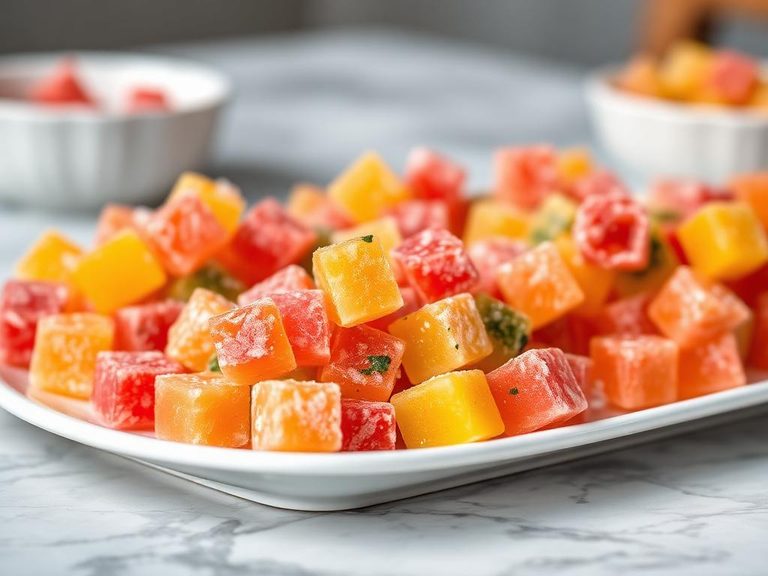
These are vibrant, fruit-flavored chewy candies coated in a sour sugar dust that delivers an immediate tangy zing before melting into a sweet, fruity finish. The texture is a signature soft, pliable chew that resists sticking to teeth, offering a satisfying mouthfeel. Nutritionally, they are a concentrated source of simple carbohydrates, with nearly 80 grams of carbs and 56 grams of sugar per 100 grams, providing a quick energy burst.
Calorie split: 0% protein · 82% carbs · 18% fat
↓ Full nutrition💚 Why it's loved
People love the intense, playful contrast between the initial sour pucker and the subsequent sweet fruit flavor, which creates a dynamic taste experience. The iconic, soft chew and vibrant colors make it a nostalgic and fun candy for all ages, often shared or used in games and social settings.
⚠️ Watch-outs & how to enjoy it better
The high sugar content (over 56g per 100g) can cause rapid blood sugar spikes and is a significant concern for individuals managing diabetes or watching caloric intake. To mitigate this, consume a small portion (e.g., 2-3 pieces) and pair it with a source of protein or healthy fat, like a handful of nuts, to slow sugar absorption. The sticky texture, while beloved, can adhere to dental work; rinsing with water after eating is a good practice.
Key benefits
- Provides a rapid source of energy from simple sugars.
- Offers a portable, non-melting sweet treat for on-the-go consumption.
- The sour coating can stimulate saliva production.
- Widely available and affordable for occasional indulgence.
- Comes in a variety of fruit flavors for taste preference.
🍽️ Popular dishes
🌍 Where it's eaten
💡 Did you know?
The sour sugar coating on candies like these is often made from a mixture of sugar and food-grade acids such as citric acid, tartaric acid, and malic acid, which are the same compounds that give lemons, grapes, and green apples their characteristic tang.
Full nutrition (USDA data · scales with serving)
| Water | 10.9 g |
| Energy | 400 kcal |
| Energy | 1674 kj |
| Protein | 0.39 g |
| Total lipid (fat) | 7.8 g |
| Ash | 0.30 g |
| Carbohydrate, by difference | 79.7 g |
| Fiber, total dietary | 0.00 g |
| Total Sugars | 56.1 g |
| Calcium, Ca | 0.00 mg |
| Iron, Fe | 0.01 mg |
| Sodium, Na | 89.0 mg |
| Vitamin C, total ascorbic acid | 56.6 mg |
| Vitamin A, RAE | 0.00 ug |
| Vitamin A, IU | 0.00 iu |
Fat & fatty acid profile (per 100g)
| Fatty acids, total saturated | 7.5 g |
| Fatty acids, total trans | 0.14 g |
| Cholesterol | 0.00 mg |
Amino acid profile (per 100g)
Estimated from Candies, honey-combed, with peanut butter — USDA does not publish this profile for Candies.
| Tryptophan | 0.09 g |
| Threonine | 0.21 g |
| Isoleucine | 0.24 g |
| Leucine | 0.61 g |
| Lysine | 0.27 g |
| Methionine | 0.10 g |
| Cystine | 0.09 g |
| Phenylalanine | 0.47 g |
| Tyrosine | 0.33 g |
| Valine | 0.31 g |
| Arginine | 1.1 g |
| Histidine | 0.22 g |
| Alanine | 0.36 g |
| Aspartic acid | 1.2 g |
| Glutamic acid | 2.0 g |
| Glycine | 0.56 g |
| Proline | 0.55 g |
| Serine | 0.58 g |
FAQ
What makes these candies sour?
The sour taste comes from a coating of food-grade acids, primarily citric acid, tartaric acid, and malic acid, applied to the outside of the chew.
Are they gluten-free?
While recipes can vary, the standard Starburst Sour Fruit Chews are generally considered gluten-free, but it's always best to check the specific product packaging for allergen information.
Why is the texture so chewy and not sticky?
The unique texture is achieved through a precise cooking process of the sugar syrup and the addition of ingredients like corn syrup and hydrogenated palm kernel oil, which create a soft, pliable matrix that doesn't adhere strongly to teeth.
Nutrient density (calculated · NRF9.3)
Nutrient Rich Foods index: beneficial nutrients (protein, fiber, vitamins, minerals) minus saturated fat, added sugar & sodium, per 100 kcal.
NRF9.3 index — Fulgoni, Keast & Drewnowski, 2009. Computed from USDA nutrients.
Weight-loss friendliness (composite index)
Energy density 4.00 kcal/g · 0% calories from protein · 0.0 g fiber · 56.1 g sugar per 100 g.
Composite of energy density (Rolls et al., 1999), protein & fiber satiety, minus sugar. A calculated heuristic — ranks satiety-per-calorie, not a clinical measure.