

McDONALD'S, QUARTER POUNDER with Cheese
Whole food · Fast Foods
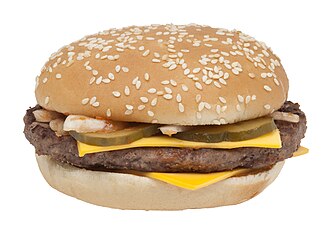
Photo: Wikipedia
The Quarter Pounder with Cheese is a substantial, iconic McDonald's burger featuring a quarter-pound (113g) beef patty, melted American cheese, pickles, onions, ketchup, and mustard on a toasted sesame seed bun. It delivers a savory, umami-rich flavor with a juicy, slightly charred patty and a soft, yielding bun. Nutritionally, it provides a significant protein boost but is also high in calories, fat, and sodium for its size.
Calorie split: 22% protein · 30% carbs · 48% fat
↓ Full nutrition💚 Why it's loved
People love it for its satisfying, no-frills beefiness and the perfect salty-savory balance of melted cheese and tangy pickles. It's a cultural staple, representing a reliable, indulgent classic in fast-food history.
⚠️ Watch-outs & how to enjoy it better
Its high sodium, saturated fat, and calorie density can be problematic for those monitoring heart health or blood sugar. To mitigate, consider sharing the burger, pairing it with a side salad instead of fries, or drinking water to help manage sodium intake.
Key benefits
- High-quality protein source (over 30g per burger)
- Provides essential minerals like iron and zinc from beef
- Quick, accessible source of energy and calories
- Satisfies savory, umami cravings effectively
🍽️ Popular dishes

🌍 Where it's eaten
💡 Did you know?
The 'Quarter Pounder' name was trademarked by McDonald's in 1973, and the burger was originally introduced in 1971 as a response to competitors offering larger burgers.
Full nutrition (USDA data · scales with serving)
| Water | 48.9 g |
| Energy | 258 kcal |
| Energy | 1079 kj |
| Protein | 14.6 g |
| Total lipid (fat) | 14.2 g |
| Ash | 2.4 g |
| Carbohydrate, by difference | 19.9 g |
| Fiber, total dietary | 1.4 g |
| Total Sugars | 4.9 g |
| Sucrose | 0.19 g |
| Glucose | 1.6 g |
| Fructose | 1.9 g |
| Lactose | 0.55 g |
| Maltose | 0.63 g |
| Galactose | 0.00 g |
| Calcium, Ca | 144 mg |
| Iron, Fe | 2.1 mg |
| Magnesium, Mg | 22.0 mg |
| Phosphorus, P | 161 mg |
| Potassium, K | 219 mg |
| Sodium, Na | 579 mg |
| Zinc, Zn | 2.6 mg |
| Copper, Cu | 0.10 mg |
| Manganese, Mn | 0.17 mg |
| Vitamin C, total ascorbic acid | 0.80 mg |
| Thiamin | 0.16 mg |
| Riboflavin | 0.35 mg |
| Niacin | 3.9 mg |
| Folate, total | 51.0 ug |
| Vitamin B-12 | 1.3 ug |
| Vitamin A, IU | 280 iu |
Fat & fatty acid profile (per 100g)
| Fatty acids, total saturated | 5.6 g |
| Fatty acids, total monounsaturated | 4.6 g |
| Fatty acids, total polyunsaturated | 0.43 g |
| Cholesterol | 47.0 mg |
FAQ
How does the Quarter Pounder differ from a regular hamburger?
The primary difference is the beef patty weight: a Quarter Pounder uses a 113g (quarter-pound) raw weight patty, while a regular hamburger uses a smaller patty, typically around 45g. This results in a much meatier, more substantial burger.
Is the Quarter Pounder with Cheese a good source of protein?
Yes, it is an excellent source of protein, providing over 30 grams per serving, which is a significant portion of the daily recommended intake for most adults.
What are the main allergens in a Quarter Pounder with Cheese?
The main allergens are wheat (in the bun) and milk (in the cheese). It may also contain soy and sesame depending on regional preparation.
Nutrient density (calculated · NRF9.3)
Nutrient Rich Foods index: beneficial nutrients (protein, fiber, vitamins, minerals) minus saturated fat, added sugar & sodium, per 100 kcal.
NRF9.3 index — Fulgoni, Keast & Drewnowski, 2009. Computed from USDA nutrients.
Weight-loss friendliness (composite index)
Energy density 2.58 kcal/g · 23% calories from protein · 1.4 g fiber · 4.9 g sugar per 100 g.
Composite of energy density (Rolls et al., 1999), protein & fiber satiety, minus sugar. A calculated heuristic — ranks satiety-per-calorie, not a clinical measure.
Dietary load (calculated from USDA values)
Potential renal acid load. Positive = acid-forming, negative = alkaline-forming.
Sodium-to-potassium ratio: 2.64 (lower is better — aim for ≤ 1)
Sodium:potassium per WHO potassium guidance. Computed from USDA nutrients.