

McDONALD'S, QUARTER POUNDER
Whole food · Fast Foods
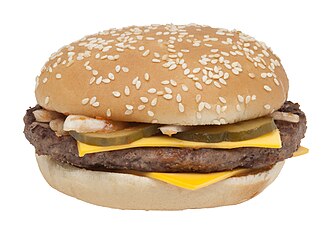
Photo: Wikipedia
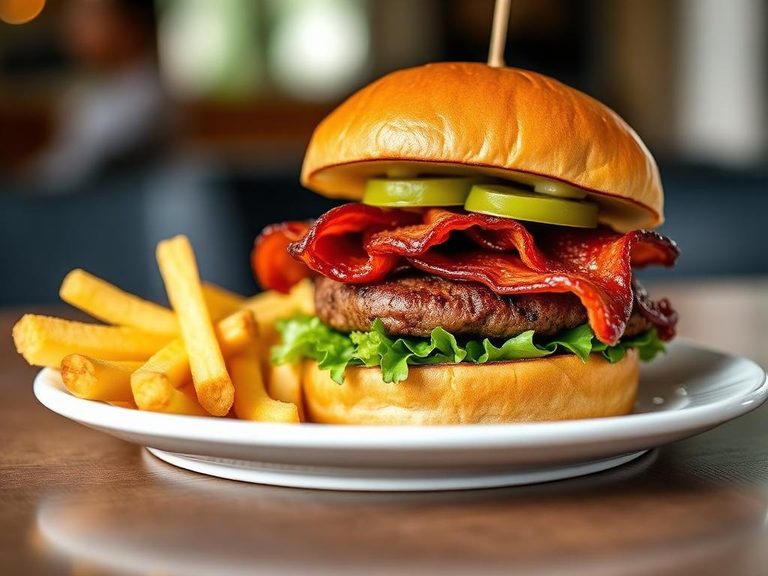
The McDonald's Quarter Pounder is a substantial, flame-grilled beef patty sandwich, known for its juicy, savory flavor and satisfying, meaty texture. Nutritionally, it provides a solid protein boost but is also calorie-dense, with a significant portion of its energy coming from fat and refined carbohydrates in the bun.
Calorie split: 23% protein · 36% carbs · 42% fat
↓ Full nutrition💚 Why it's loved
People love it for its straightforward, hearty beef flavor and the satisfying 'umami' punch from the grilled patty, often paired with cheese and pickles. It's a cultural icon of American fast food, representing a reliable, indulgent treat.
⚠️ Watch-outs & how to enjoy it better
The high sodium and saturated fat content can be problematic for heart health, and the refined white bun can cause a rapid blood-sugar spike. To counteract this, consider skipping the cheese or mayo, pairing it with a side salad instead of fries, or eating only half the bun to reduce refined carbs.
Key benefits
- High-quality protein source for muscle maintenance.
- Quick, convenient, and calorie-dense energy source.
- Contains iron and B vitamins from the beef patty.
- A familiar, consistent taste and texture globally.
🍽️ Popular dishes

🌍 Where it's eaten
💡 Did you know?
The 'Quarter Pounder' name is a direct reference to the pre-cooked weight of the beef patty, which is a quarter of a pound (4 ounces or about 113 grams).
Full nutrition (USDA data · scales with serving)
| Water | 50.4 g |
| Energy | 244 kcal |
| Energy | 1021 kj |
| Protein | 14.1 g |
| Total lipid (fat) | 11.6 g |
| Ash | 1.8 g |
| Carbohydrate, by difference | 22.2 g |
| Fiber, total dietary | 1.6 g |
| Total Sugars | 5.1 g |
| Sucrose | 0.22 g |
| Glucose | 1.9 g |
| Fructose | 2.2 g |
| Lactose | 0.07 g |
| Maltose | 0.73 g |
| Galactose | 0.00 g |
| Calcium, Ca | 84.0 mg |
| Iron, Fe | 2.4 mg |
| Magnesium, Mg | 22.0 mg |
| Phosphorus, P | 124 mg |
| Potassium, K | 227 mg |
| Sodium, Na | 427 mg |
| Zinc, Zn | 2.7 mg |
| Copper, Cu | 0.11 mg |
| Manganese, Mn | 0.20 mg |
| Vitamin C, total ascorbic acid | 0.90 mg |
| Thiamin | 0.18 mg |
| Riboflavin | 0.34 mg |
| Niacin | 4.5 mg |
| Folate, total | 56.0 ug |
| Vitamin B-12 | 1.3 ug |
| Vitamin A, IU | 56.0 iu |
Fat & fatty acid profile (per 100g)
| Fatty acids, total saturated | 4.0 g |
| Fatty acids, total monounsaturated | 4.2 g |
| Fatty acids, total polyunsaturated | 0.28 g |
| Cholesterol | 39.0 mg |
FAQ
Is the Quarter Pounder beef patty 100% beef?
Yes, McDonald's states their Quarter Pounder patties are made from 100% pure USDA-inspected beef, with no fillers, additives, or preservatives in the meat itself.
How does the Quarter Pounder differ from a Big Mac?
The Quarter Pounder features a larger, single quarter-pound beef patty on a sesame seed bun, while a Big Mac uses two smaller patties with a special sauce and an extra middle bun layer.
Can I customize the Quarter Pounder to be healthier?
You can request it without cheese or mayonnaise to reduce fat and sodium. Choosing a side salad with light dressing instead of fries also significantly improves the nutritional profile.
Nutrient density (calculated · NRF9.3)
Nutrient Rich Foods index: beneficial nutrients (protein, fiber, vitamins, minerals) minus saturated fat, added sugar & sodium, per 100 kcal.
NRF9.3 index — Fulgoni, Keast & Drewnowski, 2009. Computed from USDA nutrients.
Weight-loss friendliness (composite index)
Energy density 2.44 kcal/g · 23% calories from protein · 1.6 g fiber · 5.1 g sugar per 100 g.
Composite of energy density (Rolls et al., 1999), protein & fiber satiety, minus sugar. A calculated heuristic — ranks satiety-per-calorie, not a clinical measure.
Dietary load (calculated from USDA values)
Potential renal acid load. Positive = acid-forming, negative = alkaline-forming.
Sodium-to-potassium ratio: 1.88 (lower is better — aim for ≤ 1)
Sodium:potassium per WHO potassium guidance. Computed from USDA nutrients.